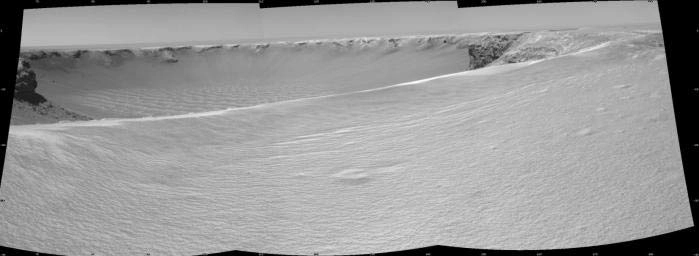
Scientistsstudying initial on-the-scene images relayed from NASA's Opportunity Mars rover at VictoriaCrater are elated.
Theenormous impact crater has been the six-wheeled robot's long-term destinationfor the past 21 Earth months.
"Forthe first day or two after we saw the initial images we were just overwhelmed,"said SteveSquyres, lead Mars Exploration Rover scientist from Cornell University inIthaca, New York.
Thefar side of the crater is about one-half mile (800 meters) away from where the Mars machine is positioned.
"Nowthat the reality of the scene has sunk in and the features have started tobecome familiar, we're beginning to think carefully about the science and aboutour plan of attack," Squyres told SPACE.com.
Clockwise or counterclockwise
Roverhandlers back here on Earth are in the process of acquiring sweeping PanoramicCamera (Pancam) shots of the crater. After that, the plan is to driveOpportunity to a spot called "Cape Verde" - a large promontory and a spot fortaking more Pancam imagery.
Squyressaid that a partial circumnavigation of the crater is on tap. "We haven'tdecided yet whether we'll head clockwise or counterclockwise," he added.
Afuture decision is whether or not to steer Opportunity into Victoria Crater.
"Wewant very much to drive into the crater, because that's where the geology is!Whether or not we'll do it, though, depends on an assessment of how steep theslopes are," Squyres noted.
Tohelp determine whether Opportunity will make tracks and take on that daringmaneuver, long-baseline stereo images are needed. These are produced as Pancamimages taken from two different locations on the crater's rim. Doing so wouldgenerate a good model of the terrain, Squyres advised.
"We'renot going to make any decisions about driving in or not driving in until we understandthe slopes a lot better than we do now," Squyres emphasized.
Die at any moment
CouldVictoria be a final resting spot for Opportunity?
Scientistson the rover team clearly view Victoria Crater as impressive real estate. Andgiven the wide open spaces surrounding Victoria at Meridiani Planum of lessscientific interest, perhaps the robot should spend its final days at the site.
"Victoriacould be the final resting spot for Opportunity," Squyres said, just like LowRidge could be the final resting spot for the Spirit Mars rover, also busy atwork at Gusev Crater, another exploration zone on the red planet.
"Theserovers are so far past their design lifetime that they could die at anymoment," Squyres pointed out.
"Everysol [a day on Mars] could be our last. We're going to use every capability thatOpportunity has to understand this crater and the story it has to tell as wellas we can. That's going to take a long time. If the rover's still alive oncewe're done, then we'll see what we see," Squyres concluded.
Eye-popping size
Thesightseeing on Mars from Opportunity's vantage place is staggering, explainedWilliam Farrand, a research scientist at the Space Science Institute inBoulder, Colorado and a member of the Mars Exploration Rover science team.
"Ithink the thing that most impresses me is the sheer size of Victoria Crater andthe associated outcrops compared with things we've seen thus far in themission," Farrand told SPACE.com.
Inthe images transmitted from the rover, sometimes blocks and boulders at firstappear really big, Farrand said. But when scientists actually figure out theactual scale, those objects turn out to be not that large - only a meter or acouple of meters in size.
"Victoriacrater is actually pretty darn big," Farrand said, adding that the featurethat's an eye-popping 2,428 feet (740 meters) in diameter. "It's about threequarters of the size of Meteor Crater in Arizona...and if you've been there...youknow it is pretty big," he said.
Whole new mission
Farrandsaid that first looks at Opportunity images of Victoria show that outcropsexposed in the rim are large in size. Victoria crater, in map view, consists ofa number of promontories and incut regions which Mars researchers are, at leastfor now, referring to as "capes" and "bays".
Currently,Opportunity is at "Duck Bay", Farrand explained, named after a site visited byPortuguese maritime explorer, Ferdinand Magellan and his crew. To the north ofthe rover is a promontory now named "Cape Verde" - another spot visited byMagellan and a huge block, roughly 33 feet (10 meters) or so high.
"Withregards to what the rocks will tell us or whether it is what we expected, it isjust too early to say. We have a lot of work ahead of us to understandthe crater and its outcrops," Farrand stressed. 'It is like a whole newmission."
- Mars Rover Sends First Photo of Victoria Crater
- Video: All Eyes on Mars
- Images: Visualizations of Mars
- Mars Probes Continue to Unlock Planet's Mysteries
- Complete Coverage: Mars Rovers
- All About Mars