





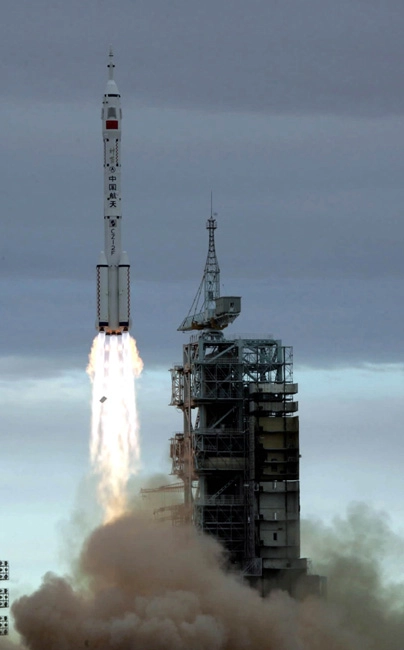
Two yearsafter making its first foray into the realm of human spaceflight, China hasonce again launched a manned spacecraft into Earth orbit during a successfulTuesday space shot.
Clad in space suits andtucked inside their Shenzhou 6 spacecraft, Chinese astronauts Fei Junlong and NieHaisheng left Earth behind at 9:00 p.m. EDT (0100 Oct. 12 GMT) as their 19-storyLong March 2F rocket lifted off from Jiuquan Satellite Launch Center, statemedia reported. A few minutes later, the astronauts were in orbit.
It was9:00 a.m. local time during the space shot, which was beamed across China via livetelevision.
Chinese Premier Wen Jiabaowished the astronauts - whose identities were unveiled only hours beforeliftoff - well, adding that he was confident they "will accomplish the gloriousand sacred mission," China's Xinhua News Agency reported.


Fei and Nie will orbitEarth for as long as five days during the Shenzhou 6 spaceflight, China's firsttwo-person mission, and are expected to perform a series of experiments toadvance China's understanding of human spaceflight. Their mission comes almosttwo years to the day of China's first manned spaceflight, Shenzhou 5, whichlaunched astronaut Yang Liwei on a 21 ? hour mission on Oct. 15, 2003. China isthe third nation to independently launch astronauts into orbit.
"Feelingpretty good,'' Fei reportedly said, in the first broadcast comment from theastronauts, according to the Associated Press.
Fei, 40, hails from Kunshanin China's eastern province of Jiangsu and was one of five candidates forChina's first manned spaceflight, Shenzhou 5, Xinhua stated. Fei'screwmate Nie, 41, is from Zaoyang, in the Hubei Province in central China, andwas one of the three finalists for the Shenzhou 5 spaceflight alongsideastronauts Zhai Zhigang and Yang Liwei, who ultimately made the country's firstmanned space shot.
"We have confidence andcapability to fulfill the glorious task of the motherland and the people," Feisaid during a prelaunch press briefing.
Fei and Nie composed one ofthree, two-astronaut teams vying for the Shenzhou 6 spaceflight. Astronauts ZhaiZhigang, Wu Jie, Liu Boming and Jing Haipeng were the four other candidates forthe mission, according to state media reports.
Accordingto Xinhua reports, Fei and Nie will doff their 22-pound spacesuits andmove between their crew and orbital modules - something Yang did not do duringhis day-long spaceflight.
Bigger, better, longer
Shenzhou 6 will mark thefirst time that Chinese astronauts will participate in the experiments flying aboardtheir spacecraft, Xinhua reported.
China's Shenzhou - or "DivineVessel" - spacecraft is a three-part vehicle based partly on Russia's Soyuz,but heavily modernized and modified to suit the nation's spaceflight program.Like the Soyuz, Shenzhou vehicles contain an orbital module, a crewcompartment, and a service module that houses propulsion and other vitalsystems. But it is only the crew-carrying section that returns to Earth intact.
Shenzhou 6 reportedlycarries a series of advancements of its Shenzhou 5 predecessor, including afood heater, dishware and an "excretement collecting facility" - or spacetoilet - that are being used for the first time, according to Xinhua.Sleeping bags and a new data recorder - a spacecraft black box - are also beingtested. The black box is faster than its Shenzhou 5 counterpart and containsmore storage space, but at only half the size, Xinhua reported.
Earlier this week, mediareports stated that Fei and Nie were not carrying seeds into space with them tobe exposed to radiation. The admission prompted some space experts to questionexactly what type of experiments the two astronauts will be performing duringtheir multi-day trek.
"The Chinese are probablygoing to surprise us in terms of what the two guys will have been doing," Chinaspace specialist Dean Cheng, of the CNA Corp. in Arlington,Virginia, told SPACE.combefore launch. "It's a way for China to make the point again that this is 'biggerand better, and that our firsts are more meaningful.'"
Cheng said that Earthobservation and human physiology checks are potential experiments.
The live broadcast ofShenzhou 6's launch may be a sign that China's tight-lipped tradition with itsspace mission may be loosening, though official barred foreign press from theJiuquan launch site and warned Chinese journalists that they might have to handover their still or video footage should something go wrong, the AssociatedPress reported.
The 2003 launch of Shenzhou 5 was not broadcast live.
Astronaut league welcomesChinese comrades
Before today's successful launch,the non-profit Association of Space Explorers (ASE), which is populated by past and presentastronauts and cosmonauts, issued an invitation to China's professional spaceflyers - though the United Nations - to take part in their organization.
"As a member of theAssociation of Space Explorers and a three-time space flyer, I amabsolutely convinced that the more human presence there is in orbitalspace and beyond, the better for all humanity in understanding our placein a very limited one planet environment," space shuttle payload specialist CharlieWalker told collectSPACE, a SPACE.compartner, during the 19th annual ASE Planetary Congress in Salt Lake City,Utah. "We have to look forward to a successful launch, and a successful return,of any and all taikonauts and Chinese flyers to space and backagain."
Fei and Nie are slated toreturn to Earth in about five days and land their Shenzhou 6 crew capsule onthe flat grasslands of Inner Mongolia. Today's space shot marked the 88thflight of a rocket from China's Long March family, Xinhua reported.
Robert Z. Pearlman, of collectSPACE, contributed to thisarticle from the Salt Lake City, Utah.
- ZOOM View: Close in on Shenzhou 6 on its Launch Pad
- Shenzhou Rising: China's Second Manned Spaceflight
- Special Report: Emerging China, Engaging China
