Thoseplucky robots--Spirit and Opportunity--arecontinuing their respective missions on Mars, each wheeling toward new scienceobjectives.
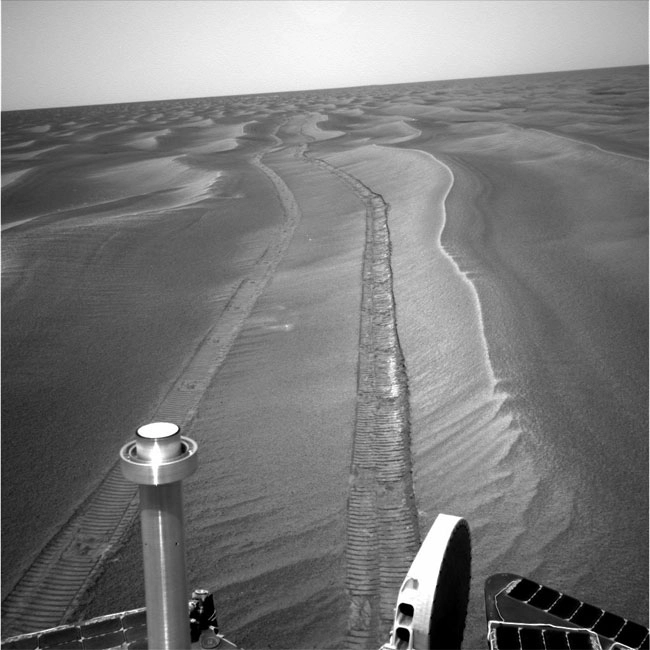
Imagesfrom Opportunity show an expanse of dunes atMeridiani Planum. Rover operators are taking precautions that the golfcart-sized robot won't get bogged down in any sand trap--to avoid a repeatperformance that halted movement of the machine last April.
Ittook nearly five weeks for engineers to extricate Opportunity'swheels that became buried in soft sand of a small martiandune--later dubbed "Purgatory Dune" by the Mars Exploration Rover team.
Onthe other side of Mars at Gusev Crater, Spirit continues to climb Husband Hillwithin the Columbia Hills. Using its science-instrumented robot arm, the roverhas made observations that are causing a stir within the circle of Mars roverscientists on the project.
In a maze
Opportunityis pressing onward to Erebus crater, said Steve Squyres, lead science teammember for the Mars Exploration Rover effort at CornellUniversity in Ithaca, New York.
Ina rover update, Squyres noted that driving the rover across the sandy landscapeis a challenge.
"Weare literally in a maze. The easiest going is to stay within the troughsbetween the ripple crests, which run roughly north-south. So the best way tomake southward progress is to follow a trough until it peters out, make a 'lanechange' to a nearby trough, and continue onward," Squyres explained.
Usingimagery taken from Mars orbit, scientists and engineers see what they term the"Erebus Highway".It is a stretch of light-toned terrain, perhaps consisting of exposed bedrock.If so, that'll make easier going for Opportunity.
"Wealso like the idea of getting to bedrock from a science perspective," Squyresadded. "It's been a long time since we've looked at any rock with Opportunity."
Cross-country driving
But there's a catch, Squyres warned.
"Theentrance to the Erebus Highwayis not straight south of us, along the troughs. It is a bit off to the east, ona heading closer to 160 degrees or so," Squyresexplained. However, to get there, the rover has to go "cross-country, going upand over quite a few ripple crests."
"That'sdo-able," said Squyres, "but it's also a lot slowerthan just bombing straight south down a nice trough."
Adriving decision is forthcoming. Heading for the highway means making slowprogress for awhile, but perhaps a better route to Erebus Crater. If the roverwheels down the troughs instead, it's a speedier path to Erebus Crater.
"Soit should work either way," Squyres said. "Whether or not we're actually goingto 'hit the Highway' is an open question at this point, but Erebus isn't toofar off either way you cut it."
There'ssome other good news about what Opportunity isdriving through. The terrain appears to be changing as it moves south ofPurgatory Dune. Rover images show fewer tall dunes, more pebbles in thetroughs, and what might be tiny outcrops of bedrock.
"Idon't want to jump to conclusions," said Squyres, "butthe driving definitely looks a little nicer here than it did a hundred metersback."
Chugging throughthe data
TheSpirit robot at Gusev Crater is also on the move.
Duringits ascent of Husband Hill within the Columbia Hills, the robot came across a "verycool outcrop" of layered bedrock that has been tagged as Independence Rock,Squyres said.
"We'vethoroughly worked it over with all of the arm instruments now, and it's verystrange stuff," Squyres reported. He said it was one of the oddest things seenat Gusev.
"I'mnot ready to go into much detail here about the chemistry and mineralogy yet,since we're still chugging through the data," Squyres noted. The rock isclearly highly altered, sporting an unusually low iron content, he said, "whichisn't something we've seen much of before."
Science work at the Independence Rock has been completed. Spirit has resumedits ascent. "The ground is real solid here, and the climbing is good. I stilldon't know if we'll reach the summit or not, but the recent progress has beenexcellent," Squyres concluded.
According to rover operator, Jake Matijevicof the Jet Propulsion Laboratory (JPL), both Spirit and Opportunityhave benefited from clearing skies at the two landing sites.
Furthermore, the rovers have improved energy levels. That is due to dustclearing events which have been seen on both vehicles, Matijevic reported.
- A Mars Rover's Great Escape
- Mars Rover Special Report