


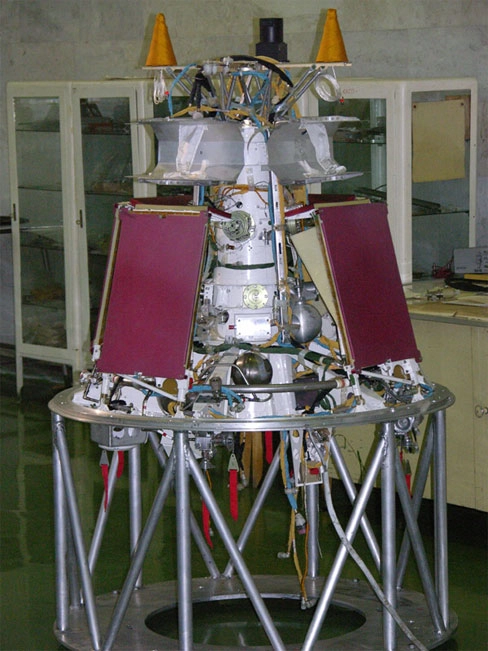
A privateteam of space-savvy civilians has hit a major milestone in plans to launch thefirst spacecraft propelled by sunlight after shipping the small probe to be loaded atop ballistic missile.
The solarsail-propelled Cosmos1 vehicle, hailed as the world's first solar sail spacecraft, has left itsMoscow testing center and now bound to Severomorsk, Russia, where it will beloaded into a modified intercontinental ballistic missile (ICBM) and readiedfor a June 21 launch, mission planners announced Monday.
Cosmos 1 isset to fly atop a Volna rocket and launch from a Russian submarine submergedbeneath the Barents Sea. If all goes well, the spacecraft will unfurl its solarsails in Earth orbit and demonstratethe first, controlled use of solar sail propulsion.
"Reachingthis milestone puts us on the doorstep to space," said Louis Friedman, Cosmos 1project director and executive director of The Planetary Society, a space advocacygroup that organized the upcoming space shot. "We are proud of our newspacecraft and hope that Cosmos 1 blazes a new path into the solar system,opening the way to eventual journeys to the stars."
The Cosmos 1spacecraft consists of a small central hub and eight triangular sail blades,each packed into a container the size of a coffee can. Hollow tubes along thesides of each mylar blade are inflated with nitrogen gas to deploy the sail,the components of which can be rotated to control the spacecraft.
Cosmos 1was developed for the Planetary Society by the Lavochkin Association and Russia'sSpace Research Institute.
Missiondirectors said there is some reasoning behind the flight's launch date, which isscheduled for the summer solstice.
"LaunchingCosmos 1 on the summer solstice is a great way to honor our ancestors and tocontinue the journey to the stars which they began," said Ann Druyan, theflight's program director and head of Ithaca, New York's Cosmos Studios, whichprovided the bulk of funding for the solar sail mission.
WhileCosmos 1 could demonstrate the feasibility of controlled solar sail-basedspaceflight, it won't be the first sail deployed in space.
TheJapanese Aerospace Exploration Agency (JAXA) launched and deployed two largesolar sails in August 2004, the same month that NASA researchers unfurled a33-foot (10-meter) sail in ground-based vacuum chamber tests. The EuropeanSpace Agency, German Aerospace Agency and Russia have also performed solar sailtests.
"The solarsail is an important step in [the] development of space technologies," saidKonstantin Pichkhadze, of the Lavochkin Association, in a statement.
