
I met my
first alien, and he looked like a tall Canadian.
Indeed, he was
Canadian. It was Keanu Reeves, suited up to play the part of a visiting
extraterrestrial by the name of Klaatu.
This was
months ago, when I was ushered into a large building in an industrial suburb of
Vancouver. The interior was stuffed with sets for the remake of the sci-fi
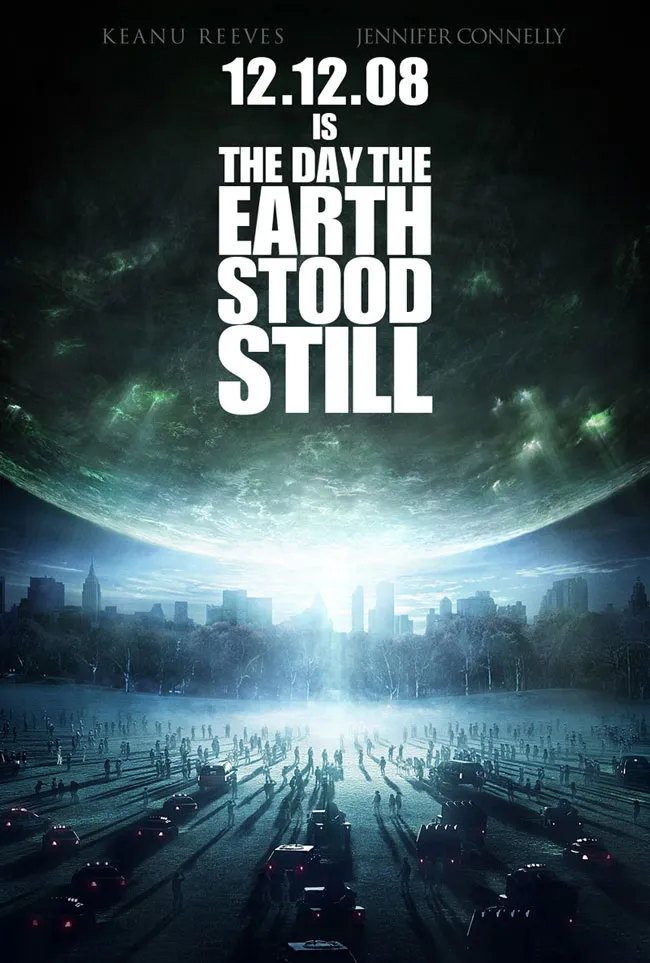
movie classic The Day the Earth Stood Still. Fox studios had brought
me here to be a technical advisor – to review the film's script and some of the
staging to ensure that this archetypical tale of aliens
come to Earth was at least modestly true to science.
In the 1951
version of this story, Klaatu (played by the smoothly laconic Michael Rennie)
lands his saucer on the White House ellipse. He's come to deliver a telegram to
Earth, and the message is straightforward: Don't spread nuclear armaments to
the rest of the Galaxy. Failure to heed this small request will provoke a fate "too
terrible to risk" at the mechanical hands of Gort – an interstellar
Robocop brought along by Klaatu who looks as if he could barely stumble across
a busy street. If we don't behave, Gort and his chrome-plated android buddies
will reduce Earth to "a burned-out cinder." The worst kind.
Now, a
half-century later, Klaatu and Gort are back – with more complaints. No longer
concerned that Earth will somehow start nuking other planets, the aliens have
sent their good-cop, bad-cop emissaries to rescue terra firma from
environmental destruction. Imagine: The inhabitants of other worlds are more
concerned with global warming than we are (although their remediation plans are
not gentle)! This intervention reminds me of alien
abductions: not precisely the social life to which you aspire, but at least
someone's showing interest.
My job on
the film was straightforward: review the screenplay for errors
in the science, and coach the principles in certain technical details.
I read the
script several times, and made suggestions both with regard to the specifics of
the dialogue, and the portrayal of the (earthly) scientists. The former sported
some techno-babble that – while approximately accurate – was as stiff as an
I-beam. Real scientists don't describe an object entering the solar system as "notable
for the fact that it was not moving in an asteroidal ellipse ... but moving at
nearly three times ten to the seventh meters per second." More likely,
they would say that there was "a goddamned rock headed our way!" (Real
scientists might also note, in passing, that any object encountering the dust
of the inner solar system at 0.1 times the speed of light would burn up faster
than a bug in a blast furnace. But that's Klaatu's problem.)
In addition
to making dialogue suggestions, I tried to wean the filmmakers from the cliche
image of scientists as clipboard-carrying, labcoat-wearing ciphers. Rather than
addressing one another as "Dr. Rodney" or "Professor Furball,"
I suggested that they do what real scientists do, and use first names (or in
the case of men, last names) without the honorific. Stuff like that.
Among my
biggest responsibilities was to advise Jennifer Connelly on believable jargon
and interests for her character Helen, the astrobiologist. Connelly was, like
Reeves, remarkably serious about her role, wanting to understand her real-world
counterparts as well as possible. She did everything short of writing a NASA
grant application.
In Vancouver, my major task was monitoring a sequence in which Klaatu meets up with a human
scientist, Professor Barnhardt, played by John Cleese. The two of them engage
in a blackboard duel, writing equations to flaunt their stuff, eventually
convincing Barnhardt that this Klaatu guy knows some important physics that
humankind doesn't. The film's director, Scott Derrickson had me suggest some
high-falutin' equations for this interchange, and instruct Reeves and Cleese on
how to convincingly chalk them on the board. The equations were taken from
General Relativity, and since this is hardly my specialty, I enlisted the help
of a couple of experts (Marco Peloso at the University of Minnesota, and Hector Calderon and William Hiscock at Montana State) to come up with some relevant mathematics.
Actors are
better at memorizing lines than tensor equations, so the formulae were first
written on the board in light pencil, and Cleese and Reeves simply traced them
as the Panavisions rolled. After a few takes, I told Derrickson about my
concern that Keanu was scribing the Greek letters very slowly, and it might not
look convincing. The director responded, "Hey, Seth, he's an alien!"
Sounded right to me.
Between
takes, both Reeves and Cleese solicited my opinion on subjects that had nothing
to do with the film. In particular, they wanted to know why we're here. What's
the grander meaning of our existence? Apparently a lot of people assume that
astronomers, who deal with big things and long timescales, have some insight
into what life is all about. More than, say, tax accountants.
"Surely,"
Cleese ventured, "we're here for a purpose." I figured that a
lifetime of standing around movie and television sets, not to mention the front
desk at Fawlty Towers, had prompted this question.
"Well,
John," I responded, "maybe that's true. Maybe there is some grand
plan. But then again, you might have asked that question 100 million years ago,
hanging out with a bunch of your dinosaur pals. The answer then was 'you're
just a dinosaur.' The answer today might be no more profound."
I'm not
sure Cleese was fully gratified by my response.
The Day
the Earth Stood Still
raises a straightforward question: Should we really expect aliens
to intervene in our bad behavior – be it nuclear warfare, global warming,
or any other ornery aspect of contemporary society?
I think it's
unlikely. The evidence for these transgressions is now moving into space at the
speed of light, betrayed by the flash from bomb tests and the atmospheric
absorption features of chlorofluorocarbons. But this evidence – even aside from
being difficult to detect – has reached only a few thousand nearby star
systems. It's a very long shot indeed that Klaatu or his buddies will know
about any of our problems, let alone rocket to Earth to solve them.
But in a
way, that's all beside the point. The sci-fi films I so avidly devoured as a
youngster weren't important because of the science content (such as it was). They
were significant because they engaged me emotionally, and inspired me to learn
more. In that sense, The Day the Earth Stood Still may have a greater
impact on the next generation of scientists than any ten textbooks.
Seth
Shostak is Senior Astronomer at the SETI
Institute and host of the weekly radio program Are We Alone?.