


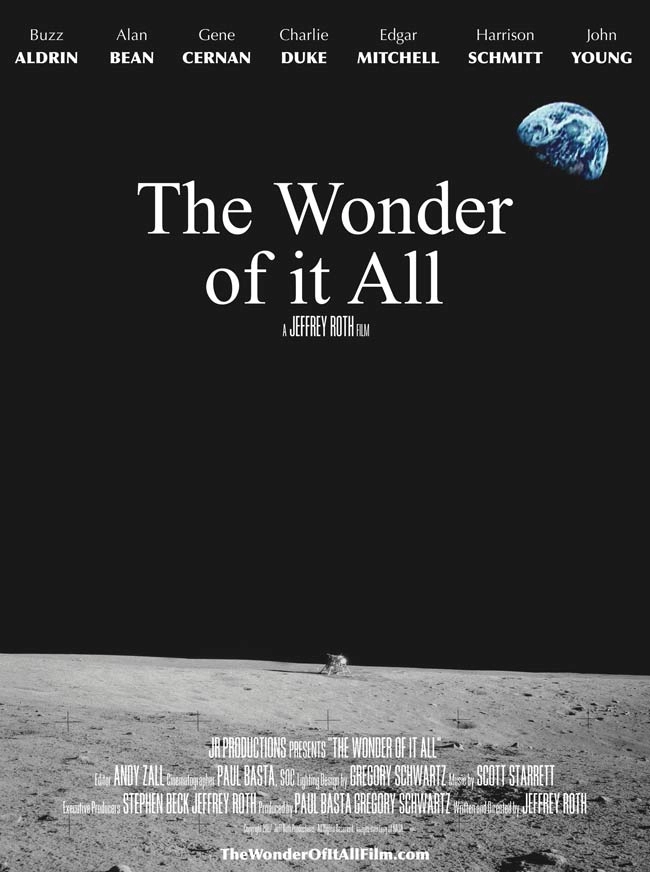
The onlyastronauts to set foot on the moon will share tales of their journey Saturdayin a film screening to raise funds for a monument to their Apollo lunar missions.
"TheWonder of it All" looks to understand the men who walked on the moon, insteadof the science and technology behind the Apollo missions. The result is ahighly personal and affecting history of the U.S. effort to send men to the moon.
"We'reall about the guys," said Jeffrey Roth, director of the film. The filmwill screen at the Kennedy Space Center Visitor Complex in Cape Canaveral, Fla., to help raise funds for a monument honoring NASA?s Apollolunar program.
Many of theApollo astronauts share early childhood fantasies of flying like sci-fi heroBuck Rogers, and later pursued careers as military pilots. Their eagerness topush limits meant they had to mentally prepare themselves for the risks anduncertainties of the space program, as those became evident during the infamous Apollo1 fire and the Apollo 13 accident in space.
However,the astronaut experiences diverge more when they touch down on the lunarsurface. Some moonwalkers ran around methodically to accomplish their assignedtasks. Others took the opportunity to conduct an impromptu "lunarOlympics" by bouncing up and down in the moon's one-sixth gravity, or hita golf shot on camera.
"Allof us needed to do more human things," said Alan Bean, lunar module pilot for Apollo 12, who regretted focusing too muchon collecting moon rocks.
Yet Apollo11 lunar module pilot Buzz Aldrin, the second person ever to walkon the moon in 1969, took a moment to give thanks and pray under theblackness of space that astronauts described as beyond any darkness on Earth.Charlie Duke, of Apollo 16, left his family's photo in a clear plastic bag on thelunar soil.
Those humanmoments remain the most vivid impressions from "The Wonder of itAll," particularly as the astronauts describe life following the Apolloprogram. Bean eventually left NASA to become an artist, turning his impressionsas a moonwalker into vivid paintings. Fellow astronauts stayed on with NASA towork and consult, or entered politics.
The filmalso sheds some light on the less-joyful experiences of the Apollo program,such as returning astronauts being egged by student protesters or a personalstruggle with alcoholism and depression.
By the end,astronauts reflect upon a spiritual experience in space that transcends theboundaries of human knowledge — and allows film viewers to appreciate thatother component of the space program beyond rockets and spacecraft.
?Wonder ofit All? is one in a series of recent films, which include ?In theShadow of the Moon? and ?Magnificent Desolation,? that focus on thepersonal stories of those few humans who set foot on the lunar surface.
"Scienceand technology could no longer explain what I was feeling," said Eugene Cernan,Apollo 17.
Thebenefit screening for the U.S. Space Walk of Fame will take place at 6 p.m. on Jan. 19 at the Kennedy Space Center's IMAX Theater. For ticketinformation, go to www.thewonderofitallfilm.com.Additional screenings are planned for the U.S., Europe, Canada, and Australia in 2008.
- VIDEO: Apollo 11: The First Moon Men
- IMAGES: Magnificent Desolation: An IMAX Look at the Apollo Moon Landings
- VIDEO: A New Era of Exploration with NASA's Orion and Ares