LAS CRUCES, New Mexico -- A little bit of Apollo Moon history was revisited here today. The NorthropGrumman Lunar Lander Challenge was staged for the first time at the Wirefly XPrize Cup.
The NASA-sponsored Challenge is part of the two-day Cup being held October 20-21 at the Las Cruces International Airport. NASA is providing $2 million in prize money for the Challenge.
The event was founded by the creators the Ansari X Prize, the $10 million prize package offered to anyone who could launch a re-usable sub-orbital spacecraft, capable of carrying passengers, twice in a two week period.
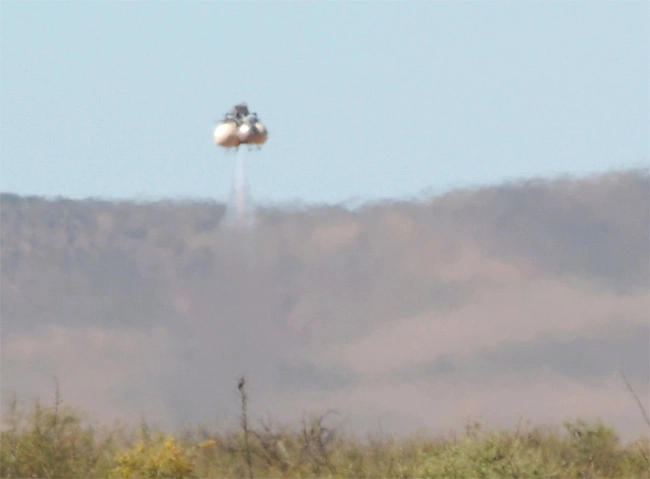
Roaringoff into clear skies over a stretch of remote terrain, the Armadillo Aerospacevertical takeoff and landing vehicle rose to altitude, remained aloft, scootedhorizontally a distance, but ran into trouble at touch down on a landing pad.
Thecraft--nicknamed "Pixel"--came down too fast causing breakage of landing legs. Fire damage causedby the hard landing has curtailed the vehicle's second flight - needed to claimNASA prize money. Depending on overnight fixes to software and hardware,another attempt at grabbing Lunar Lander Challenge money may be attempted.
Permit to experiment
John Carmack, leadrocketeer of the Mesquite, Texas-based Armadillo Aerospace, admitted in a pre-flight interview of being nervous about the team's space shottoday. Test flying of their rocket hardware on Thursday was highly successful,but some technical snags cropped up during those early shakeout hops.
Forone, Carmack said their vehicle kicked up significant dust making it tough toremotely control the touch down. "I couldn't see a damn thing," he noted, as hepiloted the automated craft with a hand-controller.
ForPixel to take to the air today, it had to pass regulatory safety oversight ofthe Federal Aviation Administration's Office of Commercial SpaceTransportation. That body granted Armadillo Aerospace an experimental permit tofly, Patricia Smith, Associate Administrator for the office told SPACE.com.
Despitethe landing problems, Carmack remained optimistic about the flight.
"Ithink that the best benefit that NASA can possibly get out of this is anoperation like this - going from concept to almost successful flight in undersix months by a team of 8 people part time for about $200,000," Carmack saidafter the flight. "That should change some of their current contractors thatare going to be spending tens of billions of dollars doing different things."
On the level
Winningthe Level 1 competition was worth $350,000 in prize money - a purse provided byNASA's Centennial Challenges. This NASA effort is meant to promote technicalinnovation through a novel program of prize contests.
Rocketteams for the Lunar Lander Challenge are scored on their ability to meetchallenge requirements, the accuracy of their landing and, in case of a tie,the number of "round trips" they can complete within a specified period oftime.
Newideas, like those stimulated by the Lunar Lander Challenge can help returnhumans to the Moon by 2020, said Art Stephenson, vice president of spaceexploration systems for Northrop Grumman's Integrated Systems sector.
ArmadilloAerospace had competitors for this year's Lunar Lander Challenge. However,other teams experienced technical as well as financial woes, narrowing down thefield to Carmack and his team this year.
Theory and reality
Whilethe pursuit of the Challenge did significantly accelerate the development ofMasten Space Systems' commercial XA-1 vehicle, the group had to delay takingpart in the contest.
VerticalTakeoff and Vertical Landing spacecraft are hard, Masten said. "We knew thatwhen we started this business. In the end, it was Murphy that conspired to delayenough key elements that we couldn't meet the X Prize Cup deadline," he said.
"Overthe last couple of months we have been working on issues where theory andreality did not quite meet up. We have all those issues just about wrapped up,"Masten told SPACE.com.
Thegroup's XA-1 is being readied for flight in the very near future, said MichaelMealling, Vice President of Business Development.
- VIDEO: Complete Coverage of the X Prize Cup
- LIVE Coverage of the X Prize Cup
- Challenges Ahead for Spaceport America
- Astronaut Advice for Future Space Tourists
- Progress Touted In Private Space Travel
- Showtime for Spaceship Builders
- Space Elevator: Hoist to the Heavens