





The end ofJanuary marks a somber time for NASA with the anniversary of the three majortragedies in the history of U.S. spaceflight.
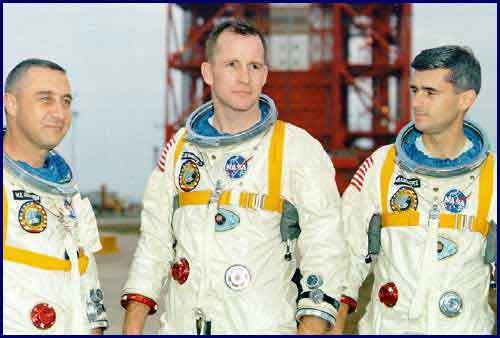
On Jan. 27,1967, three of the first group of NASA astronauts - Virgil ?Gus? Grissom,Edward White and Roger Chaffee - died during a routineground test of the Apollo capsule, later named Apollo 1.
Theastronauts suffocated when an electrical spark ignited a fire that engulfedtheir high-pressurized, pure-oxygen cabin. The Apollo 1 ground test had notbeen designated as potentially hazardous, the NASA History Web site said.
These werethe first U.S. astronaut deaths associated with spaceflight. Sadly, thataccident was not the last such tragedy.
The highlyanticipated Jan. 28, 1986, launch of SpaceShuttle Challenger, which carried the first teacher-astronaut, ChristaMcAuliffe, was watched live by many around the nation, including schoolchildren. But 73 seconds after takeoff, the shuttle erupted in a fireball that killedthe entire crew.
In June1986, the Presidential Commission on the Space Shuttle Challenger Accident,chaired by William P. Rogers, found that the O-ring seals in the rightsolid-rocket booster failed in the cold temperature, eventually causing thebooster to rupture and explode, taking the lives of McAuliffe and astronautsFrancis ?Dick? Scobee, Ron McNair, Mike Smith, Ellison Onizuka, Judy Resnik andGreg Jarvis. A complete failure of the O-ring was not expected at frigidtemperatures, said Roger Launius, chairman of the Washington-based spacehistory division of the Smithsonian Institute.
Seventeenyears later, tragedy struck NASA once again. On Feb. 1, 2003, following a 16-dayscience mission, the space shuttle Columbia broke apart upon re-entry,killing the entire crew: U.S. astronauts Rick Husband, Willie McCool, MichaelAnderson, Kalpana Chawla, David Brown, Laurel Clark and Israeli astronaut IlanRamon.
A gouge inthe shuttle?s left wing absorbed too much heat as the shuttle re-enteredEarth?s atmosphere. NASA officials did not believe that the gouge on the wing -caused by the impact of insulating foam from the shuttle?s external tank duringits Jan. 16 liftoff - was severe enough to cause the loss of the shuttle,Launius said.
?Theproblem with all three of these accidents is they really didn?t know they had aproblem,? Launius said in a phone interview.
However,certain individuals did in fact raise awareness about these and other issues.Roger Boisjoly, an engineer for Morton Thiokol which built the space shuttlerocket boosters, warned his superiors and NASA officials that the O-rings mightnot hold up in cold temperatures. While there had been problems with the O-ringseals during previous shuttle flights, there never was a total breach, Launiussaid. And without the necessary amount of hard evidence, those objections werenot seen as sufficient enough to stop a shuttle launch, he said.
There wasnot a thorough enough understanding of these risks, he said.
Theinability to communicate potential problems in an understandable way betweenthe different groups working on the spacecraft contributed to the accidentsthat led to the astronauts? deaths, Launius said.
After allthree accidents, new protocols immediately were implemented to prevent theproblems in the future, including:
- The hatch for the Apollo capsule was reworked to allow faster egress, wiring was redone, flammable materials inside the cabin were replaced with flame-retardant items and the cabin pressure was lessened.
- The O-rings for the shuttle?s solid-rocket boosters were redesigned after the Challenger disaster.
- Foam debris hitting the shuttle was strictly scrutinized after the loss of Columbia, according to the NASA History Web site.
Despite therisks, astronauts continue to risk their lives. ?The spirit of exploration istruly what it is to be human,? astronaut Stephen Robinson said in an August2005 audio message on flight STS-114,which directly followed the Columbia disaster.
?[W]e hopeif anything happens to us, it will not delay the program,? Grissom said just afew weeks before he died, the NASA History Web site said. ?The conquest ofspace is worth the risk of life.?
- VIDEO: NASA's Apollo 1 Tragedy
- VIDEO: Columbia?s Crew: In Their Own Words
- GALLERY: Columbia?s STS-107 Shuttle Crew