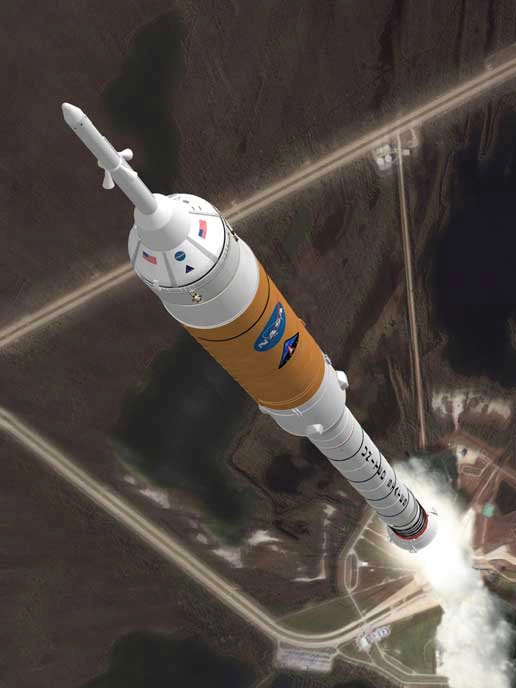
COLORADOSPRINGS, Colorado - The future of NASA's exploration agenda in a post-spaceshuttle world - the Orion spacecraft and Ares boosters - is on target as itmoves from contractor blueprints to real hardware.
Still, challengesremain - particularly in maintaining critical workforce skills in the transition betweenshuttle and Orion programs.
NASA'sConstellation Program - the umbrella name for the space agency's Moon, Mars and beyondvisionary agenda - was kick started by U.S. President George W. Bush inJanuary 2004.
"We have aroad map," said Doug Cooke, NASA's Deputy Associate Administrator, ExplorationSystems Mission Directorate, speaking here at the 23rd National Space Symposiumstaged by the Space Foundation. Given the intervening three years, NASA and itsindustrial partners "have collectively made a tremendous amount of progress,"he said.
Areas ofcommon interest
Cookeobserved that engine test stands and wind tunnels are active in helping toshape the Orionspacecraft program that will tote six people to the International SpaceStation, as well as carry crews back to the Moon, then onward to Mars.
"We have alot of progress underway in testing hardware," Cooke said. Furthermore, therole of other nations as well as entrepreneurs in creating a global strategyfor exploring the Moon is coming together, he noted.
"We'relooking for areas of common interest," Cooke explained.
Cooke saidshuttle decisions on flight hardware production have been made that are notreversible. "We are shutting things down."
By end ofthis calendar year, all components of Orionand its Ares booster will be on contract, Cooke said.
Criticalpath
JoiningCooke on a panel of experts, John Karas, Vice President & General Manager, HumanSpace Flight, Lockheed Martin Space Systems Company detailed the Orion program.The company was selected by NASA to build the multi-purpose spacecraft.
Karashighlighted the company's strategy to keep Orion on cost and schedule, and tokeep the crew safe. Queried about the toughest tasks ahead, he highlighted theintegration of contractor hardware matched to NASA requirements and the needfor all to communicate with each other - as well as with outside customers,like the Congress and the public.
From ahardware perspective, Karas said a "critical path" item is Orion's launch abortsystem. It is, essentially, a three stage rocket, a "unique system untoitself," he said, with a number of challenging requirements to provide fullabort profiles to keep the crew safe if the Ares rocket encounters problems.
MichaelKahn, Vice President, Space Launch Systems, ATK Launch Systems, said progressis being made on the Ares I and Ares V designs. Both boosters leverage shuttlegear. The Ares I makes use of a five-segment solid rocket booster, with aspectsof the shuttle program-derived equipment undergoing upgrading and modificationto handle the job of boosting the piloted Orion craft, he said.
Upcomingfor the Ares I booster, Kahn said, are sets of rigorous and key tests,including the booster'stest flight in 2009.
"We'replugging along very well and staying on schedule," Kahn said.
Workforcereductions
Formershuttle astronaut, Richard Covey, USAF (Retired), now Executive Vice President& Chief Operating Officer for United Space Alliance, LLC flagged the needto keep an eye on the need for "significantly reduced" operations costs forOrion contrasted to today's space shuttle prep and fly expenses.
Covey saidhis company is creating a suite of new computer tools to simplifyOrion/Constellation operations. He did spotlight workforce uncertainty in thetransition of skills from shuttle to Orion operations.
A reducedoperations tempo, Covey said, will mean less people involved in getting Orionlaunched. However, in building toward that capability, a strong and sizeableengineering workforce will be necessary, he said.