
Gorgeous Hubble telescope image was 20 years in the making: Space photo of the day
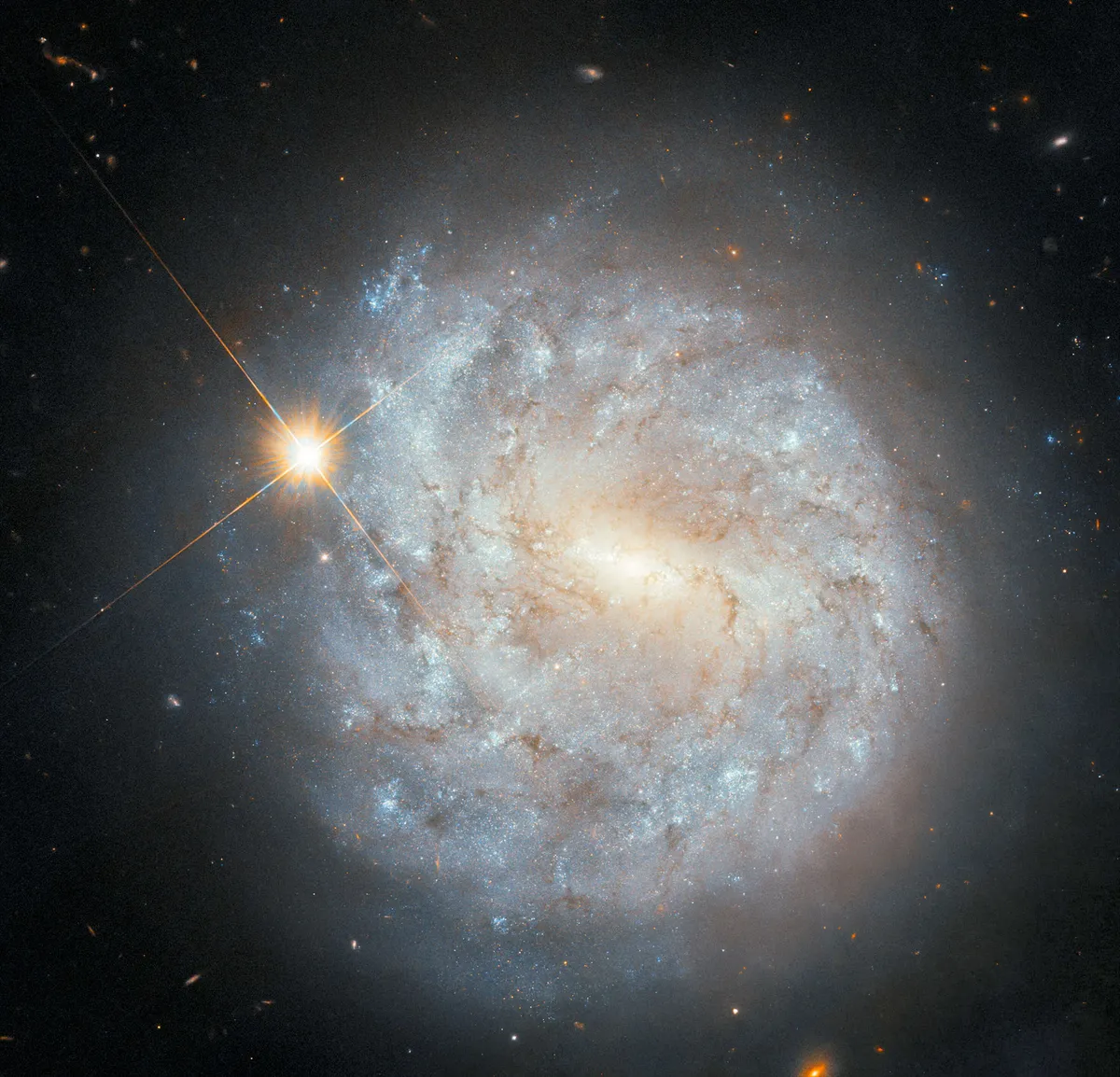
The Hubble Space Telescope captured an image of a star and a spiral galaxy, both in the constellation Virgo. But the photo is an optical illusion.
Breaking space news, the latest updates on rocket launches, skywatching events and more!
You are now subscribed
Your newsletter sign-up was successful
Want to add more newsletters?
Delivered daily
Daily Newsletter
Breaking space news, the latest updates on rocket launches, skywatching events and more!
Once a month
Watch This Space
Sign up to our monthly entertainment newsletter to keep up with all our coverage of the latest sci-fi and space movies, tv shows, games and books.
Once a week
Night Sky This Week
Discover this week's must-see night sky events, moon phases, and stunning astrophotos. Sign up for our skywatching newsletter and explore the universe with us!
Twice a month
Strange New Words
Space.com's Sci-Fi Reader's Club. Read a sci-fi short story every month and join a virtual community of fellow science fiction fans!
This Hubble Space Telescope image shows a spiral galaxy and a bright star, both in the constellation Virgo. The two celestial bodies appear to be close to one another but in actuality, they are far apart.
Why is it amazing?
This stunning image by the Hubble Space Telescope contains an optical illusion. The spiral galaxy, referred to by astronomers as NGC 4900, appears to be sharing space with a brilliant star.
The star, which stands out due to its prominent diffraction spikes, is in our own galaxy, the Milky Way, and is 7,109 light-years from Earth. The galaxy, on the other hand, is about 45 million light years away.
How was it taken?
The star and galaxy are not the only details separated in this image. It is also the product of two different Hubble Space Telescope instruments from two different eras of its use 20 years apart, NASA wrote in a statement accompanying the image.
The data was recorded by both the Advanced Camera for Surveys, which was installed in 2002 and is still in operation, and the Wide Field and Planetary Camera 2, which was added in 1993 and removed in 2009.
Why was it taken?
The data was collected for two different observing programs. Both were focused on better understanding the demise of massive stars, but in one, the study was aimed at the sites of past supernovas (like NGC 4900) to estimate the masses of the stars that exploded and learn more about how the powerful events interact with their surroundings.
The other program provided the foundation for studying future supernovae by collecting images of more than 150 nearby galaxies. When supernova in one of these galaxies is detected, researchers can refer to the baseline images. Identifying details in pre-explosion images can help inform the how, when and why supernovas occur.
Where can I read more?
You can read more about supernovas and the affect they had on Earth, possibly triggering two mass extinctions in our past. Or see a Hubble Space Telescope image of a rare supernova explosion.
Breaking space news, the latest updates on rocket launches, skywatching events and more!
You can also see another stunning image taken by Hubble, this one of a spiral starbust galaxy.

Robert Pearlman is a space historian, journalist and the founder and editor of collectSPACE.com, a daily news publication and community devoted to space history with a particular focus on how and where space exploration intersects with pop culture. Pearlman is also a contributing writer for Space.com and co-author of "Space Stations: The Art, Science, and Reality of Working in Space” published by Smithsonian Books in 2018.
In 2009, he was inducted into the U.S. Space Camp Hall of Fame in Huntsville, Alabama. In 2021, he was honored by the American Astronautical Society with the Ordway Award for Sustained Excellence in Spaceflight History. In 2023, the National Space Club Florida Committee recognized Pearlman with the Kolcum News and Communications Award for excellence in telling the space story along the Space Coast and throughout the world.
You must confirm your public display name before commenting
Please logout and then login again, you will then be prompted to enter your display name.
