
Latest articles by Victoria Corless

The optics for NASA's Nancy Grace Roman Space Telescope have been delivered, marking a big milestone in the assembly of the powerful next-generation observatory.

Scientists are using chemical modeling to dissect whether life exists on icy moons in our solar system.

Long-duration spaceflight affects some aspects of astronauts' cognitive health, but the observed impairment was not found to be lasting, a new study finds.

Scientists with the HESS Observatory have identified the most energetic cosmic electrons ever observed. What could this mean for our understanding of the universe?

Could Mars have once hosted life? NASA's Perseverance rover has uncovered a tantalizing clue, but scientists remain divided on what it truly means for the search for extraterrestrial life.

Dirk Schulze-Makuch is a scientist who thinks NASA's Viking landers could have inadvertently destroyed the life they were searching for. In this Q&A, we ask why.

Samples collected from the near-Earth asteroid Ryugu have revealed clues about a primordial magnetic field that helped asteroids, planets and moons grow in our solar system.

Scientists found molecules containing nitriles in space — the discovery could shed light on the origins of life as we know it.

The Roman Coronagraph Instrument on NASA's Nancy Grace Roman Space Telescope will enable scientists to detect the faint light from planets beyond our solar system.

Scientists are tracking the evolution of comet Hale-Bopp, one of the brightest comets ever seen.

Scientists have identified one of the largest carbon-based molecules in space yet. It could help us decode the origins of life as we know it.

NASA recently put a crucial part of the Roman Space Telescope through a rigorous "spin test" designed to evaluate its resilience against the forces of its planned 2027 launch.

Scientists think space's "sweetness" could be linked to the origins of life as we know it. Here's how.

Using an "organ-on-a-chip" device, scientists have found that heart tissues beat half as strongly on the International Space Station as they do on Earth.
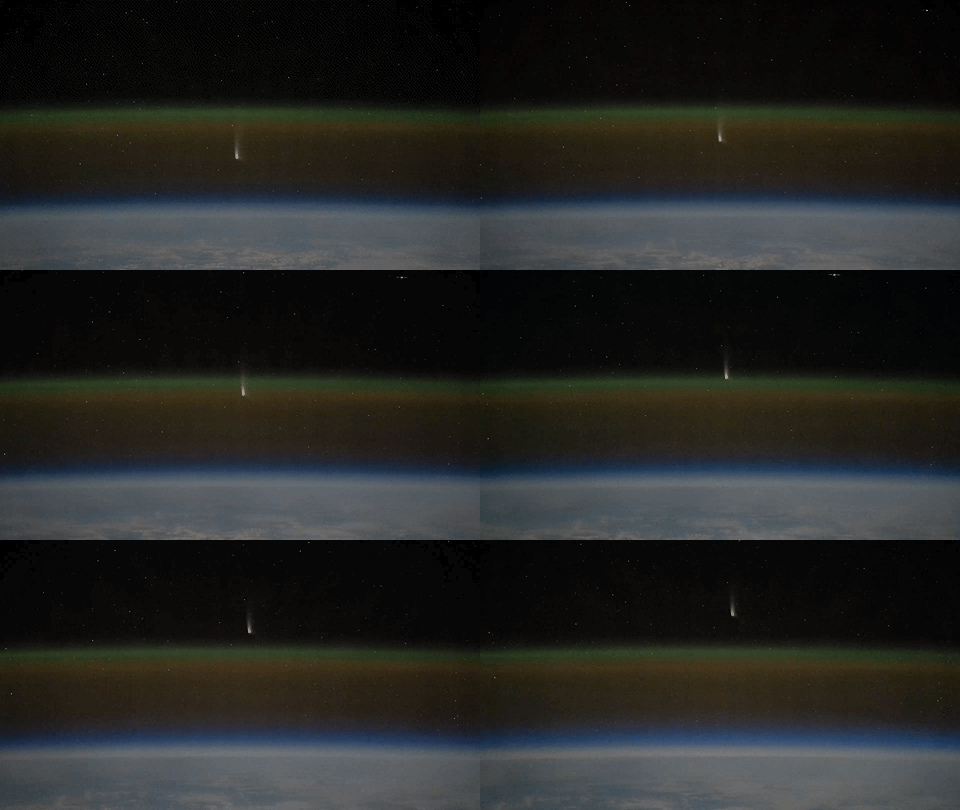
A video filmed by NASA astronaut Matthew Dominick shows a rare glimpse of Comet Tsuchinshan-ATLAS as seen from the International Space Station.

Happy Observe the Moon Night 2024!

ESA scientists have successfully demonstrated 3D printing of a metal part in space for the first time.

Cosmic dust may have helped to kick-start life on Earth, new research suggests. The findings challenge a widely held assumption that this was not a plausible explanation.

To commemorate the 25th anniversary of NASA's Chandra X-ray Observatory, scientists have rereleased new "sonified" images of nearby objects, including the supernova remnant Cassiopeia A.

The Hubble Space Telescope has imaged one of Andromeda's dwarf galaxies. It's named Pegasus.

Scientists found an unexpected ratio of hydrogen to deuterium in Venus' atmosphere, offering clues about the world's past.

DART appears to have derailed its asteroid target from its normal evolution progress. The impact also made a crater.

The first ever 3D radiation map of Jupiter and its moons has been created using low-light cameras aboard the Juno Spacecraft that have been tweaked to operate as radiation detectors.

