
Latest articles by Monisha Ravisetti

The Hubble Space Telescope has exited safe mode after a gyroscope glitch, NASA says, and should resume its regular science operations sometime in January.

Having launched on Oct. 13, the Psyche spacecraft has been journeying to a metal asteroid reminiscent of Earth's core. It just snapped its first image.

There will be 20 total payloads being brought to the moon, five of which are NASA's.

Asteroid Dinkinesh, target No. 1 on Lucy's journey, turned out to be not one, but two (technically three) space rocks put together. Scientists finally gave its satellite a name.

The Hubble Space Telescope has entered an automatic safe mode due to gyroscope difficulties, but scientists aren't worried about the observatory's health.

NASA's Europa Clipper spacecraft is headed to one of Jupiter's largest moons. It's bringing along a microchip filled with human names.

NASA's sonification project has done it again, this time turning the Galactic Center into a perfectly dissonant symphony.

The brightest gamma-ray burst ever seen was also the first to impact Earth's upper ionosphere, a new study suggests.

ESA's TRISAT-R satellite has a camera that's only about the size of a coin's edge, yet it managed to capture a view of our entire world.

The museum's curator of meteorites had been dreaming of this moment for two decades.

A coalition of over 50 astronomers is calling to rename the Large and Small Magellanic Clouds.

NASA's Lucy mission is set to visit several asteroids over 12 years, and the probe just successfully flew by target number one.

With guidance from the telescope's scientists, an actress, a computer animation artist, a composer, and many other experts, 'Deep Sky' aims to reintroduce us to the JWST's lens on our universe.

Scientists have confirmed that OSIRIS-REx brought home at least 70.3 grams of material from asteroid Bennu, surpassing its intended goal of 60 grams.

The JWST's perspective on our solar system has offered us the 1st evidence of a superfast Jovian jet stream.

Gaganyaan translates to "celestial vehicle" and is a mission to bring Indian astronauts to space.
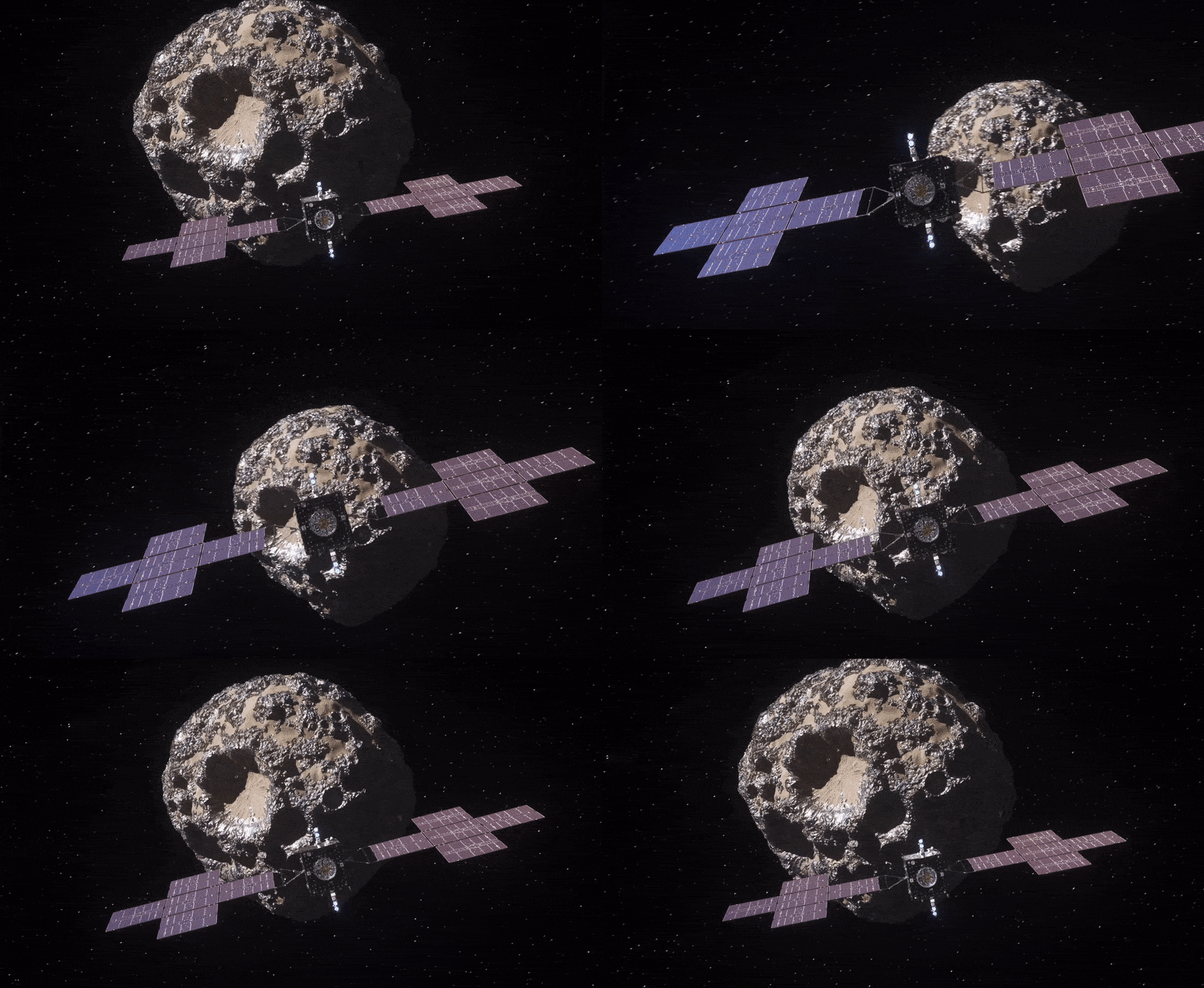
NASA's launching a spacecraft toward an intriguing metal asteroid on Oct. 12. Here's what we might find on 16 Psyche.

The galaxy NGC 6951 was a star factory 800 million years ago, then it halted operations for 300 million years before cranking stellar bodies out once more.

A stunning new Hubble Telescope image showcases NGC 612's orange-hued star-forming disk.

If we can understand how stars form, perhaps we can understand how planets do, too.

The well-known Vela Pulsar just smashed a record for the highest-energy radiation ever detected from one of these highly magnetized spinning neutron stars.

The James Webb Space Telescope and the now-retired SOFIA telescope, impressive as they may be, have hit their limits when it comes to studying Psyche.

For years, experts haven't agreed on whether Venus' lightning is truly lightning. New data from NASA's sun-kissing spacecraft may have settled the debate.

