
Latest articles by Harry Baker

Russia's Klyuchevskoy volcano, which is the tallest volcano in Europe and Asia, violently erupted on Nov. 1 and left behind a trail of smoke and ash that was photographed by NASA satellites.

The massive volcanic comet 12P/Pons-Brooks, which grows giant horns when it erupts, has exploded for a third time in five months as it continues to race toward the sun.

Researchers are developing a real-life tractor beam, with the goal of pulling defunct satellites out of geostationary orbit to alleviate the space junk problem.

A striking new image shows bright orange auroras dancing in the night sky above Canada. But auroras should never be this color, so what's going on?

NASA has released a new image of an eerie, cranium-shaped caldera in the Sahara Desert, which looks like it is staring right at the orbiting camera.

Scientists have created the world's first nanophotonic electron accelerator, which speeds negatively charged particles with mini laser pulses and is small enough to fit on a coin.

Aurora records in royal chronicles from Korea show that during the 'Maunder Minimum' between 1645 and 1715, the sun's solar cycles became several years shorter than they are today.

The cryovolcanic comet 12P/Pons–Brooks, which will make its closest approach to Earth next year, has re-sprouted its distinctive "horns" after its second major eruption in four months.

Atoms within the enormous ball of iron in Earth's inner core may move around much more than previously thought, which could explain recent findings about the core's surprising softness.
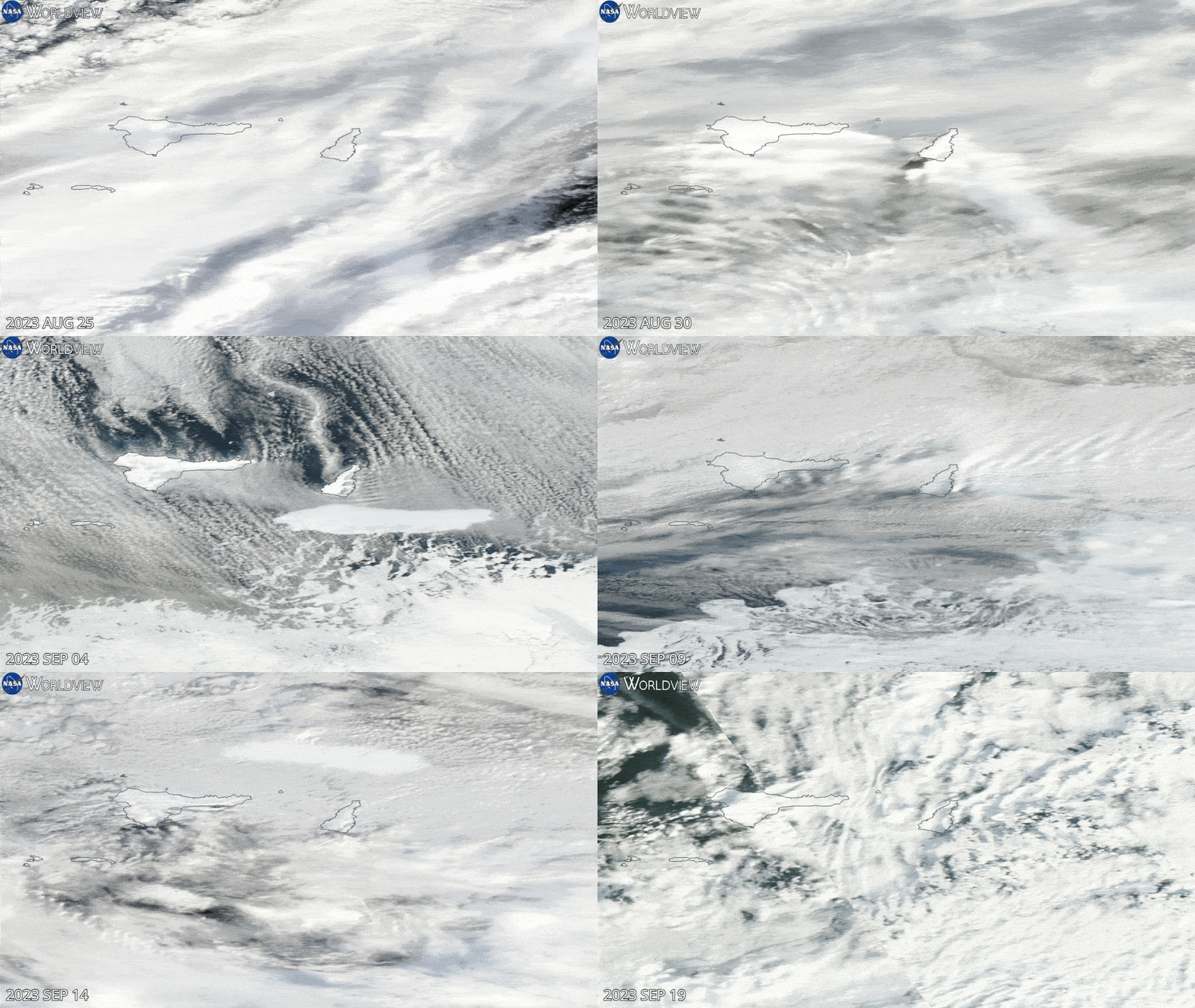
Hefty iceberg D-30A has collided with Clarence Island — an important refuge for breeding penguins in Antarctica. But luckily, the penguins weren't at home when the berg struck.

NASA's James Webb Space Telescope has spotted a distant supernova that appears three times in the same photo. The new observations could help solve one of the universe's biggest inconsistencies.

After surviving its closest approach to the sun, Comet Nishimura was buffeted by a possible coronal mass ejection that briefly blew its tail away. The rare event was captured by a NASA spacecraft.

The James Webb Space Telescope has snapped a stunning image of a perfectly formed Einstein ring, which is also the most distant gravitationally lensed object ever detected.

A rocket carrying a Space Force surveillance satellite may have created a hole in the ionosphere as it shot into space. The launch was carried out with just 27 hours' notice, which is a new record.

Scientists have developed a nuclear fuel source no larger than a seed, which NASA will test for use in future moon missions.

Comet Nishimura, which was only discovered in August, has survived its closest approach to the sun and will brighten over the next week. But is it still visible from Earth?

Researchers have shown that if the James Webb Space Telescope was pointed at Earth from a distant star, it could detect the signatures of intelligent life in our planet's atmosphere.

One researcher hypothesizes that experiments carried out by NASA's Viking landers in 1976 could have inadvertently killed microbes living in Martian rocks. Other experts are skeptical.

An astronomer in Slovakia captured the rare luminous phenomenon as it briefly flashed in Earth's upper atmosphere during a thunderstorm.

The sun has launched a surprise coronal mass ejection directly at Mars, which could spark auroras on the Red Planet and potentially erode part of Mars' remaining atmosphere when it hits on Sept. 1.

For the first time, researchers were able to transmit, or "tunnel," sound waves across extremely small distances between two crystals in a vacuum.

The Landsat 8 satellite captured the deadly flames that burned through the town of Lahaina in Hawaii and killed at least 99 people.

The exploding comet, known as 12P/Pons–Brooks, is currently approaching its closest point to Earth during its 71-year orbit through the solar system.

