


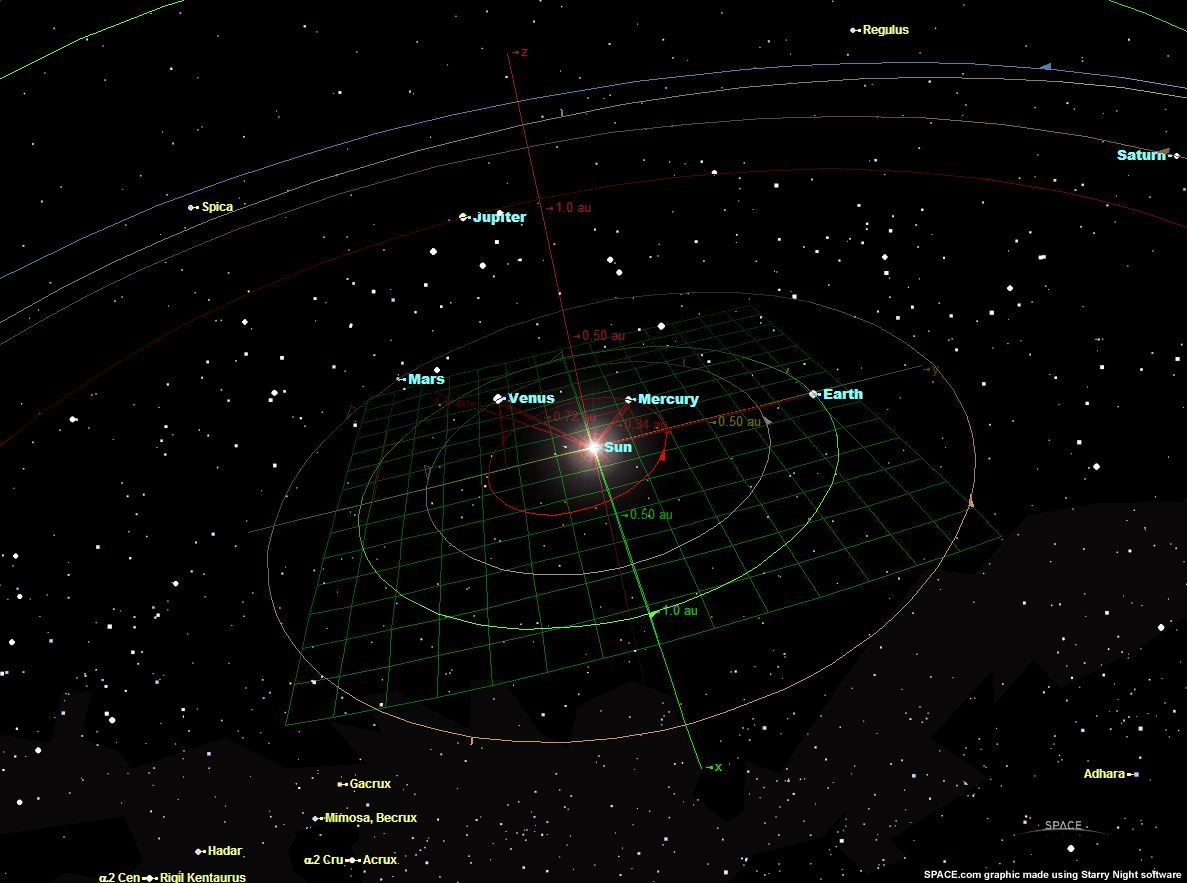
As winter begins, the early morning sky is loaded with planets. Some are unmistakably bright, but a few will require some sleuthing.
The winter solstice occurs Dec. 21 at 7:42 a.m. ET. It is when the Sun is at its southernmost point in the sky, and marks the official beginning of winter. For those willing to brave the cold, there is much to see before the Sun comes up.
Mercury, Venus and Mars are all visible in the East just before sunrise. Mars is best found using a map under dark skies away from city lights, and Mercury requires an intense gaze at just the right time in the moments prior to sunrise. [Sky Map for Dec. 25 predawn]
Jupiter, second only to Venus in brightness among planets and stars right now, reigns high in the south-southeast during predawn hours, while Saturn is brighter than any star in the western sky.
All of these objects can be seen with the naked eye. But a small telescope will reveal the rings of Saturn and up to four of Jupiter's largest moons, which appear as pinpoints of light. A larger backyard telescope can bring out the cloud bands of Jupiter's atmosphere.
The planets are all in the morning sky at the same time because they all happen to be on the same side of the Sun right now, as viewed from above the solar system.
Trace an arc from Mercury to Saturn, passing near each of the other planets, and you can envision the main plane of the solar system through which all of the planets orbit the Sun. Astronomers call this the ecliptic.
Each morning, the arrangement is slightly different, because each planet travels around the Sun at its own distance and pace. Mercury is particularly difficult to spot because it is only moderately bright and very close to the Sun, as always; it rises just before the Sun does. An unobstructed view of the eastern horizon is needed to see this most elusive of the naked-eye planets.
Through this week, Mercury is climbing slightly higher each morning, while Venus is slowly sinking.
On Dec. 25, Mercury and Venus will be shoulder-to-shoulder, making Mercury easier to find than would otherwise be the case. Find Venus, the brightest object other than the Moon in the predawn sky (you might for a moment think it's an airplane coming in for a landing) and look just to its left to spot Mercury. One or two fingers on an outstretched arm will blot out both planets at once.
Mars is about 10 degrees above and to the right of Venus. Your fist at arm's-length covers about 10 degrees of sky. Mars is dim, but brighter than any star in its immediate vicinity. Pluto happens to be very near Venus and Mercury as seen from our terrestrial vantagepoint, but the tiny planet is too far and dim and close to the Sun to be spotted.
The Moon sets around 1:30 a.m. on Dec. 20, but it hangs around longer each morning. On Dec. 28, the Moon will hover directly above Saturn just before sunrise.
Any morning this month, look high in the northern sky for the Big Dipper, that most recognizable of all star patterns.
While the winter solstice is but one of many cold nights ahead for avid skywatchers, there is a bright side: It is the shortest day of the year in the Northern Hemisphere, so summer is, as always, around the corner.
Basic Sky Guides
- Tonight: Explore Andromeda
- Telescope Buying Tips
- Astrophotography 101
- Sky Calendar & Moon Phases
- 10 Steps to Rewarding Stargazing
- Reading Weather in the Sun, Moon and Stars
- How and Why the Night Sky Changes with the Seasons
- Night Sky Main Page: More Skywatching News & Features


Starry Night software brings the universe to your desktop. Map the sky from your location, or just sit back and let the cosmos come to you.

