Latest about Mercury

Where did Mercury get its water ice? Maybe from a single slow asteroid impact
Mercury may have gotten much of its polar ice within a single Mercurian day following a massive asteroid impact, a new study suggests.

How much has Mercury shrunk?
Mercury is still shrinking as it cools in the aftermath of its formation; new research narrows down estimates of just how much it has contracted.

Mercury quiz: How well do you know the Swift Planet?
This quiz will explore the facts, the fun and the fascinating quirks of our solar system's speedster, Mercury

BepiColombo spacecraft flies by Mercury, sees volcanic plain and impact craters
The BepiColombo spacecraft has captured the 1st mid-infrared portrait of Mercury.

BepiColombo probe captures haunting Mercury image on 5th of 6 gravity assist flybys (photo)
The European-Japanese BepiColombo probe made a close flyby of Mercury on Dec. 1, 2024 and captured an image of the planet.

BepiColombo spacecraft's flyby of Mercury begins unraveling the planet's magnetic mystery
The secrets of Mercury's strange magnetic bubble are gradually being unlocked by the BepiColombo spacecraft as it makes its rapid flybys of the world.

Magnetic mystery at Mercury revealed by BepiColombo probe (video)
The BepiColombo probe's flybys of Mercury have revealed just how sharply and rapidly the planet's local environment changes in response to the solar wind.

BepiColombo probe captures stunning Mercury images in closest flyby yet
BepiColombo made a close flyby of Mercury on Sept. 4, getting just 103 miles (165 kilometers) above the planet.

Mercury has a layer of diamond 10 miles thick, NASA spacecraft finds
Using data from NASA's MESSENGER spacecraft, scientists have determined that the solar system's tiniest planet, Mercury, hides a not-so-tiny secret: a 10-mile-thick mantle of diamond.
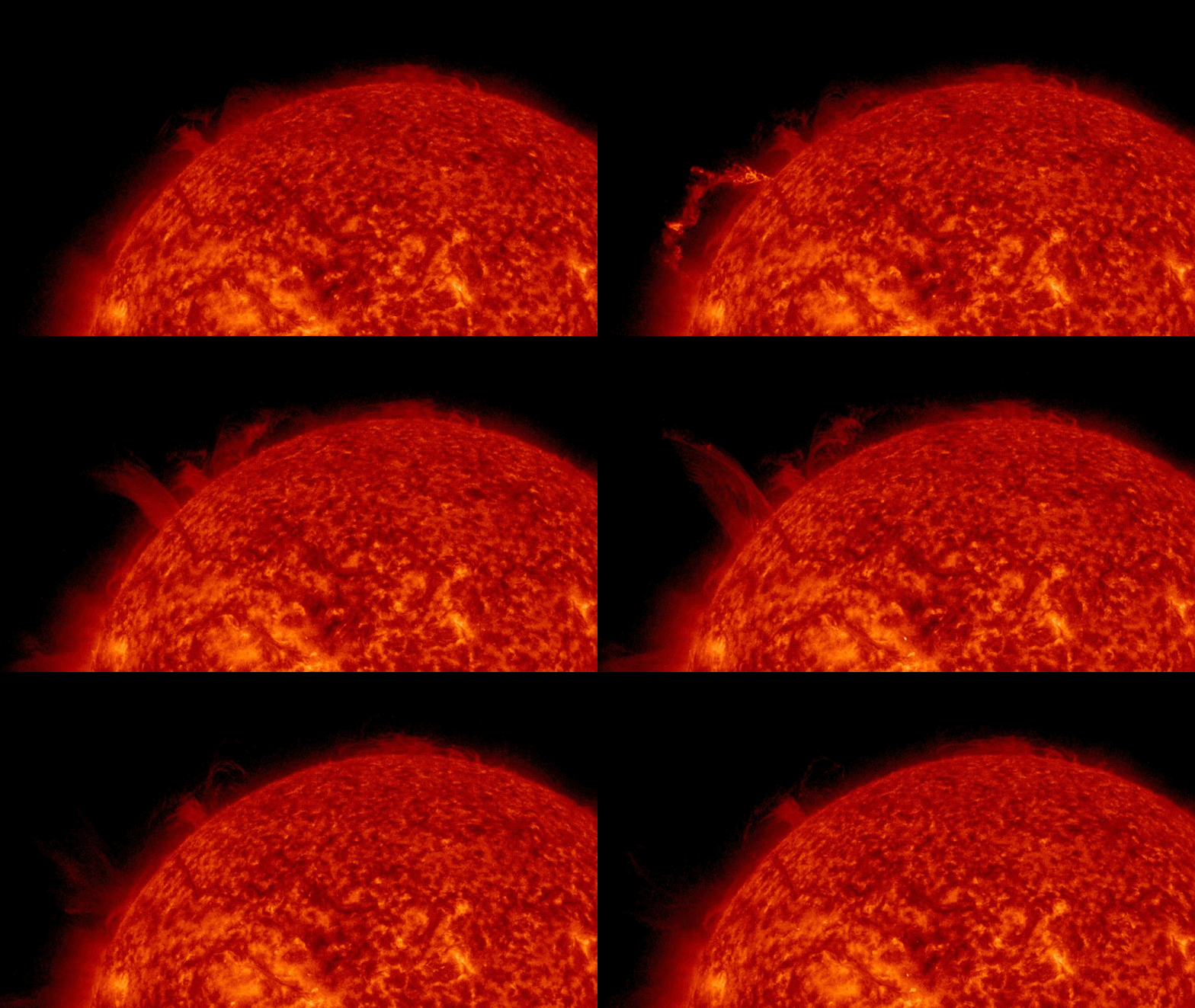
Mercury slammed by gargantuan eruption from the sun's hidden far side, possibly triggering 'X-ray auroras'
A gigantic plasma eruption from the sun's hidden far side recently launched a sizable coronal mass ejection that slammed into Mercury, potentially triggering invisible X-ray auroras around the planet's rocky surface.