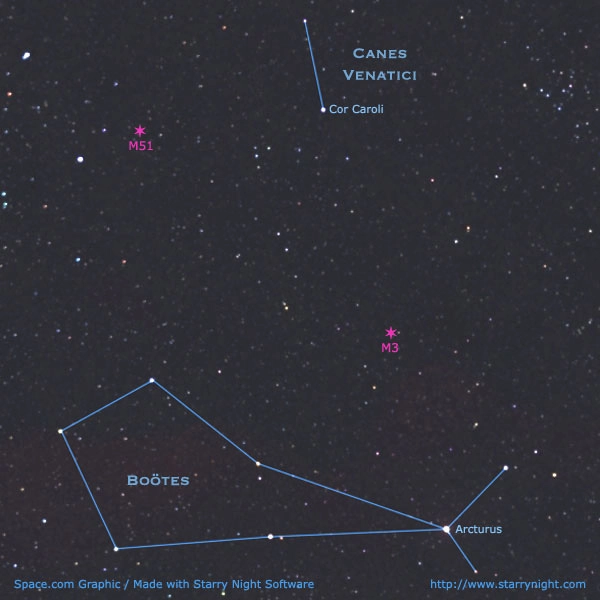
Soaring high in the eastern sky and almost overhead ataround midnight are the two stars marking the Hunting Dogs, known as CanesVenatici.
Located about a third of the way from the end of the BigDipper's handle and below it, these dogs were placed in the sky to assistBo?tes, the Bear Driver in his daily task of pursuing the Big Bear (Ursa Major)around the pole of the heavens. Unlike the two faithful canine companions ofOrion, the Hunter (Canis Major and Canis Minor), which are separateconstellations in of themselves, the two Hunting Dogs of Bo?tes are bothconsidered a single constellation (hence the plural "Canes" asopposed to the singular "Canis").
Of the two stars that mark the Hunting Dogs, the brightestis Cor Caroli, known as the "the Heart of Charles." A popular storyis that the star was so-named by Edmund Halley in honor of King Charles II of England.However, upon delving deeper into this star's history, it is found that thisstar's original name was "Cor Caroli Regis Martyris" honoring theexecuted Charles I. Cor Caroli marks the position of "Chara," one ofthe two hunting dogs in the mythological outline of the constellation. Theother dog is named "Asterion" and is marked by the other, fainter star.
What to look for
Two objects in Canes Venatici are worth looking for. Thefirst is a beautiful and bright globular cluster, first seen by Charles Messierin 1764 and was listed as number three in his famous catalogue of deep-skyobjects.
In a good pair of binoculars, M3 looks like a fuzzy star.But with a small telescope it appears as a circular, nebulous object. Largerinstruments will bring out the cluster's full glory: a beautiful ball of tinycountless star images, with streams of stars seemingly running out from all sides.Perhaps 40,000 light years away, M3's diameter is estimated to be 220 lightyears.
The other object, also discovered by Messier in October1773, is M51. Not a cluster of stars, but one of the nearest and brightestgalaxies relative to our own. This was also the very first galaxy to show aspiral form and hence has come to be known as the "Whirlpool Galaxy."A good pair of binoculars will show it as a faint patch of light. Unfortunately,you'll need a telescope of at least eight-inch aperture if you hope to get aglimpse of this galaxy's spiral arms. Many years ago, under a very dark andclear sky at Long Island's Custer Institute (http://www.custerobservatory.org/),I was readily able to discern the spiral coils of M51 using a 10.1-inchDobsonian reflector. There is also a much smaller satellite galaxy ? NGC 5195 ?that appears just off the end of one of the spiral arms of M51. When you aregazing at this entire star system, keep in mind that you are looking out intospace to a distance of some 35 million light years.
The great diamond of spring
Cor Caroli is the faintest of four stars that comprise alarge diamond frame that can be found high in the sky and due south at aroundmidnight local daylight time.
The other stars in the diamond are Denebola (marking thetail of Leo, the Lion), Arcturus (in Bo?tes) and Spica (the spike of wheat inthe hand of Virgo). Some guidebooks call it the "Virgin's Diamond,"though others refer to it simply as "The Great Diamond."
Unlike the famous Summer Triangle, the Diamond is nowherenear the Milky Way, but it overlaps a great number of other milky ways. Forjust east of Denebola is a region of the sky known as the "Realm of theGalaxies," where there's a concentration of thousands of galaxies locatedbetween 40 and 70 million light years from us. So it is possible that as yourun across these pale little patches of light in your telescope, irregularlyshaped, round or elongated in appearance, that you are gazing upon galaxieswhose light may have started toward the Earth around the time of the extinctionof the dinosaurs.
- Online Sky Maps and More
- Sky Calendar& Moon Phases
- Astrophotography101
Joe Rao serves as an instructor and guest lecturer at New York's HaydenPlanetarium. He writes about astronomy for The New York Times and otherpublications, and he is also an on-camera meteorologist for News 12Westchester, New York.