

Biology is often called the
study of life, yet in the history of the field, experts have never agreed on
just what, exactly, life is.
Many attempts to classify life focus on a list
of requirements, such as the ability to reproduce, to carry out metabolic
reactions, to grow, to defend against injury, and others. Yet exceptions to
each of those can be made for things that are generally accepted to be alive.
For example, mules and worker bees cannot reproduce, but surely they are alive.
And bacteria, when frozen, are completely inactive but still are alive.
Biologist Gerard Jagers op
Akkerhuis of Wageningen University in the Netherlands has come up with a novel
solution that does not ask life to meet a long list of abilities.
"People have focused on
facultative properties like breathing or moving, and then say if we combine a
few of those properties we are close to having defined
life, but there are always exceptions," Jagers op Akkerhuis said.
"What [my idea] does is it turns the whole thing completely upside down. I
focus on the minimal absolutely necessary properties and I don't care about any
facultative properties."
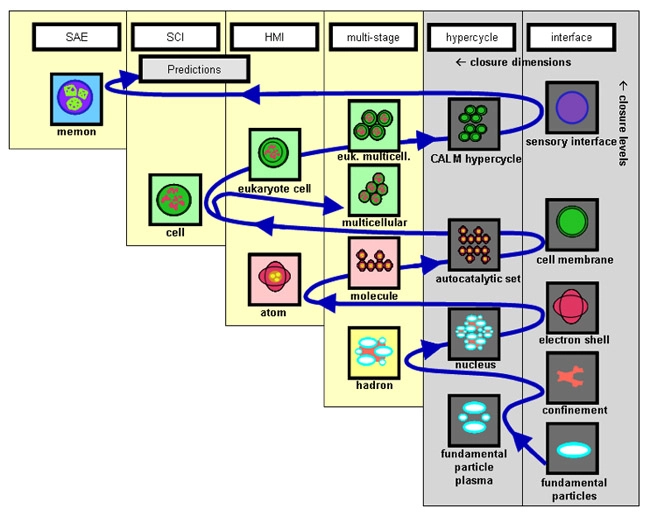
Instead, he defines life in
terms of a concept he calls an operator. This name was introduced to relate to
both physical particles (atoms and molecules) and organisms. The operators are
entities that, as the result of specific self-organization processes, stand out
from the surrounding environment. All living things, like humans and
hummingbirds, as well as some non-living things, such as atoms
and molecules, would be operators.
To qualify as life, Jagers op
Akkerhuis requires an operator to be equally or more complex than a cell.
"From the level of the
cellular operator and up, everything is a living operator, is life," Jagers
op Akkerhuis said. "I define life by means of operators. And I have the
operators ranked by their level of complexity."
Complexity, in this
formulation, can be measured by levels of "closure" — a kind of
circle pattern that connects the beginning and end of a process or structure.
"You have functional closure, in which the products of a process fall into
the set of the ingredients," Jagers op Akkerhuis said. "Then there is
structural closure, which results in a spatially closed entity."
For example, in a cell, the,
membrane is the structural closure. Its functional closure, Jagers op Akkerhuis
said, is the set of so-called autocatalytic enzymes, which are chemicals that
react in a self-perpetuating cycle. The end-product of the reaction is also
what drives the reaction (the catalyst).
Using these concepts, the
theory builds up a strict hierarchy of operators by increasing the levels of
closure step by step. To create the ranking, Jagers op Akkerhuis focuses on an
idea called "first-next possible closure," so every next level
operator in the hierarchy has exactly one additional level of closure.
In the case of a human
being, the functional closure is the brain's network of interacting neurons
(cycles of cycles leading to a "hypercyclic neural network," Jagers op
Akkerhuis said). But a brain without sensors to interact with the physical
world is useless. Therefore a structural closure co-evolved, in the form of an
interface of sensors, both for perceiving the world (e.g. smell, sight, taste,
sensory perception, etc.) and for being active in the world (the motor neurons
directing muscle activity). These closures, on top of the closure of
multicellularity, define a new level of life.
If all this is a little heady,
the scientist says he understands the idea is complex and may take some getting
used to.
"I think the operator
hierarchy offers a very fundamental, new way of defining life. It may, however,
require some time before other people start recognizing its value," Jagers
op Akkerhuis told Roelof Kleis for the Wageningen University journal.
One scientist, Rob Hengeveld
of the Dutch Vrije Universiteit, took issue with the definition in an essay
published in the proceedings of the First International Conference on the
Evolution and Development of the Universe in October 2008.
"This theory and
definition will confuse our biological issues even more by their circularity of
reasoning," he wrote. "Recognizing something as living depends on
criteria derived from known, recent living systems; a bean is a bean because it
is bean shaped."
But Jagers op Akkerhuis said
this is a common misconception.
The construction of the operator hierarchy is
recursive in the sense that every operator depends on its preceding level operator,
but this hierarchical architecture precludes circularity of reasoning, he said.
Plus, the operator theory includes both living and non-living operators.
Another common
misconception, Jagers op Akkerhuis said, is the idea that in order to define
life it's enough to understand the origin
of life. "This is a problematic trend, because the first cell lacks many
properties that define life at higher levels in the operator hierarchy," he
said.
One benefit of his theory,
Jagers op Akkerhuis said, is that it allows easy elimination of many red
herrings, such as flames and computer viruses, which have proved to be pesky
possible qualifiers in other definitions of life.
But these things cannot be
life under the operator hierarchy simply because they are not operators, Jagers
op Akkerhuis said — the interactions of their parts do not create the
required first-next possible closure.