
Ad Astra OnlineLiveScience.com HomepageStarryNight.comtelescope.com
  SEARCH:

advertisement


The Day the Earth Stood Still
By Ingrid Richter

Special to space.com

posted: 07:08 pm ET
05 November 1999

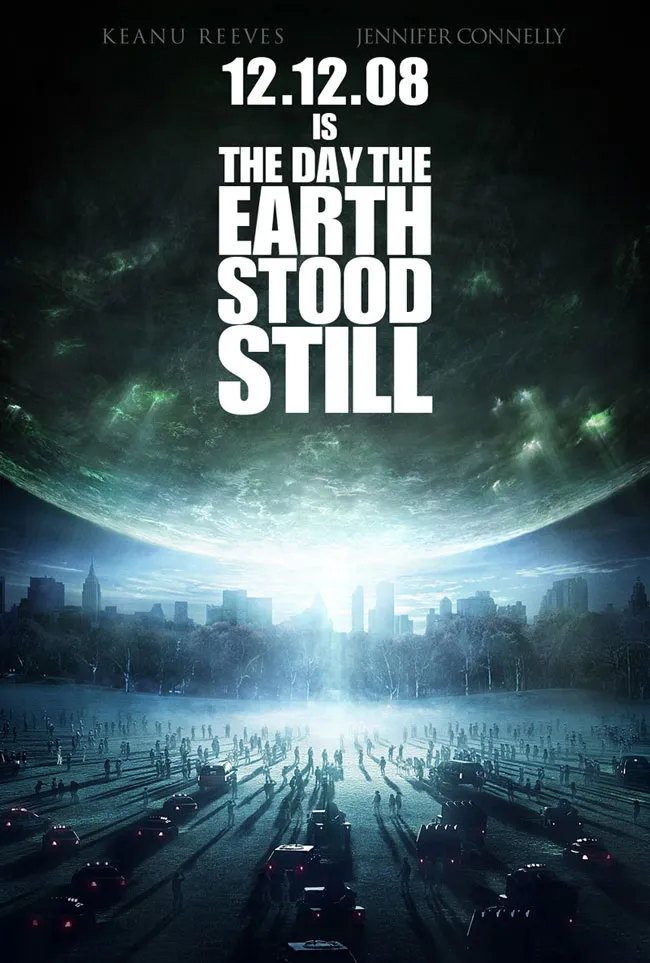
The Day the Earth Stood Still

Directed by Robert Wise in 1951, "The Day the Earth Stood Still" is widely revered as a cautionary tale about the dangers of unregulated scientific advancements in an era of nuclear power. However, benevolent space brother Klaatu (Michael Rennie) makes a lousy messianic figure.

The trouble begins when interplanetary emissary Klaatu lands in D.C. and offers first a perfunctory "I come in peace" and then a mechanical device of questionable military application.

Soldiers quickly shoot him, prompting his ill-tempered robot Gort (Lock Martin) to vaporize their weapons. As Earth medical personnel whisk Klaatu to a nearby hospital, he bemoans the loss of his device, a now-broken gift earmarked for the U.S. president.

After fleeing the hospital, Klaatu joins forces with beautiful widow Helen (Patricia Neal, paving the way for Kate Mulgrew), and her son Bobby (Billy Gray). Even then, his martyr tendencies emerge as he offers to look after Bobby while Helen goes on a date with her beau, Tom (Hugh Marlowe).
   Images

If Klaatu is a Christ figure, who is Gort supposed to be?
   More Stories

War of the Worlds: Why the Hoax Worked


Celebrities Have Close Encounters, Too


ISS Measures Up to 1950s Magazine Inspiration


Wilhelm Reich's Contact With Space

   Related Links

The Day the Earth Stood Still


Tribute to Robert Wise


Robert Wise

A day with Bobby is like a day with your worst enemy, but Klaatu has a great time. Meanwhile, the military is also having a great time trying to blowtorch Klaatu's ship.

Not even friendly scientists and a "benevolent" demonstration of Klaatu's power over the industrial complex -- he stops all power everywhere for half an hour -- can keep the friendly alien out of the hands of his tormentors, who end up killing him. And then, of course, his robot Gort goes berserk, vaporizing weapons and humans until Helen recites the magical phrase that stops the rampage.

Shortly thereafter, Klaatu emerges both from the grave and from his ship to deliver the sternest moral lesson ever presented by a guy clad in a sequined jumpsuit. With the recent (this was 1951) development of space travel through nuclear power, Earth's aggressive tendencies had disturbed other planets, who had elected to send robots to our planet as "keepers of the peace."

These robots, including the malignant Gort, will remain, ready to use enough force to reduce Earth to a burnt-out cinder if we extend our violent ways into space. After delivering this bitter message, Klaatu waves to Helen and flies off into the great beyond. Mission complete.

An extremely cautionary tale
"The Day the Earth Stood Still" took place in the interim between World War II's nuclear finale and the launching of the Russian satellite Sputnik in 1957. Interest in space exploration and concern about scientific responsibility were running high, and the science fiction genre, consequently, was thriving.

In literature, Isaac Asimov's I, Robot (1950) addressed the need for moral boundaries in technology by formulating the Rules of Robotics which Gort, incidentally, flagrantly disregards. The same year that "the earth stood still," Ray Bradbury expressed the desire for space exploration and the need for fundamental changes in human nature in The Martian Chronicles.

Likewise, the SF films to come out of this era reflect the best and worst of the genre -- the idealism and techno-phobia that characterize science fiction's relationship with its subject matter.

"The Day the Earth Stood Still" clearly meant well, and this quixotic intention goes a long way toward making it one of the best of the 1950s SF classics. Klaatu's final warning that we should end our conflicts with other countries and concentrate our energies towards space is inherently noble, albeit somewhat naive.

Moreover, the film delivers this idea in a bizarrely moralistic and contradictory way that ultimately reduces to the simple, "stop fighting or we'll kill you." Is this the superior moral dictum of an enlightened universe? Violence tends to beget violence, and the need for strong enforcers to secure peace is more of a military issue than a scientific one.

Much has been made about the messianic qualities of Klaatu, a peaceful being who offers a superior moral code, only to be killed and resurrected for his trouble. Still, disregarding the film's novel -- and prophetic, given the many religions that would later be formed around similar friendly aliens -- amalgamation of religion and science, Klaatu seems to lack the patience of a good messiah.

If the only two options for humanity are either giving up space exploration entirely or having the remainder of our existence patrolled by cranky robots, we really don't have much choice at all.


     about us | FREE Email Newsletter | message boards | register at SPACE.com | contact us | advertise with us | terms & conditions | privacy policy      DMCA/Copyright

     © Imaginova Corp. All rights reserved.