





Updated at 11:32 p.m. ET
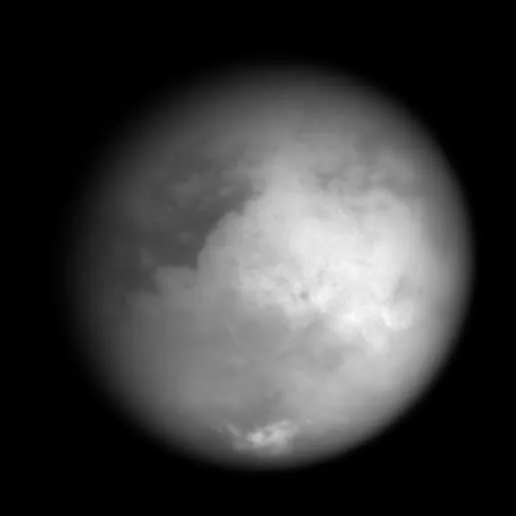
NASA released some of the best pictures ever made of Saturn's moon Titan as the Cassini spacecraft begins a close-up inspection of the satellite today. Cassini made the nearest flyby ever of the smog-shrouded moon.
The spacecraft was slated to fly within 745 miles (1,200 kilometers) of Titan at 12:44 p.m. ET (9:44 a.m. PT). Images were released throughout the day.
It is one of 45 planned flybys of Titan -- some even closer -- during Cassini's four-year tour of Saturn and its moons and rings. Later this year Cassini will deploy a probe, named Huygens, that will descend to the surface of Titan in January.
Scientists believe Titan's atmosphere is similar to that of early Earth, and they want to study it to learn about the sort of pre-biotic chemistry that might have existed just before life on Earth began.
"Cassini will see Titan as it has never been seen before," said Charles Elachi, director of NASA's Jet Propulsion Laboratory, Pasadena, Calif., and team leader for the Cassini radar instrument. "We expect the onboard instruments will pierce the moon's dense atmosphere and reveal a whole new world."
Among the immediate tasks is to learn more about Titan's atmosphere and surface before Huygens parachutes in. The daughter probe is built and managed by the European Space Agency. NASA runs the overall Cassini mission.
Huygens will photograph and record sounds and other data of Titan's atmosphere. If all goes well, it will do the same at the surface and reveal whether it is land or sea. The expected sea, if it exists, would be made of methane and other hydrocarbons, described by one scientist as "Lake Michigan brimming with paint thinner."
Huygens might be bobbed by waves larger than those on Earth.
"Cassini may finally show us if what we thought of this moon is true, and whether the Huygens probe touchdown will be a splash," said Jean-Pierre Lebreton, Huygens project manager and project scientist for the European Space Research and Technology Center, Noordwijk, Netherlands.
The flyby today is expected to improve understanding of the atmosphere's density and composition, which will engineers finalize plans for Huygens' path and descent. Radar imaging today might reveal whether the surface is liquid or solid.
Saturn's largest Moon, Titan is bigger than Mercury and Pluto, too. It is frigid and probably inhospitable to life at minus 289 degrees Fahrenheit (95 degrees Kelvin). Its thick atmosphere it too dense for optical instruments to see through.
One image of Titan released Monday shows a continent-sized region named Xanadu, whose bright features suggest a mountain range, a giant basin, a smooth plain or some combination of these, scientists say. Astronomers are still analyzing other pictures.
- Tour Titan
- Cassini: Full Coverage
- More New Cassini Images
