

newsarama.com
advertisement
Solar Eruption Jets In Our Direction
What is a Solar Maximum and What Happens?
Sailing with Sunlight: Non-nuclear Asteroid Deflection
Our Smokin' Sun: SOHO Sees Solar Rings
Astronaut Threat Is Blowing In the Solar Wind
By Leonard David
Senior Space Writer
posted: 10:48 am ET
22 February 2000

solar_wind_000222

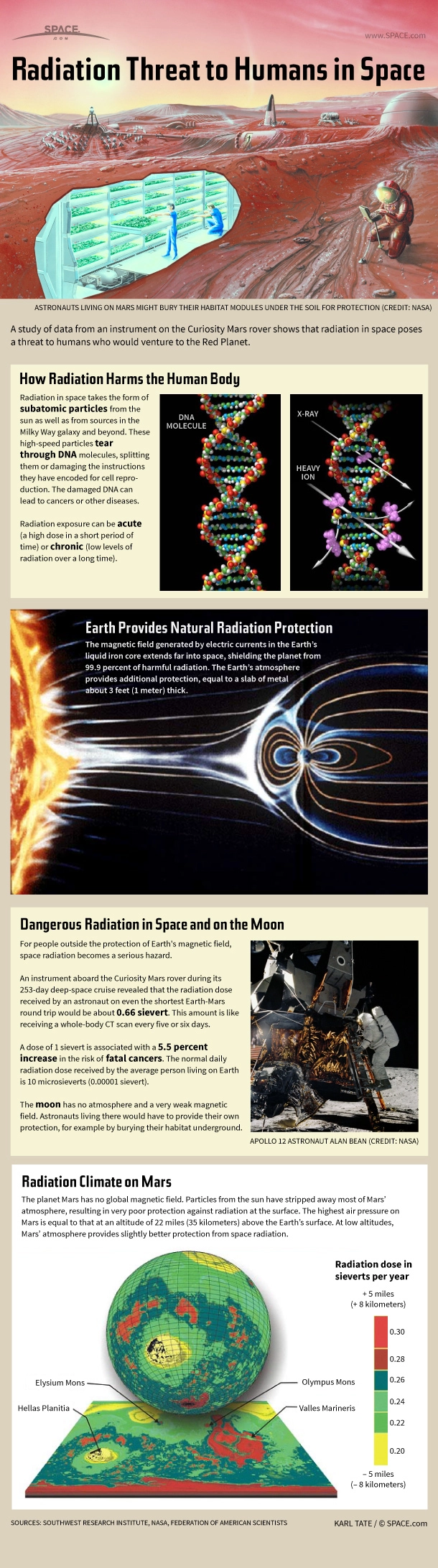
WASHINGTON -- The 30 or so astronauts that NASA plans to send to space this year for construction of the International Space Station may face deadly doses of solar radiation when a period of intense space weather peaks in the coming months.

For that reason, the U.S. Occupational Safety and Health Administration officially classifies astronauts as "radiation workers," said Mark Weyland, project manager for Lockheed Martins space mission systems and services in Houston, Texas. Space radiation is more damaging to astronauts than radiation typically encountered by ground-based workers.

With construction of the space station about to ramp up this spring and a total of six missions planned for later this year, the increase in solar storms could mean trouble.

"If youre timing space station construction and the solar cycle, you couldnt have done a worse job," Weyland said.

A solar storm warning flag is now flying high, scientists said last week during a special session on space weather, during the annual meeting of the American Association for the Advancement of Science in Washington, D.C.

Things are "heating up," said Ernest Hildner, head of the Space Environment Center in Boulder, Colorado. The center is an arm of the governments National Oceanic and Atmospheric Administration (NOAA).

The sun is expected to reach a fever pitch of activity later in the year, part of an 11-year solar cycle that began in the fall of 1996.

"We originally said March 2000 was going to be the maximum. Now it looks as though its going to be a little late," Hildner said.

For that reason, chances are high that spacewalks may be shortened or scrapped altogether to protect astronauts' lives. If solar blasts are strong enough, astronauts may take cover in more heavily shielded locations of the shuttle or space station, or even come home at the earliest opportunity.

Of all the risks encountered by astronauts, radiation-induced cancers remain an issue long after landing, Weyland said. He recalled one astronaut felt like a walking "time bomb" because of exposure to space radiation.

As for any documented cases of cancer due to a persons space voyaging, Weyland said that the astronaut population is still too young and too small to obtain valid statistical data.

On Earth, things can also get a little bumpy from solar storms too.

When it belches out solar flares, intense but temporary blasts of energy also can strike Earths protective magnetic field that cocoons our planet. Powerful particles that spurt from the sun can cripple satellites and disrupt electric power grids on Earth.

John Kappenman, division manager for Metatech in Duluth, Minnesota, said that geomagnetically induced currents have rained down from space, energized by solar storms. Metatech is now working with power companies around the world to better manage the effects stemming from space weather phenomena. While each power grid is unique, advance planning and early warning can help regulate voltages, even assure that power reserves might be at the ready in case of solar storm-caused outages, Kappenman said.

"In the past, power systems have been blind-sided by these big storm events," he said.

In March 1989, in less than 90 seconds, a powerful solar storm knocked out electrical power grids in Quebec, Canada, leaving 6 million people in the dark. That same blast also fried the innards of a nuclear power plant transformer in New Jersey, Kappenman said.

Solar storms can have continent-wide footprints, he said, and should be seen as a "planetary problem."

Spacecraft are now positioned to help provide up to an hours worth of early warning time on nasty space storms en route to Earth, NOAAs Hildner said. To help communicate space weather effects, NOAA last November rolled out a set of space weather warning scales, similar to hurricane, tornado and earthquake scales.

Getting to know the astronomical antics of Earths sun is becoming all the more critical as society becomes more dependent on satellites.

"When people make a deposit at the bank, or flip the electric light switch, or turn on the TV, they want the service to be there," Hildner said. "So the operators of the systems delivering those services have to be very aware of space weather."


Rino 120 GPS/GMRS Radio
$239.00
Explore More


Site Map | News | SpaceFlight | Science | Technology | Entertainment | SpaceViews | NightSky | Ad Astra | SETI | Hot Topics
Image Galleries | Videos | Reader Favorites | Image of the Day | Amazing Images | Wallpapers | Games | Community
about us | FREE Email Newsletter | message boards | register at SPACE.com | contact us | advertise with us | terms & conditions | privacy statement
DMCA/Copyright
  What is This?