





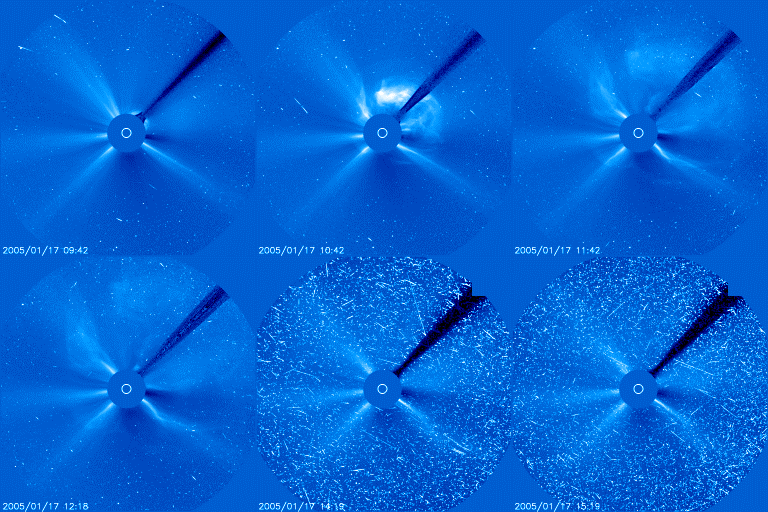
A large sunspot has been the site of several major eruptions in recent days, including one Thursday that was the largest of the series. Charged particles from the events have been hammering orbital spacecraft.
The storms caused minor glitches on the Sun-watching SOHO spacecraft and forced scientists to put two of its instruments into "safe mode," not unlike an electronic nap.
The sunspot group is "one of the most flaring regions of the last few years," said Bernhard Fleck, SOHO Project Scientist with the European Space Agency (ESA).
Sunspots are regions of intense magnetic energy, cooler than the surrounding solar surface. They're a bit like corks in a shaken bottle of champagne, and when they cut loose, radiation and matter are flung into space. Flares of visible light and X-rays are rated M for medium and X for strong, with an accompanying number that signifies further intensity.
The sunspot group, numbered 720, has delivered 15 M-class flares and five X-class flares. At around 2 a.m. ET Thursday, it unleashed an X7, one of the most intense measured in recent years.
"This activity is significant," said NOAA space weather forecaster Bill Murtagh. "However, it is considerably less intense than the activity observed during the 'Halloween Storms' of 2003."
The 2003 rampage, which included 10 X-class flares, knocked out two Earth-orbiting satellites and even crippled an instrument aboard a Mars orbiter.
Some flares are accompanied by coronal mass ejections (CMEs), which are clouds of charged subatomic particles that race outward at millions of miles per hour. They can damage satellites and occasionally trip power grids on Earth. No serious effects have been attributed to this month's storms. But scientists are on watch.
"Even before the peak of the flare, energetic protons were pummeling SOHO as well as geostationary spacecraft around Earth," Fleck said.
SOHO (Solar and Heliospheric Observatory) is run by ESA and NASA. It and the geostationary satellites orbit much higher than many other satellite and are more directly exposed to storms.


SOHO uses stars to guide it and maintain its attitude. In the past, loss of a guide star could throw the probe into an emergency. A software upgrade was done in 1999 after such a problem.
"With the improved software, several stars are tracked at the same time, and losing the primary one is no big deal as long as there are more stars left to track," Fleck said. Good thing, because these latest tempests have proved challenging.
"During the first few hours of the storm, four stars were lost," Fleck said. Two of SOHO's instruments were manually put in safe mode by turning down high voltages, he added.
Residents of the far north have enjoyed fantastic displays of the Northern Lights during the storm series. The aurora, as they are also known, are triggered when the solar storms hit Earth's protective magnetosphere, causing charged particles to stream into the upper atmosphere, where they excite molecules into glowing.
The residents of the International Space Station are relatively safe from most solar storms, because they orbit inside the planet's protective magnetosphere.
In general, the Sun is near a minimum of activity in a roughly 11-year cycle. But sunspots, flares and eruptions can occur anytime during the cycle. The storminess is likely to subside in coming days as the sunspot rotates to the back side of the Sun.
- Sun Cam
- Aurora Meter
- What is the Aurora?
- Anatomy of the Sun
- Best Sun Pictures Ever
| About the Sun The Sun makes up 99.86 percent of the solar system's mass and provides the energy that both sustains and endangers us. |
About the Sun The Sun makes up 99.86 percent of the solar system's mass and provides the energy that both sustains and endangers us. |
About the Sun | The Sun makes up 99.86 percent of the solar system's mass and provides the energy that both sustains and endangers us. |
| About the Sun The Sun makes up 99.86 percent of the solar system's mass and provides the energy that both sustains and endangers us. |
About the Sun | The Sun makes up 99.86 percent of the solar system's mass and provides the energy that both sustains and endangers us. |
|
| About the Sun | |||
The Sun makes up 99.86 percent of the solar system's mass and provides the energy that both sustains and endangers us. |

Scientists estimate that it takes a few hundred thousand years for photons, the basic units of light, to escape the Sun's core and reach the surface. They arrive at Earth about 8-and-a-half minutes later.
If you stood on the Sun, its gravity would make you feel 38 times more heavy than you do on Earth. We don't recommend trying.


Starry Night software brings the universe to your desktop. Map the sky from your location, or just sit back and let the cosmos come to you.

