





TheEuropean Space Agency (ESA) is looking to amateur skywatchersfor help tracking its Rosetta spacecraft, a comet-hunting probe set to swingpast Earth next week.
Rosetta– and its attached lander Philae – is expected to fly by our planeton March 4, though ESA officials expect the spacecraft will be visible viatelescopes and binoculars as soon as Feb. 26. and haveannounced a photography contest dubbed “RossettaUp Close” for homegrown astronomers hoping to catch the spacecraft in theircamera crosshairs.
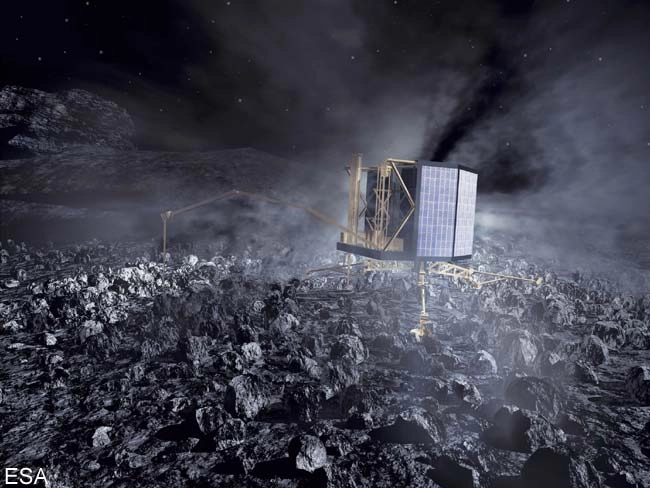
Launched inMarch 2004, Rosetta has spent about one year in space – about one-tenthof its ultimate journey – playing catch-up to the Comet 67P/Churyumov-Gerasimenko. Rosetta itself is bound to orbit thecomet and study the object as it nears the Sun and begins to outgas material.Later, the Philae lander is designed to harpoon the comet and anchor itselfto the surface for further study.
It appearsthe best view for Rosetta fans – weather providing – will be in Mexico. Thecomet probe will fly over the region as it makes its closest approach to Earthat about 5:10 p.m. EST (2210 GMT) coming within 1,180 miles (1,900 kilometers).
Because ofits current trajectory, the Rosetta-Philae spacecraftcombo should appear from a patch of sky between the constellations Leo and Sextans.
Whileobservers in Europe are not expected to beable to spot Rosetta with the naked eye, they may be able to use video andphoto imaging together with telescopes to catch the approaching spacecraft. Theprobe’s high gain antenna and solar panels, which extend out to 104 feet(32 meters), may also be visible via imaging equipment.
Rosettawill not be silent as it swings past Earth during the upcoming flyby maneuver.Just a few hours before the spacecraft makes its closest approach, the probewill be pointed toward the moon in order to use the natural satellites tocalibrate its onboard instruments.
After theflyby, two navigation cameras will be switched on to check Rosetta’s asteroidtracking ability using the moon as a ‘dummy’ asteroid. They will beused to verify Rosetta’s position once the spacecraft drifts past twoasteroids, Steins in September 2008 and Lutetia inJuly 2010.
After itsMarch 4 approach, Rosetta will move faster as it heads west on to its nextplanetary encounter, a flyby with the planet Mars on Feb. 27, 2007. Followingthat Mars boost, the probe will return to swing past Earth twice more to buildup enough acceleration to reach its target comet in 2014.
Observershoping to learn more about ESA’s “RosettaUp Close” contest should visit the spaceagency’s website herefor details as they become available.
