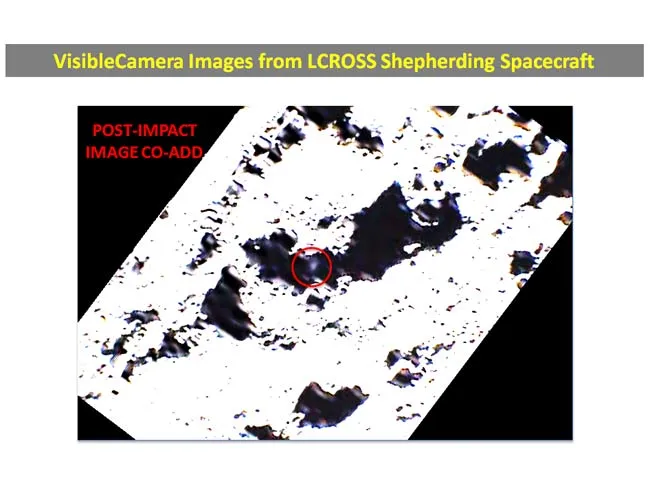
NASA scientists have finally seen in their data a debris plume createdby the impact of a moon probe last week.
The faint plume was seen in the data from the engineeredcrash one week after the impactof the LCROSS probe.
Scientists are hoping that analysis of the plume will showsigns of water ice ejected from the probe'starget crater, named Cabeus, at the lunar south pole.
The debris plume, created by the probe's Centaur stagerocket, was captured by the LCROSS ultraviolet/visible and near infra-redspectrometer. Its signature was faint, but distinct.
"There is a clear indication of a plume of vapor andfine debris," said Anthony Colaprete, LCROSS principal investigator andproject scientist.
The magnitude, form, and visibility of the debris plume addadditional information about the concentrations and state of the material atthe impact site.
?Within the range of model predictions we made, the ejectabrightness appears to be at the low end of our predictions and this may be aclue to the properties of the material the Centaur impacted," Colapretesaid.
The LCROSS spacecraft also captured the Centaur impact flashin both mid-infrared (MIR) thermal cameras over a couple of seconds. Thetemperature of the flash provides valuable information about the composition ofthe material at the impact site.
LCROSS also captured emissions and absorption spectra acrossthe flash using an ultraviolet/visible spectrometer. Different materialsrelease or absorb energy at specific wavelengths that are measurable by thespectrometers.
With the spacecraft returning data until virtually the lastsecond, the thermal and near-infrared cameras captured excellent images of theCentaur impact crater at a resolution of less than 6.5 feet (2 m). The imagesindicate that the crater was about 92 feet (28 m) wide.
"The images of the floor of Cabeus are exciting,"Colaprete said. "Being able to image the Centaur crater helps usreconstruct the impact process, which in turn helps us understand theobservations of the flash and ejecta plume."
The LCROSS team will continue combing through and examiningthe probe's data in the coming weeks to see if they can find signs of water ice.
"We are blown away by the data returned,"Colaprete said. "The team is working hard on the analysis and the dataappear to be of very high quality.?
Water has alreadybeen detected in small quantities all over the lunar surface, bound to theparticles of dirt that coat the moon.
And evidence from other spacecraft suggests there is water ice in permanently shadowed craters like Cabeus.
- Video - Last Moments of LCROSS - NASA Probes Crash Into Moon
- KAPOW! NASA Smacks the Moon in Search for Water Ice
- The Greatest Lunar Crashes Ever