

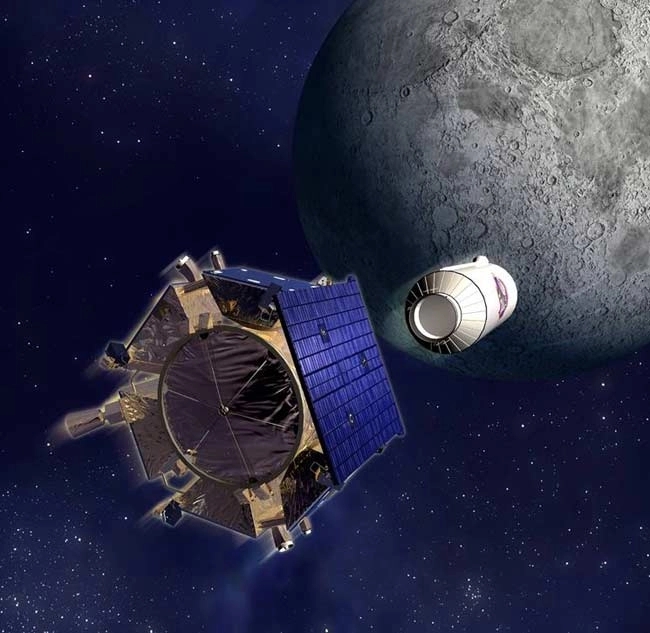
NASA's latest lunar probe looks to grab the spotlight next month when it
takes a two-part sledgehammer to the moon, but it's hardly the first space
mission to set a planned collision course for destruction.
The history of space exploration includes many spacecraft that intentionally
impacted on the moon or other solar system bodies. Some simply went out in
a blaze of glory upon completion of their primary mission. For others such as
Deep Impact in 2005 and NASA's current LCROSS
mission, slamming into a celestial body represented the highlight of their
existence.
Never mind the accidental graveyards for generations of robotic
explorers that tried for the soft landings. Here SPACE.com focuses on the
willful participants in an ongoing space demolition derby – all in the name of
science, of course.
Luna 2 became the first spacecraft to impact on the surface of
Earth's moon on Sept. 13, 1959, and gave the Soviet Union bragging rights over
the United States. The third stage of Luna 2's rocket also smashed into the
lunar surface just 30 minutes later.
Ranger 4 represented a U.S. comeback attempt in lunar
exploration on April 26, 1962. The spacecraft intended to snap photos all the
way down to its hard impact on the moon, but went off course due to a computer
failure and crashed on the far side of the moon. Successors in the form of
Ranger 6, 7, 8 and 9 had better luck hitting their designated lunar targets in
1964 and 1965.
Venera 3 followed up the Soviet Union's coup in
space exploration by becoming the first spacecraft to impact the surface of
another planet, on March 1, 1966. However, communications failed before any
planetary data could be transmitted. Later Venera missions ended up crushed in
the thick atmosphere of Venus before reaching the ground, or went in for softer
landings.
Lunar Orbiter 1 capped its lunar survey mission on Oct. 29,
1966, when NASA engineers ordered the spacecraft to dive into the moon. A
similar fate awaited follow up missions in the form of Lunar Orbiter 2, 3, 4,
and 5 in 1966 and 1967, but they did the job of mapping the lunar surface and
paving the way for the manned Apollo missions.
Apollo missions by the United States didn't just land the
first men on the moon starting in 1969. They also gave NASA the opportunity to measure
man-made impacts on the moon by crashing empty stages of Apollo lunar modules
and Saturn rockets into the surface.
Pioneer Venus Multiprobe sent one large U.S. probe and three smaller versions diving toward different regions of Venus on Dec. 9, 1978.
One probe aimed at the day side of the planet managed to keep transmitting
radio signals back after impact for just over an hour.
Lunar Prospector struck pay dirt by diving into a crater on
July 31, 1999, after successfully detecting large amounts of hydrogen at the
moon's poles. But Earth observers hoping for a sign of impact ended up
disappointed.
Galileo headed in for a Jupiter impact on Sept. 21, 2003, and
marked the grand finale to a NASA mission spanning more than a decade. The
spacecraft's suicide dive ended in disintegration at high altitude within the
gas giant's turbulent atmosphere.
Deep Impact created its own big bang spectacular on July 4,
2005 by slamming an impactor probe into the comet Tempel 1. The much anticipated
smashup left a stadium-sized crater and flung tons of debris into space as the
Deep Impact mothership snapped photos. NASA scientists later dug through the
scientific data and found the first evidence of water ice on the outside of a
comet.
Smart-1 kicked off a fresh round of manmade lunar impacts on
Sept. 3, 2006, but this time left Europe's calling card for the moon. The
orbiter went out with a bang to provide a show for watchful astronomers back on
Earth, and also created a crater estimated between 16 feet and 33 feet across.
Chandrayaan-1 helped inaugurate the new space race by
releasing an impactor for a suicide nosedive into the lunar surface on Nov. 14,
2008. India prepared for the occasion by painting miniature Indian national
flags painted on four sides of the impact probe, meant to commemorate the birth
of the country's first prime minister, Jawaharlal Nehru.
Chang'e-1 ended China's first lunar mission by
cratering itself on the moon's southern side on March 1, 2009. Chinese
officials decided upon the crash course as a dry run for a possible moon
landing in the future, after the orbiter spent a year mapping the lunar surface
and studying its space environment.
Kaguya struck
the near side of the moon on June 10, 2009, at the end of life for Japan's first lunar orbiter. Earth observers spotted the flash of the impact, and
scientists had hoped to examine debris kicked up by the event. Kaguya (also
known as SELENE) deliberately aimed for a cratered highland area of the moon
where Europe's Smart 1 had crashed in 2006.
Now NASA's LCROSS mission plans to shake the moon twice in
October when it aims for a south pole crater. A two-ton Centaur rocket stage is
slated to first impact in the crater, and kick up an estimated 1,000 metric tons of debris that scientists can analyze for evidence of water ice.
A smaller lower stage will follow up its big brother and slam into a
different spot. NASA scientists plan watch the event with the Lunar
Reconnaissance Orbiter, as well as the newly refurbished Hubble Space
Telescope and other observatories.
All this physical bashing may sound hard on the moon and other solar
system bodies. But scientists know that the solar system itself has a long history
of violence, as tons of rock, ice and other debris continually slam into
planets and moons on a regular basis.
By comparison, LCROSS and its predecessors probably represent loving
pats.
Correction: The amount of debris expected to be kicked up by the LCROSS Centaur rocket stage impact has been corrected.