





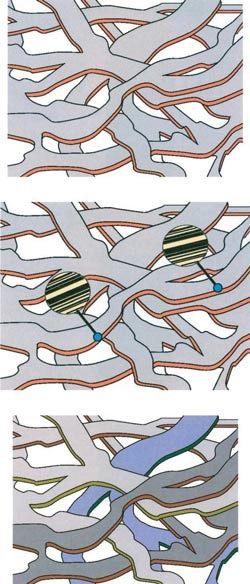
Oneof the greatest mysteries about the origin of life is how the necessaryingredients consistently came together in a workable way. On a planet full ofraw chemical materials, what happy accident of nature led to the first tinyglimmer of life?
ToAlexander Graham Cairns-Smith, that glimmer may owe something to the sparkle ofa crystal.
Cairns-Smith,an organic chemist at the University of Glasgow, sees a significantrelationship between the structure of DNA molecules and the structure ofcertain kinds of mineral crystals. He says that while patterned structures thatreplicate themselves are common in the inorganic world ofcrystals, it is a rare quality in the organic world — DNAand RNA are the only organic molecules we know of that strongly exhibit thischaracteristic.?
Thefour bases thathelp make up the DNA molecule — adenine, cytosine, guanine, and thymine — do not repeatendlessly in strict order (such as ACGTACGTACGT?). Instead, the pattern is varied,like a barcode. This variability in DNA leads to the differences betweenorganisms, and the copying of such complex sequences is the basis of heredity. Cairns-Smithsees this ability to print off reliable copies of sequences as an important pointof similarity between certain kinds of inorganic crystals and DNA.?
"Oneof the miracles of life, to my mind, is the accuracy with which DNA gets itselfreplicated in the cell," he says. "It has to be that unbelievablyaccurate, otherwise we'd all die out in no time."
Life'sFirst Barcode?
In1949, the Irish scientist J.D. Bernal suggested that clay minerals may have createda meeting place for life's first molecules. Such a scenario could explain howthe randomly dispersed molecules of life managed to come together in thediffuse primordial soup.
Cairns-Smith'sidea takes Bernal's theory a step further. In his view, claymineral layers not only attracted certain chemicals from the environment totheir surfaces, the mineral layers also acted as the first genetic informationcarriers, much as the base pairs in DNA do today.
"Theobjects that I'm particularly interested in are mixed-layered crystals, inwhich the crystal structure consists of beautifully formed layers packed on topof each other, but with an arbitrary sequence," says Cairns-Smith. "Inthat respect, they're like a DNA molecule, which has base pairs, littleplatelets inside it which are stacked on top of each other. It is the sequenceof this stacking which creates the information."
Cairns-Smithdoesn't think the clay mineral crystals were "alive" anymore than aDNA sample is thought to be alive. Instead, by acting as the first geneticmaterials for early life, clay mineral crystals created a link between theworlds of inorganic and organic chemistry.
Atsome point, life launched free of its inorganic genetic origins — the organicsubstances that evolved from chemical interactions on the mineral layers becamestable enough to live apart from their birthplace, and complex enough toreplicate themselves into the future.
Somemineral layer combinations probably worked better than others when it came to marshallingthe organic molecules that were to eventually become genetic materials. One ofhis favorite contenders for life's early mineral template is authigenicchlorite, which can create complicated shapes that resemble brussels sprouts. Suchchlorite crystals growing inside sandstone often coat the sand grains and donot block the flow of solutions within the rock — a potentially importantquality for the very first evolving systems. However, rather than oneparticular mineral layer sequence leading to life, Cairns-Smith thinks manydifferent mixed layer structures might have contributed to life's evolution.?
Cairns-Smithfirst came up with his theory in the 1960s, and he has promoted it in severalbooks and articles. Some scientists find the idea intriguing, but othersdiscount it because life today shows no evidence of having inorganic origins. Mostscientists who work on the problem of life's origin instead focus on how simplesugars, amino acids, and other organic chemicals came together to form nucleicacids and proteins.
Cairns-Smiththinks such a chain of events was improbable on the early Earth — the nucleicacid and protein system of life is too complex to have sprung outright fromsimple ingredients. Even the RNA world hypothesis, which envisions RNA playing dualroles that today are carried out by DNA and proteins, is a relatively advancedand sophisticated process.?
"Asimpler kind of evolution came first, and then what are now the molecules oflife came to be produced in a consistent way," says Cairns-Smith. "Ofcourse there was no foresight here, but as soon as an evolutionary process wasunderway, the world would have changed and nature would have had a new set oftoys to play with."?
Ifcrystals provide the order life needs to arise, that has implications for the possibilityfor lifebeyond Earth. Mineral crystals should be common on rocky worlds, even if thoseplanets have chemical environments quite different from our own. IfCairns-Smith's theory is correct, then the spark of life may be shimmering oncrystal surfaces throughout the universe.