





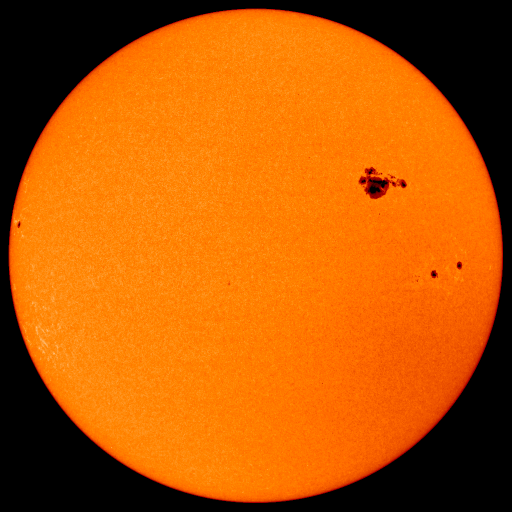
Any astronomer will tell you that the Sun is unpredictable. But on Jan. 20, 2005 it was dangerously so, leaving scientists to rework theories of how space storms operate and showing that interplanetary space travel will be a deadly serious business.
In new studies presented today, researchers detailed a solar outburst that shocked Earth with the highest dose of radiation measured in five decades.
The tempest arrived frighteningly fast.
Other solar outbursts have provided more dramatic pictures, more threatening X-ray flares, and tremendous coronal mass ejections of hot gas that arrive several hours later. But the solar event at 2 a.m. ET on that January morning created an intense burst of energetic protons that, surprisingly, tripped radiation monitors all over the planet within moments.
"This flare produced the largest solar radiation signal on the ground in nearly 50 years," said Richard Mewaldt of the California Institute of Technology. "But we were really surprised when we saw how fast the particles reached their peak intensity and arrived at Earth."


Mewaldt is a co-investigator on NASA's Advanced Composition Explorer (ACE) spacecraft, which monitored the event. Several studies on the flare are being presented this week at a meeting of the American Geophysical Union (AGU) New Orleans.
The raging proton storm peaked in 15 minutes. Normally, the most intense part of a proton event takes two hours or longer to build up.
"That's important because it's too fast to respond with much warning to astronauts or spacecraft that might be outside Earth's protective magnetosphere," Mewaldt said. "In addition to monitoring the Sun, we need to develop the ability to predict flares in advance if we are going to send humans to explore our solar system."
Normally, officials with NOAA's Space Environment Center notify NASA and satellite operators when a storm is en route. Residents of the International Space Station can take cover in a well shielded section of the ship. Managers of power systems on Earth can avoid major grid shifts until the storm passes. Some satellites are placed into modes of reduced operation to avoid electrical shorts that have destroyed craft in the past.
Other researchers have previously said that before humans can be sent to Mars, an interplanetary radiation monitoring system will have to be installed.
Scientists are now scratching their heads over the oddity of this eruption.
"Since about 1990, we've believed proton storms at Earth are caused by shock waves in the inner solar system as coronal mass ejections plow through interplanetary space," said Professor Robert Lin of the University of California at Berkeley. "But the protons from this event may have come from the Sun itself, which is very confusing."
Lin is principal investigator for the Reuven Ramaty High Energy Solar Spectroscopic Imager (RHESSI) satellite.
Flares emanate from sunspot groups, regions of the Sun where intense magnetic energy caps upwelling solar material, creating cooler, darker spots. The surprising January flare came on the heels of a series of other very large but otherwise normal flares from the same sunspot group. Scientists can't say why the fifth event was so unusual.
"It means we really don't understand how the Sun works," Lin said.
- Live SunCams
- Space Weather: FAQ
- Speed Limit Found For Solar Storms
- The Great Storm: Solar Tempest of 1859 Revealed
- Scientists Clueless over Sun's Effect on Earth
- Solar Surprise: Electrified Wind Has Deep Origins
- Top 10 Sun Images from SOHO
