


This story was updated at 5:45 p.m. ET.
A small meteorite fell from the sky and crashed through the roof of a doctor's office in Virginia, but luckily no one was hit, experts say.
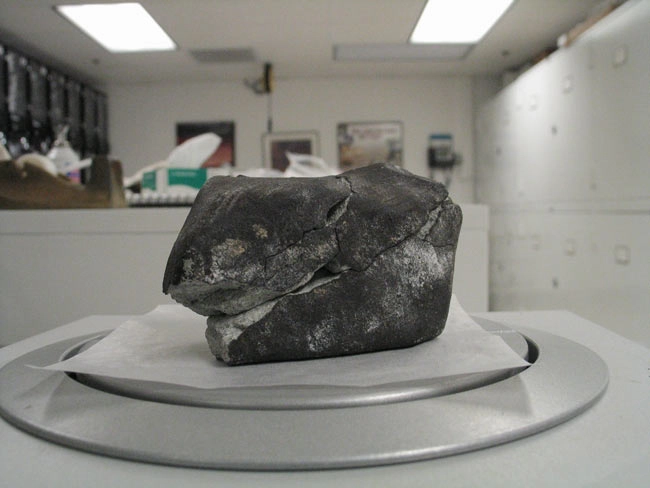
The half-pound meteorite struck the Lorton, Va.-based office of Dr. Frank Ciampi, a general practice physician, on Monday evening while he was on the second floor of his two-story building.
"It went through the roof. It through one wall partition and then passed through a particle board ceiling into the floor of an examination room," said Linda Welzenbach, manager of the meteorite collection at the Smithsonian National Museum of Natural History, which confirmed that the object was indeed a meteorite from outer space. "It's not really big. It's about the size of your fist."
It may be small, but the space rock packed a big wallop when it struck the doctor's office at up to 200 mph, Welzenbach told SPACE.com. It broke apart when it hit the concrete floor of the examination room, she added.
Witnesses described the crash as sounding like a bookshelf falling over, she added. Ciampi's practice in Lorton is about 14 miles south of the museum, which is in Washington, D.C.
"Apparently, it was quite loud," Welzenbach said.
No one in the office was hurt when the space rock fell. The meteorite split into several pieces when it hit the ground floor, Welzenbach said. But many people witnessed the brilliant fireball created by the space rock as it streaked through the Earth's atmosphere, she added.
A receptionist working in the office is married to a geologist, who recognized the meteorite for what it was. The meteorite was then carried by courier to the museum for confirmation, courtesy of a local TV news station, Welzenbach said.
Welzenbach said the meteorite is a chondrite, typical of most space rocks that fall to Earth. It is also a beautiful example of a meteorite, she added.
"It's pretty, it's very fresh," added. "It's a shame that it broke on impact."
The meteorite is only the fourth reported to fall in Virginia. The first documented crash in the state was reported in 1878, with the most recent occurring in 1924, Welzenbach said.
The meteorite and its fragments may eventually be donated to the Smithsonian's collection, she added.
