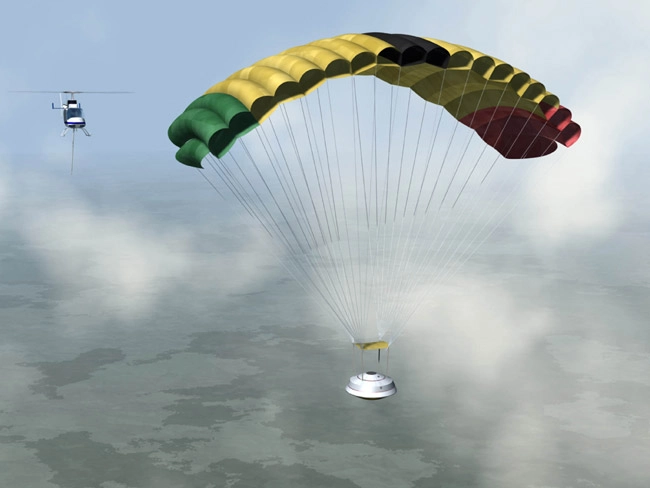
DUGWAY PROVING GROUND, UTAH - Ground teams are primed and ready for a spectacular air show here as the Genesis sample return capsule speeds its way through the Earth's atmosphere today and is snared in midair over remote desert landscape.
NASA's Genesis spacecraft is bringing back particles of solar wind collected by ultra-pure wafers of gold, sapphire, silicon and diamond carried onboard the deep space probe.
"All systems are go. We're doing quite well and on our way to Earth," said Don Sevilla, Genesis payload recovery lead from the Jet Propulsion Laboratory (JPL) in Pasadena, California. The spacecraft was accelerating en route to Earth and will dive into the atmosphere at about 25,000 miles per hour, he said during a Tuesday press briefing here.
At that speed, the 450-pound sample return capsule carries with it the same kinetic energy as a 4.5 million pound freight train slicing into the air at 80 miles per hour, said Bob Corwin, Genesis capsule recovery team chief from Lockheed Martin, designer and builder of the spacecraft.
"You can see the job the atmosphere has to do in slowing the capsule down to the point where we can deploy parachutes," Corwin said.
No take two
The Genesis return sample capsule begin the final plunge at roughly 8:55 a.m. Pacific Daylight Time (11:55 a.m. ET) over northern Oregon, experiencing peak heating conditions as it decelerates near the Oregon/Nevada border en route to the U.S. Air Force's Utah Test and Training Range (UTTR).
Helicopter teams are practiced and prepared to attempt midair capture of the Genesis sample-carrying container as its glides high over the desert terrain under a parachute-like "wing" called a parafoil.
"Both the pilots and crews are ready to go," said Cliff Fleming, pilot of the Genesis primary capture helicopter from South Coast Helicopters of Santa Ana, California.
Fleming said that two retrieval helicopters are ready to make multiple tries at snaring the capsule in midair -- from roughly 9,000-foot altitude down to just 500 feet above the ground.
"We feel pretty confident," Fleming said. "What's hard about it...it's the pressure. This is a one time chance and there's no take two."
One atom at a time
Purpose of the midair retrieval is to avoid a ground impact that could well shatter the delicate wafers that hold the solar particles. Those wafers have been exposed for over two years in space. They are likely pinged and pitted by micrometeorites, making them all the more fragile, JPL's Sevilla said.
If the sample return canister does hit the ground, it's not a loss of the mission. However, the resulting impact would turn the sample container into, basically, "a can of glass," Sevilla said, making it difficult to extract Genesis science data.
"It's not a mission failure, but they'll be hits on the science side if we end up parachuting to the ground," noted Don Burnett, Genesis principal investigator from the California Institute of Technology.
Genesis has collected solar material "one atom at a time," he told SPACE.com. Several major facilities have been established, dedicated to in-depth studies of the collected solar particles. In all there are roughly 15 laboratories around the world, he pointed out, getting ready to analyze the materials brought back to Earth by Genesis.
Let the science begin
Once the Genesis sample return capsule is snagged by helicopter, it is first lowered gently onto a ground-secured tarp. At that location, personnel will remove the parafoil for easy airlift of the Genesis canister to a specially fabricated cleanroom and work area at the Dugway Proving Ground.
Ground handlers are set to cut hinges that hold together the return capsule's backshell/heat shield segments, revealing the enclosed Genesis sample-carrying canister.
The canister is then purged with nitrogen, flushed of gases that have entered the canister during its fall through the upper atmosphere. In the next day or so, the canister will be lifted by crane and put into a container for truck transport, "and we're off to Houston and the science begins," Burnett said.
Pass the collection plates
A team of specialists at NASA's Johnson Space Center (JSC) in Houston, Texas will receive the Genesis sample container. At the space agency facility, "the cleanest cleanroom in the NASA system," is ready for use, said Carlton Allen, JSC's Astromaterials Curator.
Allen said what the Genesis sample canister collection plates have caught will be viewed for the first time early next week in the JSC ultra-cleanroom.
The spacecraft was launched on August 8, 2001, taking three months time to cruise to its solar particle sampling position nearly one million miles from Earth.
Genesis has been to a unique spot in space, Allen said. During two years of loitering at the Lagrange 1 point, the radiation flux, as well as micrometeorite hits the spacecraft has endured will be of great interest, he said.
"We ought to learn a great deal about what that part of the space environment is like...irregardless of what we're learning about the Sun," Allen said.
Valuable engineering data
David Lindstrom, Genesis program scientist at NASA Headquarters in Washington, D.C., said the probe's tour of duty in deep space and return to Earth also brings back valuable engineering data to help design future spacecraft.
Following the Genesis mission, NASA's Stardust mission will also drop into the Utah Test and Training Range in about 16 months time, hauling with it comet and interstellar dust particles.
"There's probably a lot more sample return missions down the road. Genesis is laying the groundwork for much of that," said Lockheed Martin's Corwin. "There's quite a lot going on here...a lot of firsts to Genesis, both from execution of the mission, as well as the science coming back," he said.
- Live Coverage and More Genesis News
- Detailed Map of Re-Entry