





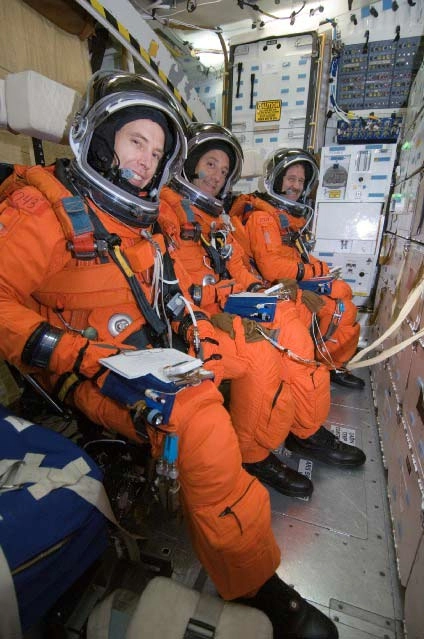
NASA's astronaut corps has long been a symbol of American exploration and drive, but as the agency turns 50 the cadre of U.S. space explorers faces some difficult challenges in the years to come.
With NASA's 50th anniversary approaching on Oct. 1, its astronauts today are looking ahead at the looming 2010 retirement of the agency's aging space shuttle fleet and at least a four-year gap before the replacement spaceship — the Orion Crew Exploration Vehicle — takes flight with spaceflyers aboard. There is even worry that NASA astronauts won't have rides to the International Space Station during the hiatus unless the agency gets a vital waiver to buy seats aboard Russian Soyuz spacecraft after 2011.
It's enough to give some veteran astronauts food for thought on what the future holds for them beyond the shuttle, while others remain committed to the long-duration missions that will be the only available rides until NASA renews manned lunar treks by 2020.
"One of the things that you're seeing now is exactly what happened with Apollo," said Roger Launius, a former NASA historian and senior curator with the Division of Space History at the Smithsonian Institution's National Air and Space Museum in Washington, D.C. "As people began to see that program wind down literally…astronauts were beginning to leave the corps."
NASA's Astronaut Office is doggedly working to preserve its base of experienced spaceflyers and planning to swell its ranks with a new group of up to 15 astronauts in summer 2009.
"We'll certainly have people retire as they get older, and they decide to go off and do another career. We'll see a lot of that happening," said four-time shuttle flyer Steve Lindsey, chief of NASA’s Astronaut Office. "What I don’t want to see is us hit 2010 and all of our experience walk out the door."
There are about 90 astronauts on NASA's flight roster today, with less than six still waiting for that first assignment to a space-bound crew, Lindsey told SPACE.com. Somewhere between 10 and 15 new astronauts may join up in the new class, though the actual number remains to be seen, he added.
"One of my objectives is to get everyone in the office flown by 2010," Lindsey said. "And my current projection is we're going to be easily able to do that."
The goal, he said, is to ensure NASA's astronaut corps is as experienced as possible before the shuttle fleet retires and ready to withstand the departure of retiring spaceflyers, yet still retain enough veterans to lead the incoming 2009 class of astronaut candidates.
"They said the astronaut office may decrease in size from 90 to about 60," said astronaut biographer Michael Cassutt, author of "Who's Who in Space." The drop, Cassutt added, would follow a similar pattern to that seen during the Apollo-shuttle transition.
Heavy decisions
While some short missions are expected during Orion test flights, the majority of post-shuttle spaceflights will be long-duration expeditions to the International Space Station and, ultimately, the moon. But the years of training for those flights, which include long trips to Russia and other countries, can be challenging for families at home.
"I think a lot of people in our office are looking into their hearts to see if they want to stay on, and if they stay on do they want to fly long duration missions," said astronaut Mike Fincke, who is training for his second six-month station flight as Expedition 18 commander this fall. "I know for me, that this is definitely where I want to be and hopefully I'll be able to get back in at the end of that long line and back up."
To make long-duration spaceflights more palatable, NASA is working with its international partners to streamline space station training wherever possible, Lindsey said. That includes assigning astronauts to prime crew slots before they've ever served on a backup team, then folding their backup training in as part of their primary mission preparations, he added.
"We've been able to reduce the training template, the amount of time from assignment to launch," Lindsey said, adding that the training flow should now typically run about 2 1/2 years.
But some veteran astronauts have already taken their leave, such as last month's retirement of teacher-astronaut Barbara Morgan and the May departure of spacewalker James Reilly, II, who left the corps after three spaceflights, five spacewalks and 13 years at NASA
"I had three excellent flights and three great teams," said Reilly, adding that NASA astronauts had a challenge ahead in crossing the gap between shuttle and Orion. "I look backward on that, and we had a lot more folks that needed to fly and I had done everything that I had pretty much thought I could do as an astronaut."
Echoes of the past
NASA's astronaut corps has faced gaps in U.S. spaceflights before, most notably between the Apollo era of the late 1960s and 1970s and the 1981 debut of the space shuttle Columbia.
"When you think of a whole cadre of people whose basic objective is to fly in space and do particularly useful work in space, as many of us did, that's a long time to wait around and spin your wheels," said former NASA astronaut Owen Garriott, who retired from spaceflight in 1986.
Garriott joined the agency as one of the first six scientist-spaceflyers in 1965, flew to the U.S. space station Skylab aboard an Apollo capsule in 1973, then worked and waited for 10 years before flying aboard the shuttle Columbia in 1983. During the gap between Apollo and shuttle, he took time off to teach and got involved in early development work for what would evolve into the International Space Station among other assignments.
"So I think that that might very well be what some of the current number of astronauts [will do]," Garriott said. "There's plenty of work to do. I'm sure NASA will assure them of that."
The real challenge for NASA, stressed Launius, will be to maintain the right balance of astronaut skills to meet demands for the fading shuttle program and rising Orion project, as well as the proper mix of veterans and new flyers.
The road ahead
NASA's astronaut corps has changed since the first seven U.S. spaceflyers were announced in April 1959. Its members have shifted from steely-eyed rocket test pilots to a diverse group of men, women, military pilots, engineers and scientists, and the trend will likely continue.
"It is going to change the culture in several ways. There will be much less emphasis in high performance piloting," said Cassutt, adding that the switch stems from NASA's move from a winged reusable spaceship to capsule craft.
Gone too is some of the perceived competition among today's astronauts, who during the shuttle era could expect ongoing launches as opposed to the limited number of Mercury, Gemini and Apollo flights earlier in the program, Cassutt said. And access to space is getting easier by the year.
"The system exists where you can write a check and go to space, you just have to pass the physical," said Cassutt. "In essence, you're seeing something that is a little bit like the end of an era."
Garriott is among the first to concede Cassutt's point. His grown 46-year-old son Richard, a multi-millionaire computer game developer, is paying $30 million to ride a Russian Soyuz spacecraft to the International Space Station under a deal brokered by the Virginia-based firm Space Adventures. Richard Garriottwill be the sixth private citizen to pay his way to the space station since 2001.
But despite the changing nature of the astronaut corps, it will likely retain the camaraderie and teamwork that has governed its tight-knit crews and their exploits, astronauts said.
"I really miss the people," Reilly said. "I look back on those 13 years as being the best 13 years of my life."
