


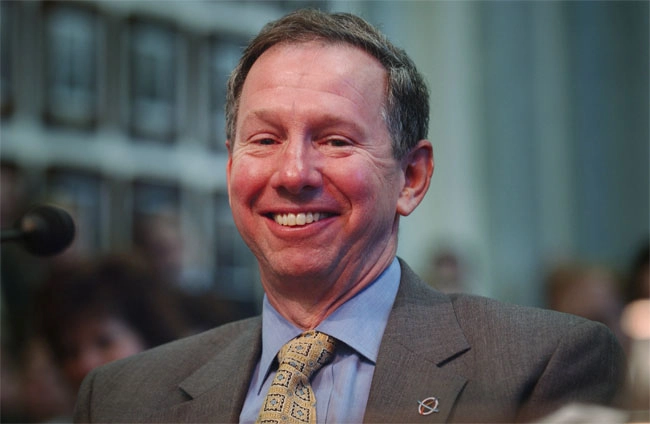
Mike Griffin's appointment as NASA administrator is encouraging to many astronomers and scientists, some of whom are concerned that basic research will be sacrificed in the new Bush vision for manned missions to the Moon and Mars. Astronomers in particular are eager for a reversal of the decision by former NASA Administrator Sean O'Keefe, Griffin's predecessor, to cancel a planned space shuttle mission to service the Hubble Space Telescope.
In testimony during his Senate confirmation hearing, Griffin said he would reconsider the Hubble decision after the space shuttle fleet returns successfully to flight status.
| BELOW NASA chiefs since 1958 |
"This is a guy who thinks like a scientist and an engineer and has had a lot of experience managing large, intractable organizations," said Robert Kirshner, a Harvard University professor and president of the American Astronomical Society. "It's really a good combination."
In a telephone interview, Kirshner said the AAS is encouraged by Griffin's appointment. "Instead of taking a dogmatic point of view," Kirshner said in reference to Hubble, "he's being very practical."
Many scientists hold Griffin in high regard and say his diverse background will serve him well in Washington.
"A scientific background is likely to increase his credibility in political circles," Howard McCurdy, a historian who has written several books about NASA, said in an e-mail interview. "He has plenty of experience with policymaking in Washington, which is a prime requirement for the job."
Putting astronauts on Mars, for example, will not be easy politically because it will require a political effort spanning multiple presidencies.
"He has worked at NASA before, so the agency and its political linkages will not be foreign to him," said Neil deGrasse Tyson, director of New York's Hayden Planetarium and a member of the president's Moon-to-Mars commission. "But this is not to undervalue the need for political dexterity when you need it. My hope and expectation is that public sentiment for NASA's programs will grow in a way that Griffin accrues the political capital he needs to sustain the vision."
Bob Park, a University of Maryland physicist and outspoken critic of human spaceflight as a means to conduct science, is less enthusiastic.
Griffin, Park said, "has clearly been picked to follow the president's 'vision,' and I have seen no indication that he is likely to go off on his own," Park said.
"The only good sign is that he has signaled a willingness to think about Hubble. We'll see," Park said in an e-mail. "My hope, as distinct from my expectation, is that he'll try to educate the president."
Jonathan Lunine, Professor of Planetary Sciences and of Physics, and chair of the Theoretical Astrophysics Program at the University of Arizona in Tucson, noted that Bush's vision was for "the Moon, Mars and beyond... three nouns there. That's my advice to Mike, don't forget the beyond."
Within the last 10 years the solar system has become a much more exciting and much more complex place, Lunine said. "Whatever is done in this exploration initiative, we can't forget the beyond part. We've seen the history of water on Mars...we see evidence that Venus had an Earth-like episode to it a long time ago. Titan, in terms of balance of physical processes, is most Earth-like in that regard but on very alien materials. How did it get that way? And Europa might harbor an ocean where there's life."
Wesley Huntress Jr., director of the Geophysical Laboratory at the Carnegie Institution of Washington, said Griffin needs little advice given his familiarity with the agency but added that he hopes Griffin can "reinvigorate NASA Headquarters and its centers with a renewed sense of leadership, competence, confidence and boldness more than anything else. Get rid of that debilitating fear-of-failure atmosphere that kind of suffuses the agency now."
For humans-to-Mars fans, Griffin looks like the right choice. Tyson said Griffin's professional pedigree resonates with the varied requirements of the White House directive. "The science, the engineering, the management, space industry, space entrepreneurs, the vision, the passion -- he's got it all," Tyson said. "If he succeeds, it won't be your daddy's NASA, but it will be the NASA this nation needs to redefine our future in space."
Nasa Administrators Since the Agency's Inception
By Sara Goudarzi
Special to SPACE.com
Thomas Keith Glennan - Serving from Aug. 19, 1958 to Jan. 20, 1961, Glennan was the first administrator of NASA and played an instrumental role in its organization from inception. He expanded NASA's infrastructure by incorporating several federal organizations involved in space exploration into the existing three major centers; Langley Aeronautical Laboratory, Ames Aeronautical Laboratory, and Lewis Flight Propulsion Laboratory. He created the Goddard Space Flight Center, and incorporated two lunar probes, several satellite programs, the Jet Propulsion Laboratory, and the Army Ballistic Missile Agency renamed as the Marshall Space Flight Center. Under his administration, NASA saw its first launch, Pioneer I, and several successive launches including Pioneer 4, the first United States lunar flyby.
James E. Webb - James Edwin Webb oversaw NASA operations from Feb. 14, 1961 to Oct. 7, 1968 as the second administrator. During his term, John Glenn became the first American to circle the Earth. He also directed and crafted the structure of one of NASA's most historical projects, the Apollo. It was during his administration in 1967, when the three crewmembers of the Apollo-Saturn 204 were killed during a simulation test in a flash fire on the launch pad at Kennedy Space Center.
Thomas O. Paine - Serving from March 21, 1969 to Sept. 15, 1970, Thomas O. Paine oversaw NASA through the first seven Apollo manned missions. Under his leadership, many automated spacecrafts were flown, 20 astronauts orbited the Earth and four men walked on the Moon (ultimately, 12 men trod the lunar surface).
James C. Fletcher - James Chipman Fletcher, was the administrator of NASA from April 27, 1971 to May 1, 1977 and oversaw the development of the Space Shuttle and the Viking program. During his term, three Skylab missions were flown, two Viking probes landed on Mars and the Voyager space probe, Hubble Space Telescope, and Apollo-Soyuz programs were approved.
He also served a second term from May 12, 1986 to April 8, 1989 with the clear goal of overseeing the recovery of NASA after the Space Shuttle Challenger tragedy on January 28, 1986 and made organizational changes to improve safety and reliability. Specifically, he was administrator when parts of the Shuttle were redesigned such as adding an astronaut egress capability, and oversaw the "return to flight" in September 29, 1988 when shuttle Discovery lifted off after nearly three years.
Robert A. Frosch, - Robert A. Frosch was NASA's administrator from June 21, 1977 until Jan. 20, 1981 and oversaw the testing of Enterprise, the first orbiter making its flight in the atmosphere on Aug. 12, 1977.
James M. Beggs - From July 10, 1981 to Dec. 4, 1985, James Montgomery Beggs was the administrator of NASA. During his administration, Space Shuttle Challenger carried the first woman and the first African American astronauts into space.
William R. Graham - William R. Graham served as the acting administrator from Dec. 4, 1985 until May 11, 1986. During his term, the Space Shuttle Challenger and its crew of seven were destroyed during its launch on January 28, 1986.
James C. Fletcher - May 12, 1986-April 8, 1989 (please see above)
Richard H. Truly - Former shuttle astronaut, Richard H. Truly served as administrator from May 14, 1989 to March 31, 1992. Under his administration, the Hubble space telescope and the Galileo spacecraft were launched. Galileo encountered both Earth and Venus on route to Jupiter and made a flyby of asteroid Gaspra in 1991.
Daniel S. Goldin - Serving from April 1, 1992 to Nov. 17, 2001, Daniel S. Goldin was the longest serving administrator at NASA. His famous "cheaper, faster, better" approach to space flight was clearly apparent in allocating some of the everyday space operations to the private sector.
During his term, the Russian and US astronauts met in orbit when the Space Shuttle Atlantis docked to the Russian MIR Space Station On June 7, 1995. Goldin started the "Origins" program focusing on understanding the evolution of the universe and Earth and searching for life on other planets. A proponent of Mars exploration, both robotic missions such as the Mars Pathfinder and human exploration research increased under his administration.
Daniel R. Mulville - Previously a Chief engineer at NASA, Daniel R. Mulville served as acting administrator from Nov. 19, 2001 to Dec. 21, 2001 before he became Associate Deputy Administrator to Sean O'Keefe in 2000.
Sean O'Keefe - Serving from Dec. 21, 2001 to February 11, 2005, Sean O'Keefe was administrator when Space Shuttle Columbia, STS-107 was lost upon reentry killing all seven of its crewmembers on Feb. 1, 2003. Under his administration, the Mars Odyssey orbited around Mars and gathered information on the composition of its surface.
Frederick D. Gregory - A former astronaut and test pilot, Frederick D. Gregory was the acting administrator from Feb. 20, 2005 until Mike Griffin took over. Gregory has been leading the space agency to "return to flight" after the Shuttle Columbia tragedy.
