





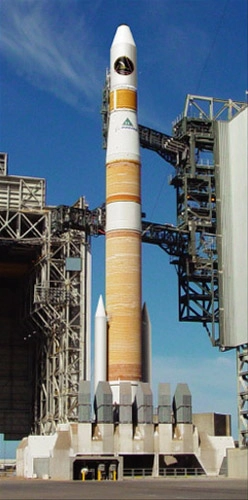
California'sdebut launch of the Boeing Delta 4 rocket is facing an extended delay --perhaps six weeks -- while engineers try to reconcile differing predictions ofsloshing fuel inside the booster during flight.
Launch dates earlier thisweek were scrapped to perform repairs on the cork insulator material thatserves as a thermal barrier around the rocket's main engine. Preparationsresumed for a Wednesday liftoff from Vandenberg Air Force Base only to behalted Tuesday because officials were worried about conflicting analyticalmodels about the launch.
Sophisticated computermodels that indicate how the rocket will operate during the flight disagree onthe potential severity of propellant sloshing in the second stage during anorbital coast period mid-way through the launch.
After separating from theDelta 4's first stage four minutes into flight, the second stage performs a10-minute firing of its RL10 engine to reach an initial parking orbit aroundEarth that is egg-shaped and stretches from 104 nautical miles at its lowestpoint to 1,196 miles at its highest.
The stage and the attachedpayload enter the 25-minute coast phase, flying southward over the Pacific andskirting the southern tip of South America to reach the orbit's high point. Thestage is placed in a slow rolling motion to keep thermal heating evenlydistributed across the vehicle during the coast. Small attitude control jetswill be active during this time, eventually performing the maneuver to stop therolling and to re-orient the stage for its next engine firing.
The second stage re-ignitesat about T+plus 40 minutes above the South Atlantic to accelerate into a highlyelliptical orbit of 601 by 20,308 nautical miles for deployment of the nationalsecurity spy satellite payload.
An earlier analytical modeldid not reveal any sloshing problems based on the launch sequence and therocket's trajectory. However, a newer simulation predicted the unwantedsloshing condition.
The time needed tounderstand and resolve the differences, including a full technical review andanalysis of the mission, will bump this launch out of Vandenberg's rocketlineup for the next month or more.
Officials are devisingplans to remove the classified National Reconnaissance Office satellite fromatop the Delta 4 rocket's Space Launch Complex-6 pad and place it in safestorage. The pad is located on the southern edge of Vandenberg, while a fewmiles to the north is the Space Launch Complex-4 where a massive Titan 4 rocketstands ready to loft another NRO cargo on October 19, sometime between 9 a.m.and 1 p.m. PDT (12-4 p.m. EDT; 1600-2000 GMT).
Overflight concerns dictatethat the costly Delta 4 payload be hauled off the rocket before the Titan 4 canthunder overhead on its southerly course to orbit. Military officials want toprotect the satellite from the possible threat, however minuscule, that theTitan could rain debris on the Delta pad in a launch failure.
Meanwhile, NASA intends toship its CloudSat and CALIPSO environmental satellites to the Space LaunchComplex-2 pad on North Vandenberg around October 10 for mating atop a Delta 2rocket. That dual-payload launch is scheduled for 3:01 a.m. PDT (6:01 a.m. EDT;1001 GMT) on October 26.
The NRO satellite for theDelta 4 mission will be brought back to SLC-6 and reunited with its rocket forliftoff no earlier than mid-November, the Air Force said.
How the much-delayed GOES-Ncivilian weather satellite fits into this evolving plan was not clearWednesday. That Delta 4 rocket at Florida's Cape Canaveral has been waiting tolaunch for months, but a variety of satellite and booster issues have postponedthe commercial mission. Boeing had envisioned flying the mission aroundNovember 5 -- one month after the Vandenberg Delta 4. The company has said itneeds about 30 days between Delta 4's for post-flight data review.
