





Thisstory is Chapter 6 in an 11-part series by Florida Today.
Michael Brieden bore badnews. Sixteen months after the Columbia accident, Brieden stood in a conferencecenter meeting room, a corporate amphitheater of sorts, in Ogden, Utah.
Surrounding him that day:Heavy hitters from NASA headquarters, the American aerospace industry, agencyfield centers, an independent oversight group and the Astronaut Office.
Brieden, then lead engineeron a project to develop wing panel repairs, was center stage. He got right tothe point.
There was no chance NASA,by return to flight, could develop a way to repair the type of severe damagethat doomed Columbia and its crew.
"I just laid the dirton the table, and that boiled up a conversation really quick," saidBrieden, 42. "So we had a big, energetic discussion on how come Briedencouldn't provide a good wrap in time for STS-114. And that just led me throughmy charts."
His PowerPoint presentationcovered all the facts.
Engineers had workedovertime on a promising concept: rigid composite carbon over-wraps that couldbe bolted onto wing panels. They performed as protective skins that could coverholes as big as a large pizza. But the earliest delivery date was late 2005,maybe 2006. That would stall NASA's first post-Columbia flight and completionof International Space Station construction.
The estimated cost wassignificant: More than $100 million to design and manufacture a full set forthe wing. There were operational challenge, too. Forty-four wraps -- one foreach unique wing panel -- would have to be built and hauled to the station tobe stowed for emergencies.
The killer was they mightnot even work.
The U-shaped wraps wouldfit over damaged panels like one taco shell over another. But they would jut upever so slightly from the wing. Even a minuscule rise, what engineers call a"step" from the outer mold line, would generate excessive heat duringre-entry.
The bolts holding a wrap inplace would melt. And the wrap itself would melt or fall off, exposing thedamaged panel beneath to temperatures up to 3,000 degrees. Hot gas wouldblowtorch through the wing. The shuttle would be ripped apart. Columbia allover again.
That day, June 9, 2004,Brieden recommended NASA put the concept on the back-burner and focus ontechniques for repairing small holes or cracks.
Columbia had been downed bya 1.7-pound chunk of foam insulation that broke free from the shuttle'sexternal tank, blasting a 6- to 10-inch hole in a wing panel. But an extensiveeffort to redesign the tank would preclude foam that big from shedding in thefuture. Even in a worst case, only small wing panel cracks -- or holes lessthan 4 inches in diameter -- might have to be fixed.
And other techniques wouldbe used to handle lesser damage.
Reaction varied.
At the end of the day, NASAleaders decided to make over-wraps a long-term research project. At least fornow, the agency acknowledged defeat: NASA could not fix Columbia-like damageany time soon.
"Nobody threw theirbadge down, and I don't think there was even a dissenting position,"Brieden said.
"I think there was arealization that we had worked extremely, extremely hard on trying to give thebest answer to the program that we could. And there was no doubt that we hadtapped every talent we could.
"We didn't give it upwithout a little sorrow ourselves."
HOUSTON: Managementpushes to find repair method
Shuttle Program DeputyManager Wayne Hale tried not to worry about the roller coaster of breakthroughsand setbacks.
At the start of the shuttleprogram, the best engineers in the world failed to figure out a way to haveastronauts repair heat shields in orbit.
"They actually gaveup," Hale said. "They didn't think it could be solved. Now we thinkwe're very close."
Even after the Columbiaaccident, some folks at NASA were skeptical it could be done in the short term.Technology might be better, but the shuttle and spacesuits were basically thesame. All told, not much had changed.
Except one thing. Resolve.
"You have to have thelaboratories; you have to do the tests," Hale said. "All that stuffcosts money, and at some point people say: 'We've done enough. We're not goingto spend any more money. We're just not getting there.' "
The message from thebosses: "Keep at it."
CAPE CANAVERAL:Astronauts ready to test repair options in space
Discovery commander EileenCollins was getting anxious.
Three months before launch,senior managers were still debating what repair techniques to test on the firstpost-Columbia mission -- the kind of decision normally made a year or moreearlier.
NASA had abandoned a methodfor patching wing-panel holes as large as the one that doomed Columbia becauseground tests showed it probably wouldn't work. A complex "goo gun"for thermal tile repairs wasn't ready to try on the flight.
Time for crew training wasrunning out.
"It is late,"Collins said on a February trip to Kennedy Space Center.
The crew opposed testingthe "goo gun," which was designed to fill dents or gouges in thermaltiles with heat-resistant material that would harden in place.
Already clad in cumbersomespacesuits, spacewalkers would have to strap on a bulky holding tank. Aheat-resistant red goo would mix inside the tank, then flow through a 5-foothose before it was squirted out of a rifle-like metal wand. Plus, the goo wasdifficult to apply. It didn't stick well to tiles. And it bubbled when mixed,creating voids that could weaken a repair patch.
"We are not going tofly it if it's not ready," astronaut Steve Robinson said at the time.
Managers decided to keepthings simple.
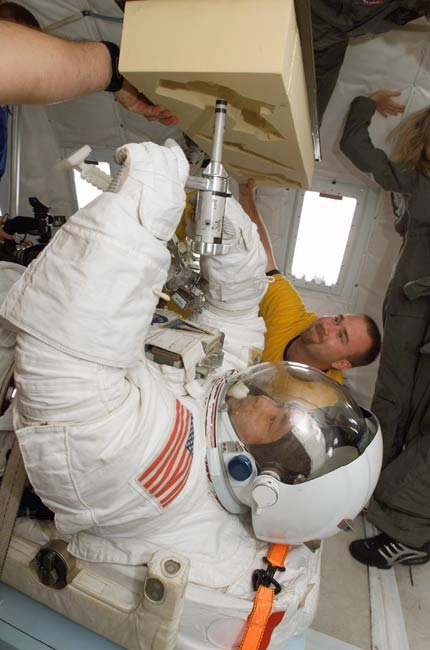
Side-by-side with Robinsonin the shuttle's cargo bay, Soichi Noguchi will coat damaged tiles, mounted ona sort of workbench, with a primer-like, heat-resistant material.
Dabbed on with a devicelike a liquid shoe polish dispenser, the "emittance wash" willincrease the amount of heat that damaged tiles could reject. Robinson will beworking with a caulk-gun and putty knife similar to those that can be bought atthe corner hardware store. He'll fill small wing-panel cracks with repairmaterial, then smooth the damaged area.
Inside Discovery, the twoalso will try a method for fixing wing holes up to 6 inches wide. They'll painta sealant around punctured panel samples and cover the holes with compositecarbon patches held in place by expanding bolts.
All of the samples will bebrought back to a Houston lab and run through a simulator to see if they canwithstand the intense heat of re-entry -- up to 3,000 degrees.
The goo guns won't betested in orbit. But two will be aboard Discovery just in case.
"It's like having anejection seat in a jet aircraft," Robinson said. "You don't plan touse it, but it is there."
HOUSTON: Hardware storeprovides simple tools for tile fix
James Reilly went to workin a dome-shaped vacuum chamber at Johnson Space Center, testing a new wingpanel repair technique that one day might save a shuttle crew.
Wearing a full-pressurespacesuit, the veteran astronaut squeezed a bead of heat-resistant adhesive outof a 9-inch caulk gun onto a palette. Then he took a standard putty knife andworked the substance into a small crack, making the surface as smooth as possible.
Sounds simple, likerepairing cracked fiberglass on a boat. And the tools are not sophisticated.
"It's pretty much thesame things you would go down to Home Depot and buy and use in the house to putspackling up," Reilly said. "That's what we started with.
"We just went down tothe local hardware store and bought a bunch of tools. And then we startedworking with them to see what we liked and what worked and what didn'twork."
Doing repairs in spaceposes unique problems.
First, the adhesive bubblesup in a vacuum, weakening the material and making it less likely to survive theintense heat of re-entry. The repair has to fill the entire crack smoothly. Thesubstance hardens fast and turns into a ceramic. Within a few minutes, it's toohard and stiff to work with. The repair "is a little bit of an art,"he said. But it works.
Wing panel samples thatReilly repaired survived tests in a NASA re-entry simulator. Astronauts one daymight actually have to use the technique. That's because tests since the accidenthave shown that cracks as small as one-15,000th of an inch -- about the widthof four stacked pieces of paper -- could allow hot gas to tear into the orbiteron the way to the landing strip.
"Hopefully, we neverhave to use it," Reilly said. "But everything that we've done up tothis point indicates that we can do it.
"And if I had to ridehome on it, there's not much choice. Give me a ride home."
Publishedunder license from FLORIDA TODAY. Copyright ? 2005 FLORIDA TODAY. No portion ofthis material may be reproduced in any way without the written consent of FLORIDA TODAY.
FloridaToday Special Report: NASA's Return to Shuttle Flight
Fixing NASA: Complete Coverage ofSpace Shuttle Return to Flight