


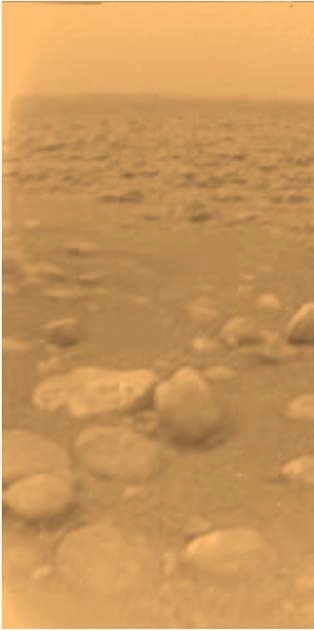
FRANKFURT, Germany (AP) -- The Huygens probe twisted and spun as it tumbled to Titan's muddy surface, European scientists said Tuesday, revealing animated pictures of the final meters (yards) of its descent.
The latest images underline the belief that Huygens landed at the shoreline of what appears to be large body of liquid when it ended a seven-year journey, reaching Saturn's largest moon Friday.
Scientists at the European Space Agency are scrambling to determine the exact spot where the probe came to rest on Titan's mysterious, frozen surface.
One photo released Tuesday showed a large body of liquid - possibly liquid methane - jutting into what appeared to be rough, frozen terrain, with the probe appearing to be just meters (yards) from the shoreline.
Another series of photos showed how Titan's hazy atmosphere gave way to a more solid, but clearly varied surface as the probe tumbled and spun toward its final resting place.
"There wasn't even a glitch at impact. That landing was a lot friendlier than we had anticipated," Charles See, a scientist who has been studying the images, said in a release from ESA.
In addition to the soft landing, material that appears to have accumulated on the camera lens in the final images suggests the weight of the 320-kilogram (705-pound) probe may have pulled it into the muddy surface.
About 30 scientists are working to recreate the probe's descent to Titan's surface in an effort to determine wind speeds and chemical makeup of Titan's atmosphere.
Cassini carried Huygens into space and ejected it on Christmas Day. The orbiter also played a key role in picking up the probe's transmission and relaying the telemetry to NASA, which passed the data on to ESA.
Scientists said Tuesday they were surprised the probe rocked so much during its descent, tilting at least 10 to 20 degrees during its descent during the high-altitude haze.
"The ride was bumpier than we though it would be," said Marty Tomasko of the Lunar and Planetary Laboratory at the University of Arizona in Tucson, who heads the imaging team.
Huygens, named after Titan's discoverer, the 17th century Dutch astronomer Christiaan Huygens, carried instruments to explore Titan's atmosphere. It will take years for scientists to fully process the information collected during the probe's 2 1/2-hour descent.
Titan is the only moon in the solar system known to have a significant atmosphere. Rich in nitrogen and containing about 6 percent methane, its atmosphere is believed to be 1 1/2 times thicker than Earth's.
Touchdown on Titan: Huygens Probe Hits its Mark