Earth's aged, crater-pocked, and bone dry-appearing moon may well sport a wet look.
That outlook is gaining momentum via a treasure-trove of new scientific measurements gleaned by an international armada of moon-orbiting scientific scouts, including a report last week that craters near the lunar poles, always in shadow, may harbor water ice.
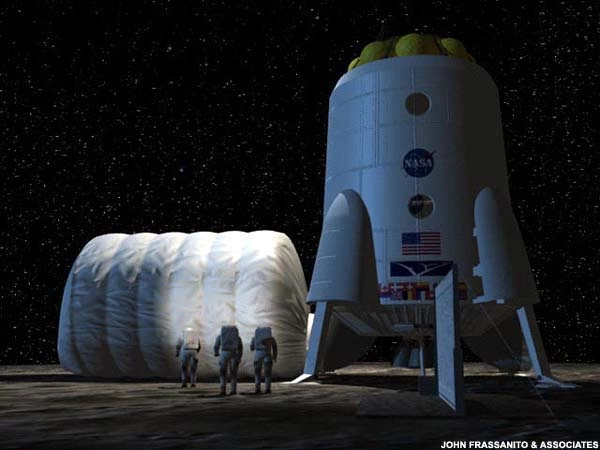
What's more is that such a prospect could fuel those eager to return human explorers to the moon, to establish a base camp there, and to hone talent and hardware for jumping off to other destinations.
History in the making
Locating, then mining and processing polar deposits of water ice on the moon, it is reasoned, would add up to a useful resource for future lunar inhabitants.
The idea of ice in the floors of sunlight-shy polar lunar craters was first aired in 1961 by Caltech researchers Kenneth Watson, Bruce Murray, and Harrison Brown. And in the late 1970s, James Arnold of the University of California, San Diego, suggested that comets and water-rich asteroids crashing into the moon could deposit water to the lunar surface.
Still, is the chatter about new lines of evidence supportive of water ice at the lunar poles a slam dunk situation?
"If ice is found we have to further explore it with landers, rovers, coring drills to assess its distribution and composition," explained Bernard Foing, the European Space Agency (ESA) project scientist for the now defunct ESA SMART-1 lunar orbiter. He is also the director of the International Lunar Exploration working Group (ILEWG).
Following that appraisal, Foing said that the next task is to organize how ice could be partly exploited on-the-spot in some areas to ease the next steps of human exploration towards an international lunar base.
Lunar natural parks
Foing also underscored the scientific merit of any ice find. That is, the lunar ice should be left intact in some "lunar natural parks" as a precious historical record of impacting comets and water-rich asteroids that have delivered the goods to the moon.
Foing paints a view of what might be found, in terms of water ice at the poles.
"I would expect the water ice could come in thin layers separated by layers of covering protective dust layers," he told SPACE.com. "The ice thickness would vary with the history of bombardment of comets and water rich asteroids, but also could come in patches on the surface."
How could water ice have stayed frozen inside shadowed craters, without sublimating into the lunar exosphere?
According to Foing, layers at colder temperatures than 80 degrees Kelvin would take billion of years to sublimate, if protected early enough from sputtering by meteorites or from energetic solar wind particles. Last week, NASA announced that its Lunar Reconnaissance Orbiter had found temperatures as low as minus 397 degrees Fahrenheit (minus 238 Celsius) in some shadowed craters, making them possibly the coldest place in the solar system.
"The next challenge for future missions will be to land in the permanently shadowed bottom of a polar crater and extract a few meters core of soil," Foing said, possibly sampling at once layers of comet material — or water rich asteroids — that impacted the moon in the past three billion years.
Uniform or patchy?
Similar in view is Clive Neal, a professor of civil engineering and geological sciences at the University of Notre Dame in Indiana. He is also chair of NASA's Lunar Exploration Analysis Group (LEAG) and also sits on the Planetary Science Subcommittee of the NASA Advisory Council.
"If the water ice is a slam dunk situation," Neal told SPACE.com, "we will need to know the distribution within the craters — is it uniform or patchy?"
If such a find it is to be used to support future moon exploration, Neal said that the magnitude of the deposits will also need to be quantified.
"We will also need to figure out where this stuff came from, which means sampling and analyzing the deposits'a non-trivial thing!"
So whatever is new and forthcoming regarding Earth's celestial next door neighbor, Neal has a bottom line: "This is an exciting time of discovery for the moon!"
Developing story
Observations that signatures of water ice have been detected on the moon that are robust, sound, and hold up within scientific circles may take a while.
That's the sense of Wendell Mendell, Chief of the Office for Lunar & Planetary Exploration, Constellation Systems Program Office at the NASA Johnson Space Center in Houston, Texas. He added that this view is a personal judgment and in no way reflects NASA policy or plans.
"If the resource is found lurking within darkened craters, how do you get to it and extract either the ice or the water from some process?" Mendell asked.
Follow-on questions are many, Mendell told SPACE.com: In that kind of environment, how do you get mechanical systems and electronic systems to work? How do you get to the bottom of the crater? You are not going to drive — are you going to fly in? What will the rocket blast do to the ice deposits?
"Enthusiasts may tell you that all of these questions are just details left to the engineers," Mendell said. "If so, when will the infrastructure be available to deal with these challenging design and operational issues?"
At first blush, even if water ice truly exists on the moon, it will be a curiosity, Mendell added. "I also will not believe it just from remote sensing data."
Sage advice comes from space scientist Alan Stern, former head of NASA's space science office.
"This is a developing story. My view is that much more will be known in a few months. So what looks tantalizing or even confusing today will be more compelling or more definitive soon," Stern said.
Leonard David has been reporting on the space industry for more than four decades. He is past editor-in-chief of the National Space Society's Ad Astra and Space World magazines and has written for SPACE.com since 1999.