


This story was updated at 4:50 p.m. ET.
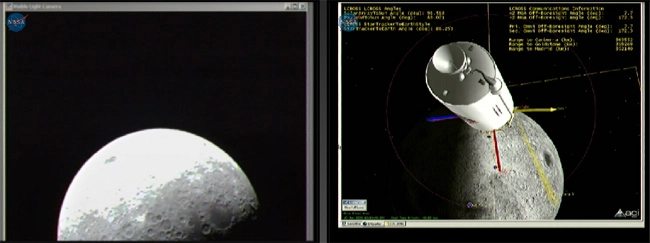
A new NASA probe beamed down live images of the moon earlyTuesday to reveal a stark surface littered with craters, as it flew toward aplanned crash at the lunar south pole later this year.
The $79 million Lunar Crater Observation and SensingSatellite, or LCROSS, launched toward the moon on June 18 and began sendingimages today at 8:20 a.m. EDT (1220 GMT).
LCROSS and an attached empty Centaur rocket stage swoopeddown near the lunar south pole and continued north along the far side of themoon. The spacecraft is getting into position to crashdown on the surface on Oct. 9.
"The successful completion of the LCROSS swingby proves the science instruments are functioning as expected. It is a testament to the hard work and dedication of the entire team," said Dan Andrews, LCROSS project manager at NASA's Ames Research Center at Moffett Field, Calif. "We are elated at the results from the maneuver and eagerly anticipate the impacts in early October."
The spacecraft snapped pictures as it flew over Mendeleev crater, a large ancient impact basin with uniform floordeposits.
At its closest approach, LCROSSwas only about 2,000 miles (3,200 km) from the moon.
During the swingby, NASA's science team will calibrate thespacecraft's cameras and spectrometers. To study the concentration of mineralsand elements in the lunar soil, the LCROSS visible spectrometer will make thefirst near-ultraviolet survey of certain spots on the far-side of the moon.
"Each instrument returned good data that the science team will spend the next few weeks analyzing," said Anthony Colaprete, LCROSS project scientist at Ames. "These data will ensure we are as prepared as possible for monitoring and interpreting data we receive during impact."
NASA plans to slam LCROSS down near the south pole in apermanently shadowed crater. The impact is intended to create a pair of debrisplumes that will be analyzed for the presence of water ice or water vapor,hydrocarbons and hydrated materials.
LCROSS's sisterspacecraft, the Lunar Reconnaissance Orbiter (LRO), arrived at the moon afew hours earlier than LCROSS to begin a stable lunar orbit. The robotic probeis expected to spend at least one year mappingthe moon for future manned missions, as well as several more yearsconducting science surveys.
LRO and LCROSS launched together aboard an Atlas 5 rocketlast. They comprise NASA first moon mission in more than a decade.
NASA plans to use the data and images beamed back from thetwo spacecraft, which together represent a $583 million mission, to aid itseffort to return humans to the lunar surface by 2020.
LCROSS will not be the first spacecraft to crash into the moon this year. The Japanese space agency's Kaguya lunar probe slammed into the lunar surface June 10, and China's Chang'e 1 spacecraft impacted in March.
Senior Editor Tariq Malik contributed to this report fromNew York.
- Video - LRO's Road to the Moon
- New Video - Target Moon: NASA's New Lunar Scouts, Part 2
- Image Gallery - Full Moon Fever
