





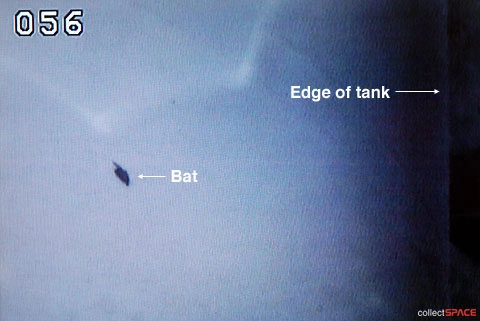
CAPE CANAVERAL, Fla. - A small bat appears to be trying tohitch a ride aboard the space shuttle Discovery from its perch on the spacecraft?sattached external tank as NASA counts down to a planned Sunday evening launch.
Mission managers said the tank-clinging fruit bat is unlikely topose a risk for the shuttle, and will probably fly away when Discoveryblasts off this evening at 7:43 p.m. EDT (2343 GMT) from Pad 39A hereat NASA's Kennedy Space Center.
"It's not expected to be a debris problem," NASA spokesmanMike Curie told SPACE.com. The bat is between one quarter and one thirdof the way up on the north side of the shuttle's huge orange external fueltank, which is the side that faces away from the orbiter. It could be seen in aNASA camera view caughtby collectSPACE.com, a SPACE.com partner.
It was first noticed this morning while the fuel tank was being filledwith its super-chilled liquid hydrogen and liquid oxygen propellant. NASA doesnot think the bat has frozen in place, though, because the tank's surfacetemperature is between 58 and 70 degrees Fahrenheit at the bat's location.
This isn't the first time a bat has taken up position on a shuttle'sfuel tank on launch day.
"On STS-72 there was a bat, but it flew away during launch,"Curie said, referring to the 1996 flight of the shuttle Endeavour. That bat didnot harm the shuttle at all.
Birds and bats canpose a hazard to space shuttles if they impact and damage an orbiter'ssensitive heat shield tiling. This thermal coating protects the shuttle fromburning up in Earth's atmosphere when it re-enters.
In 2005, a large turkey vulture ran into the back of the space shuttleDiscovery's external tank. Luckily, this impact didn't harm the shuttle, whichwas on the opposite side of the tank. Ever since, NASA launch officials useradar to track flocks of birds during a launch. NASA also fires loud canons toscare away birds when the shuttle is heading in to touch down on the longlanding strip at Kennedy Space Center.
Discovery is poised to delivernew solar arrays and a new station crewmember to the International SpaceStation. Commander Lee Archambault will lead the seven-member STS-119crew on the planned 13-day mission.
Discovery is also ferrying Japanese astronaut Koichi Wakata to the space station, where he will replace NASA astronaut Sandra Magnus as a member of the outpost's three-person crew. Coincidentally, Wakata - Japan's first long-duration astronaut - was also part of the STS-72 crew aboard Endeavour when the last bat tried to hitch a ride into space.
Click here for more on Discovery?sstowaway bat and the shuttle mission from collectSPACE.com.
SPACE.com is providing continuous coverage of STS-119 with reporterClara Moskowitz in Cape Canaveral and senior editor Tariq Malik in New York. Click here for missionupdates and SPACE.com's live NASA TV video feed. Live Coverage is under way.
- New Video - Meet Discovery's STS-119 Shuttle Astronauts
- New Video - Discovery's Mission: Space Station Power Up!
- Space Shuttle to Make Second Launch Attempt Tonight
