





This story was updated at 8:14 p.m. EST.
NASA is now targeting March 12 to launch the shuttle Discovery to the International Space Station as engineers work to replace a set of suspect fuel valves aboard the spacecraft, the space agency announced late Wednesday.
Discovery is now slated to launch no earlier than March 12 at 8:54 p.m. EDT (0054 March 13 GMT) — one month later than planned — on a two-week construction flight to the space station. The mission has been delayed several times due to concerns with the shuttle's fuel control valves.
"Right now, we're targeting March 12 but there's a lot of work to do," said Kyle Herring, a NASA spokesperson with the agency's Johnson Space Center in Houston, Texas.
In addition to replacing the three suspect valves aboard Discovery, NASA engineers will spend the next week reviewing data from recent tests and studying potential modifications to strengthen vital plumbing connected to the shuttle's fuel valves, Herring told SPACE.com.
Herring said shuttle program managers plan to meet on March 4 to review Discovery's status and decide whether to press ahead toward the March 12 launch from NASA's Kennedy Space Center (KSC) in Cape Canaveral, Fla. If so, a meeting of top NASA officials would convene on March 6 to approve the plan, he added.
NASA initially planned to launch Discovery on Feb. 12, but has delayed the mission four times because of fuel control valve safety concerns. The most recent delay, announced last Friday, left Discovery without a firm launch target.
More analysis ahead
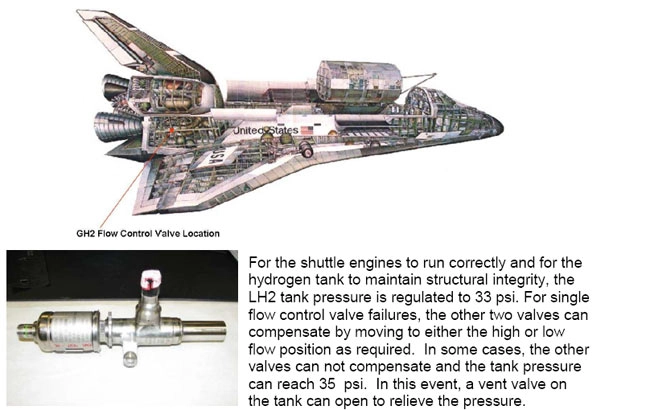
There are three fuel control valves aboard Discovery, one for each of the spacecraft's main engines. They are designed to work in concert to maintain pressure in the shuttle's liquid hydrogen reservoir inside its attached external tank.
To keep the pressure stable as a shuttle rockets toward space, metal poppets in the valves pop up as needed — much like lawn sprinkler heads — to route gaseous hydrogen from the shuttle's aft-mounted engines through a set of plumbing lines and into the external tank.
When NASA's shuttle Endeavour launched last November, one of the fuel valves aboard that shuttle cracked and chipped. The spacecraft's two other valves compensated for the damaged one and the shuttle reached orbit without incident.
But NASA wants to be sure that a similar problem, should it occur during Discovery's launch, would not cause catastrophic damage by rupturing the spacecraft's vital plumbing lines or overpressurizing its hydrogen tank. A plumbing line break near the shuttle's aft could lead to an emergency engine shutdown, while an overpressurized tank could force open an overflow port that would vent the flammable gas overboard during launch, according to a NASA document.
Herring said engineers will continue computer modeling of the fuel valves to see how they might break during flight. Meanwhile, engineers are also working on a way to reinforce part of the curved plumbing lines between Discovery's fuel valves and its external tank to ensure they can withstand impacts from debris from a broken part, he added.
"We could install this modification on the first elbow bend only, and that would basically beef it up structurally," Herring said.
After discovering Endeavour's damaged fuel valve, engineers replaced the ones aboard Discovery with valves known to be in working order. It is those replacements that engineers were removing from Discovery today. Newer valves will be installed in their place, NASA officials said.
Two of the valves being replaced will undergo a detailed inspection, with engineers planning to take 4,000 photographs of each one to search for evidence of cracks, NASA officials said.
NASA spokesperson Allard Beutel at KSC told SPACE.com that when engineers replaced the fuel valves on Discovery the first time in January, the job took about two weeks. Removing the valves alone was a six-hour job, he added.
Launch windows
NASA must launch by around March 13 in order to complete Discovery's two-week mission to the space station before the March 28 arrival of a Russian-built Soyuz spacecraft at the orbiting laboratory. That Soyuz mission is due to launch March 26 to ferry an American space tourist and a new crew to the space station.
Herring said mission planners for both Discovery and the International Space Station are looking at ways to extend the March launch window by a few days. But if Discovery is unable to launch in mid-March, NASA would have stand down until after the Soyuz crew change is complete. The next launch window would open around April 7, mission managers have said.
Commanded by veteran astronaut Lee Archambault, Discovery's STS-119 mission will deliver the final piece of the space station's backbone-like main truss and the final set of U.S.-solar arrays. Four spacewalks are planned during the 14-day mission.
Discovery will also ferry Japanese astronaut Koichi Wakata to the space station to join the outpost's current Expedition 18 crew. Wakata is Japan's first long-duration astronaut and will replace NASA astronaut Sandra Magnus as a member of the space station's crew.
Magnus has lived aboard the space station since November and will return home aboard Discovery. Wakata is due to return to Earth later this year during a subsequent shuttle flight.
Discovery's STS-119 mission is the first of up to six scheduled NASA shuttle flights for 2009. The other missions include the planned May 12 launch of seven astronauts to perform the last overhaul of the Hubble Space Telescope and a series of space station construction flights.
NASA's plan to launch Discovery a month late on March 12 is not expected to affect the scheduled May launch to Hubble or the June shuttle flight to continue space station assembly, agency officials said.
