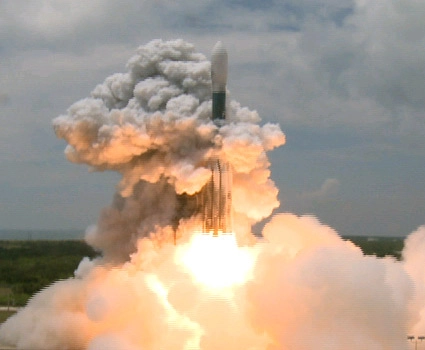
NASA?s newest space telescope aimed at glimpsing the unexploreduniverse blasted into space Wednesday morning.
The Gamma-ray Large Area Telescope (GLAST), lifted off atopa Delta 2 rocket from Florida's Cape Canaveral Air Force Station at 12:05 p.m.EDT (1605 GMT). The launch was delayed by about 20 minutes due to a long-rangetracking glitch. Now the nearly five-ton observatory is headed for an orbitabout 345 miles (555 km) above Earth.

"Astrophysicists couldn't be happier about the launchof GLAST and the discoveries it will make," said Jon Morse, director of NASA?sastrophysics division at the agency?s headquarters in Washington, D.C. "We'rereally at a unique time in the history of science and of astronomy, that we canstudy the cosmos across the entire electromagnetic spectrum for the first time ?GLAST is one of those missions where we're extending our reachsignificantly."
"I'm expecting that the most important science GLAST isgoing to do is actually not yet on anybody's list," said Steven Ritz, aGLAST project scientist and astrophysicist at NASA's Goddard Space FlightCenter in Greenbelt, Md. "What we're very excited about are thesurprises."
"GLAST is a unique collaboration between particlephysicists and astrophysicists across six countries," said Julie McEnery,GLAST's deputy project scientist, before the launch on Wednesday."Together we've been able to work to produce an extraordinary observatorywith special instruments to detect gamma rays with superb accuracy."
Today's successful launch comes as a relief to eagerscientists who have been waiting for the telescope to lift off since itsoriginal intended launch date, May 16. GLAST's voyage has been postponedrepeatedly because of delays in preparing the observatory as well as issueswith the rocket that is slated to deliver it to space.
- Video: GLAST Cast ? Part 1
- Video: GLAST Cast ? Part 2
- The Strangest Things in Space
