





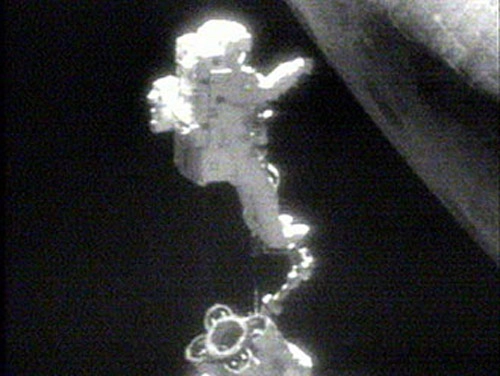
HOUSTON - Flight controllers for the spaceshuttle Discovery are lauding today's morning spacewalk and its successfulrepair of the orbiter's heat shield.
During thesix-hour spacewalk, Discovery's STS-114 mission specialist Stephen Robinsonrode a robotic arm under the orbiter's tile-lined belly and used his fingers topluck two strips filler material poking out from the spacecraft. The fix allbut cleared the shuttle's heat shield for reentry through the Earth'satmosphere next week.
"This was thelast thing remaining for us to clear," said Paul Hill, lead shuttle flightdirector for STS-114, during a mission status report here at Johnson Space Center. "So we have aclean vehicle, pending the blanket discussion."
Engineersare still examining a damaged thermalblanket puffing out below the shuttle commander's window, and just abovethe 'D' in Discovery along the orbiter's left side.While the blanket has been cleared for landing from a heating perspective,engineers want to ensure it won't rip off during descent and strike some aftportion of the orbiter.
The resultsof those studies will be presented to Discovery's Mission Management Team (MMT)by Thursday at the latest, shuttle officials said.
In themeantime, spacewalk planners are drawing up contingency plans for a potentialfourth spacewalk should mission managers decide the blanket does pose a problemand needs to be removed entirely or merely slashed to ventilate it duringreentry, they added.
Regardingtoday's extravehicular activity (EVA), spacewalk planners said Robinson'srepair job--which was watched over by his spacewalking partner Soichi Noguchi outside and their crewmate Andrew Thomasinside the orbiter--went just about as well as they could expect.
"It didturn out to be as easy as we thought it would be," said Cindy Begley, lead EVAofficer for Discovery's STS-114 flight. "We proved that we can get access tothe bottom of the vehicle, we just never needed to before. Luckily, none of ourother contingency plans were required."
Perchedatop the International Space Station's (ISS) robotic arm, Robinson carriedforceps, scissors and a bent hacksaw to cut off the offending gap-fillersshould they prove too unyielding to the human touch, and was prepared to repairany damage he accidentally inflicted on the shuttle's fragile tile surface.
Hill saidhe felt a wave of relief once Robinson retrieved the second strip and wasbacking away from the orbiter.
"It was ahuge relief, like a feeling that it's all downhill from here," he said.
The repairalso proved without a doubt that shuttle astronauts can service the undersideof their vehicles, which is desirable not only for gap-filler fixes, but alsoto manually close doors that house the shuttle's connections to its externaltank, "something that was highly desirable for us from the beginning of the[shuttle] program," Hill said.
Throughoutthe entire repair, Robinson's helmet camera broadcast stunning views ofDiscovery's tile-covered belly--which he called "a work of art"--and gave flightcontrollers they're first views of the shuttle's belly with the entire ISShovering above it.
"We'venever seen this before...this was just amazing view for me," Begley said. "Theonly time we've ever seen full pictures of the space station are when theshuttle is approaching station or flying around [it]."
- Fixing NASA: Complete Coverage of Space Shuttle Return to Flight
