





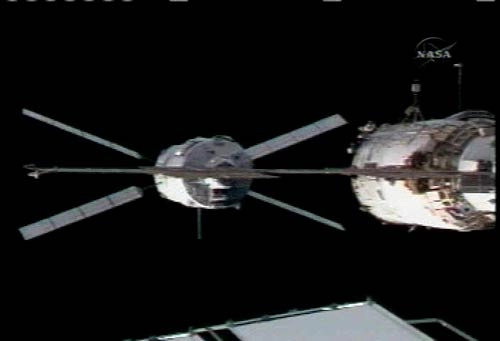
Europe's massive "Jules Verne" space freighter wrapped up its final dress rehearsal high above the Earth, priming the ship for a Thursday docking at the International Space Station (ISS).
Looking something like anoverweight X-wing fighter from the movie "Star Wars," the 21-ton automatedcargo ship crept within a bus length of the space station Monday, thenperformed an escape maneuver below the orbital laboratory.
A joint international teamof mission controllers led the "demo day" operations and are now discussingwhether or not to proceed with an April 3rd docking attempt at the spacestation. Today's activities, however, appeared to occur without issue.
Led by commander PeggyWhitson, the Expedition 16 space station crew will unload vital supplies from thespacecraft after docking, if all goes according to plan this week. Also knownas an automated transport vehicle (ATV), the craftdeparted Earth on March 8 and has been trailing the space station eversince.
Three control centers ? oneeach in France, Russia and the U.S ? led the ship through its second of twotesting days with some on-orbit help from Whitson and space station flightengineer Yuri Malenchenko. Saturday's dressrehearsal was completed without any problems, setting the ship up fortoday's events.
The space freighter beganits dress rehearsal today some 2 miles (3.2 km) behind the space station,closing the gap to the ISS by using advanced laser- and video-ranging systems.
During the more thantwo-hour operation, mission controllers commanded the Jules Verne into several built-inretreats to see if the craft could safely pull away from the space station, inthe end resuming positioning it at a holding point about 36 feet (11 m) behindthe Russian-built Zvezda service module.
After the solar-panel featheredship parked behind the space station, Malenchenko instructed it to back offaround 12:52 p.m. EDT (1652 GMT) and swing below the space station to a safepoint ? an escape maneuver astronauts can use in the event of an emergencyduring docking.
The disposable 1.3 billioneuro ($1.9 billion) spacecraft is the first of up to sevenplanned by the ESA. It is designed to deliver three times the fuel, oxygen,water, hardware and other supplies to the ISS than Russian Progress cargo shipsare able to.
- NEW VIDEO: "Jules" heads to the ISS
- VIDEO: Part 1: Europe's First ISS Cargo Ship
- VIDEO: Part 2: Jules Verne, Europe's First ISS Cargo Tug