


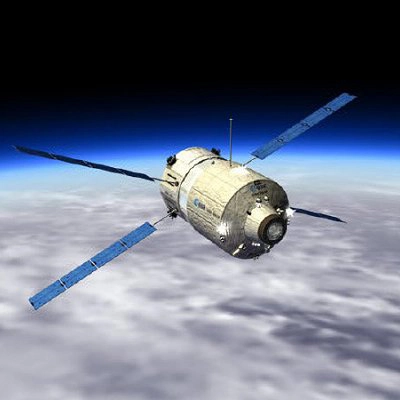
PARIS — Europe's Automated Transfer Vehicle (ATV) cargo vessel March 14successfully completed a key test of its emergency-abort sequence, performing acollision-avoidance maneuver that ground teams hope will never be needed whenthe time comes to dock with the international space station, European SpaceAgency (ESA) officials said.
In themaneuver, the 41,887-pound (19,000-kilogram)ATV, named Jules Verne after the 19th century French science fictionwriter, was stopped in its tracks and thrown into reverse, firing four of itsthrusters to move backwards at a speed of around 16.4 feet per second (5 meters per second) tosimulate a slow retreat from the space station.
It is thismaneuver that will be required if, as it approaches the station for a plannedApril 3 docking, its speed, approach angle or some other parameter poses asafety concern for the station and its astronauts.
The March14 test also demonstrated the ability of ATV to switch to its independentbackup computer, which would be required only if there are multiple failures ofthe main computer system, which has its own backup.
ATVmanagers say it is a highly unlikely scenario, but one that must be planned forgiven the delicate nature of having a machine the size of ATV approach thestation.
With itsmain computers shut off, the ATV automatically placed itself into survivalmode, pointing toward the sun to continue to feed its four power-generatingsolar arrays to await further instructions from ground teams.
About 95minutes after the reverse-thrust command, the vessel's main computers wereswitched back on. It will now remain in its current orbit of some 190 miles (305kilometers) in altitude until March 18, when it will begin its transition intohigher orbit as it preparesits approach to the space station. The station's current orbit is about 211 miles (340kilometers) in altitude.
- VIDEO: Part 1: Europe's First ISS Cargo Ship
- VIDEO: Part 2: Jules Verne, Europe's First ISS Cargo Tug
- VIDEO: Columbus: Europe's Orbital Lab at ISS
