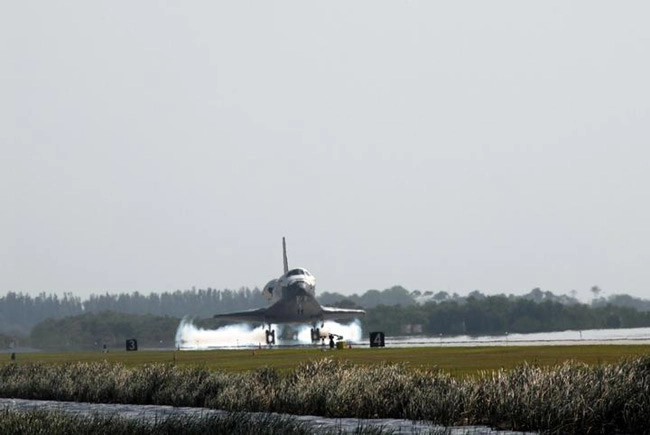
CAPE CANVERAL, Fla. - Seven astronauts safely returnedto Earth today on board space shuttle Discovery, ending a space station constructionmission that NASA called a tremendous success.
NASAadministrator Mike Griffin said the STS-120mission is like a link in a chain to build the International Space Station(ISS)--what he considers more complex than previous moon missions.
"Anylink that breaks, and it's no longer a chain," Griffin said. "We'renot going to do great things in space unless we can rely on the next crew tobuild upon what the last crew did."

During theSTS-120 mission, astronauts mendeda solar blanket that unexpectedly tore during its deployment. Griffin said the emergency repair effort was not the single most impressive task in humanspaceflight, but regarded it as impressive nonetheless.
"Therehave been some extraordinary saves [in human spaceflight]," Griffin said. "It was an extraordinary mission and we've have many such."
'Pictureperfect landing'
Discovery'stires screeched across a sun-bathed runway today, just after 1:01 p.m. EST(1801 GMT) here at Kennedy Space Center.
CommanderPamela Melroy piloted the massive spaceship over the heartlandof America--a path not taken since Columbia broke up over eastern Texas in 2003.
A convoy ofvehicles descended upon the 100-ton spacecraft shortly after a parachute slowedit to a stop. Technicians cleared the area of toxic propellant fumes and thenhelped the weak-kneed crew out of the ship.
Melroy, whomade history as one two women to share her command in space, said from therunway that the orbiter performed perfectly.
"Wecould not have done this mission without Discovery being as clean and asbeautiful as it was," Melroy said in front of the spaceship. "We arethrilled to be back home."
A timeto learn
Melroy andher crew delivered a bus-sized room to the International Space Station (ISS),relocated a massive solar array truss and repaired a solar wing that toreduring its unfurling on Oct. 30.
A secondproblem--a gritty solar-array-orienting setof gears--also arose during the astronauts' 15 days, two hours and 23minutes in space. But Bill Gerstenmaier, NASA's associate administrator forspace operations, said the issues give the agency a chance to prepare forfuture spaceflight endeavors.
"We'removing towards [the] moon and Mars," Gerstenmaier said of NASA's goals."This is the time to learn, when you're hours away from home."
Bydelivering theHarmony module, the mission created an attachment point for the EuropeanSpace Agency's Columbus laboratory module, which is set to launch Dec. 6 onboard shuttle Atlantis.
But thework is not over.
The spacestation's Expedition 16 crew must relocate the room with a pressurized dockingmechanism attached to it, then hook up all of its coolant, power and avionicslines. If any more problems arise, NASA officials said they will not hesitateto push back Atlantis' launch to January, if necessary.
Coated in adust of carbon from atmospheric reentry, 24-year-old shuttle Discovery is nowbeing towed back to a hangar, where engineers will start servicing it almostimmediately for an April 2008 flight. It is slated to ferry up a massiveJapanese experimental module and robotic arm during the mission.
NASAexpects to send as many as 12 more shuttle flights to the space station bySeptember 2010, when its shuttle fleet retires. Upgrading the Hubble Space Telescopeis also on NASA's calendar for next year.
- VIDEO: Discovery's STS-120 Astronaut Crew Speak Out
- NEW IMAGES: Launch Day for Shuttle Discovery
- SPACE.com VIDEO Interplayer: STS-120 Mission Brings 'Harmony' to ISS