





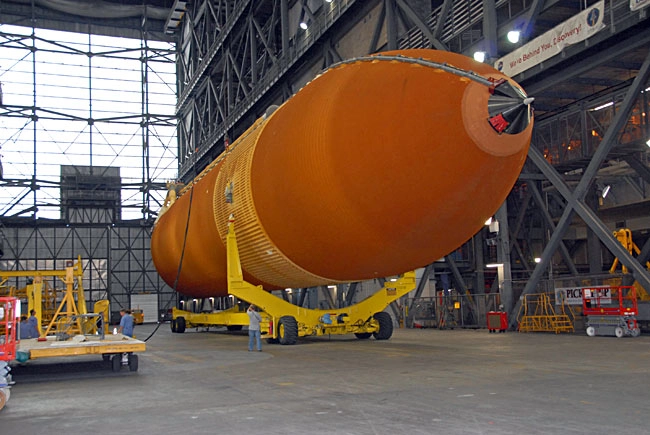
NASA will strip away cracked layers of insulation from its next space shuttle fuel tank to fly, a top shuttle official said Friday.
Wayne Hale, NASA's space shuttle program manager, said an X-ray inspection of brackets on the shuttle Discovery's external fuel tank found cracks in an underlying layer of thermal protection that could lead to similar debris shedding events like that which dinged the space shuttle Endeavour's underbelly during its Aug. 8 liftoff, he added.
"Clearly, this could lead to a shedding of foam debris, along with this heavier weight SLA, which we now know could have a debris transport path to the underside of the orbiter," Hale told reporters in a Friday teleconference. "Therefore, we've decided that this is an unacceptable situation."
The cracks run a few inches long in a composite material known as super-lightweight ablator (SLA), which sits between the fuel tank's exterior foam and aluminum bracket base, Hale said.
Engineers at NASA's Kennedy Space Center in Florida will now pry the foam insulation and underlying corkboard-like ablator, which is composed of silicone resins and cork, from at least four of five aluminum brackets securing a liquid oxygen feed line to Discovery's fuel tank hull.
The brackets will then be coated with only the lighter, less dense foam insulation when the shuttle launches toward the International Space Station (ISS) on Oct. 23, Hale said, adding that the modification is expected to take up to nine days.
Hale said that removing the ablator will strip away about the equivalent of a ping pong ball's worth of material from each fuel tank bracket.
"So we're not talking about a large mass," he added.
NASA believes the cracks in the ablator may have been caused during the fuel tank's manufacturing process at the agency's Michoud Assembly Facility in New Orleans, Louisiana.
From ding to Discovery
NASA began inspecting Discovery's fuel tank after a baseball-sized piece of debris weighing about 0.021 pounds (about one-third of an ounce) fell from a bracket on the shuttle Endeavour's external tank about one minute after it launched towards the ISS on NASA's STS-118 mission.
The debris, which likely had some SLA or ice attached, ricocheted off a metal strut to carve a 3 1/2-inch by 2-inch (9-centimeter by 5-centimeter) gash across two of the heat-resistant tiles along Endeavour's undercarriage. The debris strike penetrated completely through one tile to expose a slim area of underlying felt material.
The dinged tiles posed no risk to the safe return of Endeavour's seven-astronaut crew, though NASA engineers conducted an in-depth analysis to determine whether to fill in the divot during a risky spacewalk to avoid additional structural damage that would require lengthy repairs after landing. After six days of study, mission managers decided no such repair was necessary.
Endeavour landed safely on Wednesday, with its dinged tiles experiencing some slight erosion but no major additional damage, though engineers will scrutinize the ding to continue heat shield improvements, NASA said..
Hale said that additional X-ray inspections on the fuel tank for the planned Dec. 6 launch of Atlantis, which will deliver the European Space Agency's Columbus laboratory to the ISS, also turned up cracks in the ablator coating on some of its brackets. Those areas will also require repair, he added.
NASA initially began using the super-lightweight ablator material on shuttle fuel tanks to guard sensitive areas against high heating for during launch, when the orbiter and its fuel tank fly through the Earth's atmosphere at supersonic speeds. But the agency has since found that the extra measure is not required for the current launch trajectories now flown by three-orbiter fleet, Hale said.
Final fix ahead
NASA has kept a close watch on the health of its orbiter heat shields and the amount of debris shed by a shuttle's external tank during liftoff since 2003, when a chunk of foam insulation breached the shuttle Columbia's heat shield during launch and led to the loss of the orbiter and its crew during atmospheric reentry.
"We are making a continuing effort to eliminate areas or risk as we have the resources available to do it," Hale said.
NASA engineers were already planning to replace the foam-covered aluminum brackets shuttle fuel tanks with titanium ones, which are less susceptible to ice formation, when Endeavour was dinged during liftoff. The first flight with that new upgrade is slated to launch in April 2008.
Hale said that current projections for Discovery's fuel tank fix should allow the orbiter to launch its STS-120 mission to deliver the new Harmony connecting node to the ISS around Oct. 23. But if more time is required, NASA will not flinch from delaying the flight a few days and readjusting plans for the December mission and later ones as needed, he added.
"The point is, we will take the amount of time that we need to get this repair done properly," Hale said. "We will not rush."
