





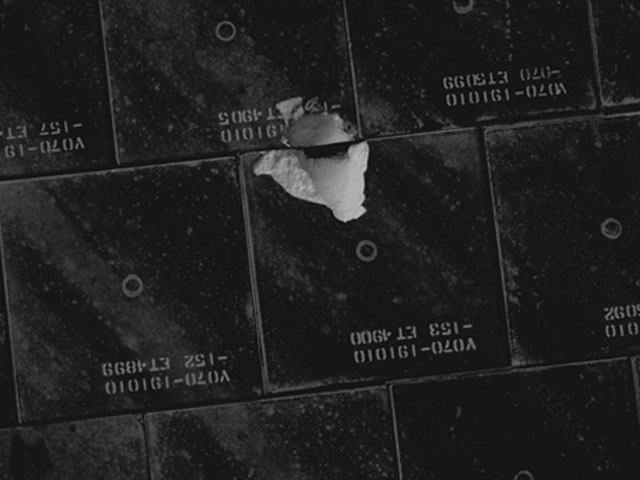
HOUSTON -- Apreliminary analysis of the gouged heat shield tile on the belly of NASA'sspace shuttle Endeavour shows promise that a spacewalk repair may not berequired, but NASA will await additional tests to be sure, mission managerssaid late Tuesday.
Initialcomputer modeling of the small, but deep, dingon Endeavour's undercarriage found that the damaged area would not leavethe orbiter vulnerable to the searing hot temperatures of reentry, they added.
"We'recautiously optimistic that we can fly as is," John Shannon, chairman ofEndeavour's mission management team, told reporters in a briefing here at NASA'sJohnson Space Center.
Shannonsaid the preliminary computer analysis is undergoing an independentverification to ensure its accuracy. Meanwhile, more tests over the next 24hours will use subject mockups of the tile damage to the same extreme temperaturesEndeavour will face during landing, as another check of that initial study, headded.
A finaldecision on whether Endeavour's STS-118 spacewalkers will have to venture beneaththe orbiter's underbelly for to make repairs is anticipated by late Wednesday,NASA said.
A piece ofdebris fell from a fuel tank bracket and bounced off a metal strut to carved the3 1/2-inch by 2-inch (9-centimeter by 5-centimeter) gash in Endeavour's fragileheat-resistant tiles about one minute after the orbiter's Aug. 8launch. The damage etched all the way through a tile to expose about one inch(2.5 centimeters) by one-quarter inch (0.5-centimeter) wide.
Preliminaryreport
Accordingto the preliminary look, the surface of the gouged tile on Endeavour's bellywill experience between 2,000 and 2,100 degrees Fahrenheit (1,093-1,148degrees Celsius), with temperatures on the inner felt strip near theshuttle's aluminum skin reaching about 325 degrees Fahrenheit (162 degrees Celsius).
The upperlimit for heating on Endeavour's hull at the damaged area is about 350 degreesFahrenheit (176 degrees Celsius), Shannon said. Ongoing tests planned for lateTuesday and Wednesday should double check that initial finding, he added.
If a repairis ultimately required, mission managers would likely delay a planned Fridayspacewalk, the fourth for Endeavour's STS-118 crew, until Saturday and possiblyextend the already extended14-day mission. The success of a new space station-to-shuttle powertransfer system has allowed Endeavour to conserve enough supplies to stay atthe ISS three additional days, mission managers said.
The repairplan would call for two spacewalkers to perch at the end of Endeavour's100-foot (30-meter) robotic arm and inspection boom and coat the dinged tilewith a heat-resistant black paint, then fill it with an ablative goo-likematerial called STA-54, NASA said.
Image analystspinned down the size and mass of that debris, finding it to be a 4-inch by3.8-inch (10- by 9.6-centineter) piece of foam about 1.8 inches (4.5centimeters) thick. The debris weighed about 0.021 pounds (about one-third ofan ounce), Shannon added.
EarlierTuesday, STS-118 commander Scott Kelly told reporters that he believedEndeavour was safe to return to Earth as is, but felt comfortable performing arepair if required.
"Myunderstanding is that this tile damage is not an issue of the safety of thecrew," Kelly said.
NASA haskept a close watch on the shuttle heat shield damage and fuel tank debris sincea combination of both led to the catastrophicloss of the Columbia orbiter and its crew in 2003.
Fueltank discussions
Whilemission managers discuss whether a repair for Endeavour is required, Shannonsaid shuttle officials are beginning to turn an eye to future flights tocomplete assembly of the ISS by September 2010.
Since NASAreturned its three-orbiter fleet to flight after the Columbia accident, theagency has seen an increased amount of foam shedding similar to that onEndeavour's current flight. That history, Shannon said, has prompted somediscussions that an extra hour added to launch countdowns for fuel tank checksmay allow more ice to build up and lead to debris events, mission managerssaid.
On Friday,shuttle officials plan to discuss plans to mate a new fuel tank to its solidrocket boosters for NASA's STS-120 mission aboard Discovery. That mission isslated to launch in late October to deliver the new Harmony connecting node tothe ISS.
"Theprogram will look at what checks we need to do before we mate to the solidrocket boosters," Shannon said.
NASA isbroadcasting Endeavour's STS-118 mission live on NASA TV. Click here for mission updates andSPACE.com's NASA TV feed.
- NEW VIDEO: Endeavour Shuttle Tile Damage
- VIDEO: Teaching the Future: Teacher-Astronaut Barbara Morgan
- Complete Space Shuttle Mission Coverage
