


Two new communications satellitesfor India and the British military blasted off Sunday, riding an Ariane 5 intoorbit one day after a launch pad glitch prevented a Saturday launch attempt.
The heavy-lift Ariane 5 rocket hauled India's INSAT-4B broadcastsatellite and the British Ministry of Defense's Skynet-5A satellite into spaceat 6:03 p.m. EDT (2203 GMT) from a launch pad at Europe's Guiana Space Centerin Kourou, French Guiana.
A glitch with the water deluge system at the Ariane 5's launch pad,which is designed to suppress fire and sound during liftoff, preventeda Saturday launch attempt.
"This will be the first in what we believe will be an extremely busyyear," Arianespace CEO Jean Yves Le Gall said before launch, adding that themission is the first of at least six planned space shots for the launchprovider.
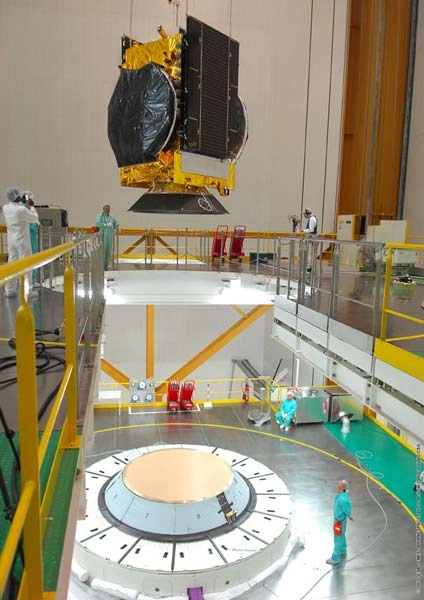
Built by the Indian Space Research Organization (ISRO), INSAT 4B [image]is a 6,675-pound (3,028-kilogram) satellite designed to providetelecommunications and television broadcast services for customers in Indiafrom a geosynchronous orbit 22,300 miles (36,000kilometers) above Earth.
Skynet-5A [image]is a 10,361-pound (4,700-kilogram) communications satellite built forthe British Ministry of Defense to aid British and NATO military forces, aswell as those of the Netherlands, Canada, Belgium and other countries,Arianespace officials said.
Paradigm Secure Communications, a subdivision of Skynet-5A manufacturerEADS Astrium, will operate the satellite for the British defense ministry. Accordingto EADS Astrium, Paradigm holds a nearly $7 billion (5.3 billion Euro) contract to provide secure military satellite communications through2020.
Sunday's successful launch marked Arianespace's 175th flightof an Ariane booster and the 31st liftoff of the rocket family'sAriane 5 variant. It also marked Arianespace's 13th launch for theISRO, Indian space agency officials said, adding that INSAT-4B is alreadyreturning a healthy signal as it heads towards its final geosynchronous orbit.
"Of course, some believe that 13 is an unlucky number, but withArianespace it doesn't not seem to be so," ISRO chairman Madhavan Nair saidafter the launch.
- Ariane 5Rocket Launch Scrubbed Due to Technical Glitch
- All About Satellites
