NASA's Opportunity and Spirit Mars rovers are on the prowl. Science teams areplotting out new escapades for the twin robots--new destinationscertain to reveal more secrets from the red planet.
WithinMeridiani Planum, the Opportunity rover is relaying great pictures of VictoriaCrater and its walls, said Steve Squyres, lead scientist of the Mars ExplorationRover (MER) project from Cornell University in Ithaca, New York.
Sofar, the story at Victoria is surprisingly similar to what rover scientists sawat Endurance Crater, a feature they closely studied for months back in 2004.
Squyrestold SPACE.com that the rover's Panoramic Camera (Pancam) is tellingMars researchers that the rocks in the crater are mostly "fossilized dunes"--withlayering that preserves clear evidence of ancient transport by wind.
Opportunity's Mini-ThermalEmission Spectrometer (Mini-TES) has revealed that this material issulfate-rich all the way down, Squyres said. Mini-TES characterizes the martianterrain by using thermal infrared spectroscopy.
"Sothe picture we got back at Endurance, with a sulfate-rich dune field and lotsof acidic groundwater, seems to apply here as well...several kilometers to thesouth," Squyres added. "This was a big, long-lived dune field and there waslots of water here."
Into Victoria Crater
Whatrover scientists may learn when Opportunity steers down inside the crater isanybody's guess. But first finding a driveway into Victoria is high on thepriority list.
"Sofar we have found two safe entry routes into Victoria. Those are Duck Bay and Bottomless Bay. We have not yet confirmed that either is a safe exit route, butthey both have potential," Squyres advised.
Opportunityis continuing with its scenic tour of the rim of Victoria Crater, said WilliamFarrand, a research scientist at the Space Science Institute in Boulder, Colorado. He is also a member of the MER science team.
"Wehave been getting some spectacular panoramas of the promontories and inner rimof Victoria. We are also in the process of building up images for a fabulousstereo model of the crater," Farrand told SPACE.com.
Itis still a bit early, Farrand said, for rover science team members to assessthe totality of the geologic story contained in the walls of Victoria. Doing socalls for detailed inspection of the stratigraphy of the walls--an assessment ofstrata, or layers.
"Weare really taking a methodical approach to mapping out the stratigraphy exposedin the walls of the crater. Once we've gotten further around I think we willhave a better understanding of what that stratigraphy is telling us," he said.
Spirit: back to Home Plate
Onthe other side of Mars at Gusev Crater scientists are preparing to steer theSpirit Mars rover back to a region called "Home Plate"--a still bafflingformation near the Columbia Hills.
Atthe moment, Spirit has been busy looking at a target tagged "Esperanza"--thefirst "vesicular" basalt that has undergone detailed scrutiny.
Vesicularbasalts form when dissolved gas in a lava comes out of solution, "like bubblesin soda," Squyres tutored, creating little Swiss-cheese-like voids within therock.
"We'veseen lots of vesicular basalts at Gusev, particularly around Home Plate, andthis is our first chance to really find out what they are made of and how theymay or may not be related to Home Plate," Squyres explained.
Target-rich environment
Squyressaid that Spirit is likely to stay in the vicinity of Home Plate for a longtime.
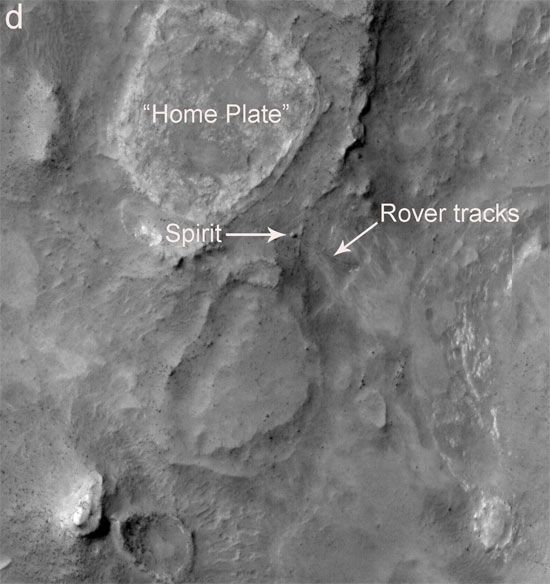
Fromoverhead, NASA's Mars Reconnaissance Orbiter has used its High ResolutionImaging Science Experiment (HiRISE) camera to sharp-shoot the site that Spiritis now appraising.
"Therecent HiRISE image of the Spirit site has shown us that there are many morescientifically interesting targets around Home Plate than we realized. Some ofthese features are difficult to spot from ground level," Squyres pointed out.
Thepowerful HiRISE camera has found things that Mars rover scientists hadn'trealized were there before. "So, having found our way with much difficulty tosuch a target-rich environment, we're going to work it for all it's worth."
New field season
Spiritpacked up winter camp and started out on a new field season over the pastcouple of weeks, said Larry Crumpler, a MER science team member based at theNew Mexico Museum of Natural History and Science in Albuquerque.
"Itwas a very long winter," Crumpler said, "but the Sun is getting high enough nowthat Spirit can survive with no tilt," a parking position used to glean moresolar energy to keep the rover healthy.
Spirithas scrambled off the ledge it has been sitting on since last April. The roverhas started a new field season on Mars...even as winds starting to pick up anddust in the air started going up, Crumpler noted, "just like a spring day in New Mexico."
"Hopefully,we will have a solar panel cleaning event somewhere in the future. That willmake the power situation better even as the atmosphere becomes dustier and theSun's rays are dimmed," Crumpler added.
Wheel drag
Spiritis limping a bit. The rover's front right wheel is not working. So the robot isdragging it, using its five other wheels to move about.
"Itmakes approaches for studies of targets with the instruments tricky, requiringa crab-like motion to put targets within the instrument work space," Crumplertold SPACE.com. "So the first drives are tentative and very carefullyconsidered for their value in learning anew how to drive on Mars."
DrivingSpirit onward, the plan is to make it back to the edge of Home Plate. Spiritwill then pick up where it left off last martian fall, and continue a driveclockwise around the south edge of Home Plate, Crumpler said.
Anothergoal of the traverse around the margin will be to see if there are anyindicators of Home Plate's geologic origin - be it volcanic or just a productof wind action.
"Althoughit is clear that the materials that make up the outcrops are volcanic, it isnot clear whether the deposition was volcanic in origin--air fall or ballistic--orwhether it was just blown into a low spot by normal wind processes," Crumplerexplained.
Thisis probably the first place where real field geology has come to the fore,Crumpler points out. "Chemical analysis of the rocks can tell us many things,but it can't tell you in every case how the rocks got where they are...that's thejob of field geology," he said.
Beyond Home Plate
"Weshould begin exploring the unseen southern margin of Home Plate in the NewYear," noted Jim Rice, a science team member of the Mars Exploration RoverProject at Arizona State University in Tempe.
"Iam personally looking forward to seeing new cross sectional views of thelayered rock outcrops along the southern margins of Home Plate," Rice said."How long we will stay at Home Plate is unknown...it sort of depends on what wefind there. This is the nature of exploration."
AfterHome Plate, Rice is voting for study of features nicknamed "von Braun" and"Goddard", after the two great rocket pioneers.
"Theseare very high priority targets in my opinion," Rice told SPACE.com. "VonBraun looks like some of the classic layered buttes and mesas one would seehere in Arizona. Goddard could be either an impact crater or volcanic vent. Theonly way to know is to go."
Howthese two features fit into the overall, complex story of the Columbia Hills isyet to be determined, Rice said.
Enter the Promised Land
Ricesaid he's longing for a look at another big target labeled the "Promised Land",a region he first pointed out and named some three years ago shortly afterSpirit landed in January 2004.
Theorigin of this material is unknown and this region would in effect constitute anew landing site, Rice suggested.
Butthe start of the Promised Land is about 3,000 feet (800 meters) away.
That'sa long haul given Spirit's mobility issues: its balky right front wheel. "Butwe should at least try. It would be a shame if we only see it from afar. Wewill not know what possible geologic treasures the Promised Land holds until weenter its domain," Rice concluded.
- Mars Rover Sends First Photo of Victoria Crater
- Video: All Eyes on Mars
- Images: Visualizations of Mars
- Mars Probes Continue to Unlock Planet's Mysteries
- Complete Coverage: Mars Rovers
- All About Mars