


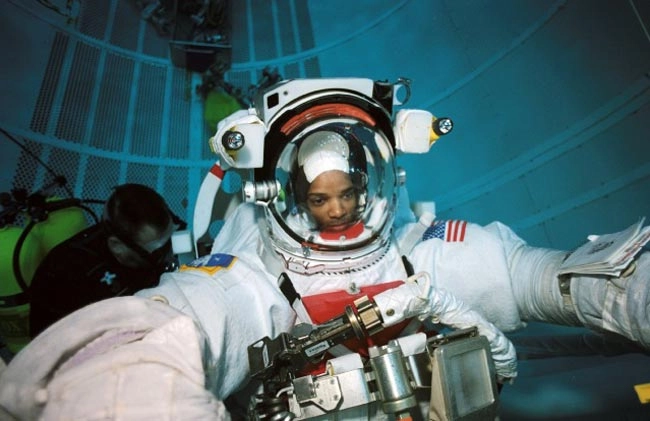
Poised tolaunch towards the InternationalSpace Station (ISS) this week are three Discovery shuttle astronautstrained in the art of orbitalconstruction.
But STS-116spacewalkers RobertCurbeam, ChristerFuglesang and SunitaWilliams are more than mere orbital electricians set to rewire the ISSpower grid. They plan to perform three extravehicular activities (EVAs) duringthe mission to deliver a new pieceof the ISS and plug the station into its primary electrical and thermalcontrol systems.
"I havecomplete confidence of everybody on the team," said Curbeam, who isleading all three STS-116 spacewalks, during an interview. "I think we'veall trained enough together."
Curbeam,Williams and Fuglesang--a European Space Agency astronaut--are slated to launchspaceward with their STS-116crewmates on Dec. 7 at 9:35:47 p.m. EST (0235:47 Dec. 8 GMT) to kick offtheir 12-daymission.
Spacewalkingpro
Of all theSTS-116 spacewalkers, it is Curbeam alone who brings actual spaceflightexperience to the table.
The Baltimorenative--known to his crewmates as "Beamer"--flew alongside STS-116commander MarkPolanskyduring NASA'sSTS-98 mission to deliver the U.S.Destiny laboratory to the ISS in 2001. He also flew aboard NASA's STS-85mission in 1997 and has logged more than 24 days in space, and 19 hours workingoutside a spacecraft during threespacewalks.
"I thinkthe biggest impression that I left with from that flight, although we did a lotof work in the sciences, was just the view," Curbeam, 44, said in a NASAinterview. "It was absolutely incredible!"
A captain inthe U.S. Navy and father of two children, Curbeam was selected to join NASA'sastronaut corps in 1994 after 10 years as a naval aviator. He originallystudied to build spacecraft, and holds several degrees in aerospace,aeronautical and astronautical engineering.
"I wasalways interested in spacecraft and aircraft. I thought I'd be a spacecraftdesigner," he said. "But I never really thought I'd be anoperator."
Curbeam servesas the STS-116 crew's Mission Specialist-1 and its chief spacewalker, and isintimately acquainted with the risks of EVAs and spaceflight. He encountered anammonialeak while wrangling ISS cooling lines during the Destiny lab'sinstallation, prompting decontamination procedures and angst he's not eager torepeat.
"Probablythe biggest thing people have to remember, especially coming out of a navaltradition, is that people are always looking out for my safety," Curbeamtold reporters. "We are trying to make sure that we have the best vehicle,best spacesuit, the best equipment to do our job with. Our part of the bargainis that we're going to go out there and we're going to do it right."
Curbeam saidthat he always wishes to share his spaceflight experience with others, addingthat the experience offers a unique perspective.
"I alwaystell my friends, 'If you leave this world not a conservationist, you'll comeback as one,'" he said, adding that the beauty and limited resources ofEarth are striking from space. "I welcome the day when more people get toexperience some of the things that I've experienced--I just think they'll getalong a lot better."
Sweden'sfirst spaceflyer
JoiningCurbeam on the first two STS-116 spacewalks is Fuglesang, as MissionSpecialist-3, who is poised to make history as the first Swede to reach space.The upcoming mission also marks his spaceflight debut 14 1⁄2 years afterbecoming an ESA astronaut.
"It'sexciting to be flying in space for the first time," said Fuglesang, 49, inan interview. "It's great that Europe can have astronauts participating inthe build-up of the space station."
A Stockholmnative and particle physicist by training, Fuglesang joined ESA's astronautranks in 1992 and served as a backup for fellow European ThomasReiter--currently servingas anExpedition 14flight engineer aboard the ISS--during the Euromir 95 mission toRussia's MirSpace Station in 1995. The two astronauts are friends, and both among thefew non-Russians certified to fly Soyuz spacecraft.
"We neverthought that we ever would fly in space together," Fuglesang said in aNASA interview, adding that the presence of two Europeans aboard the ISS hasdrawn extra interest to the STS-116 mission in Europe. "I guess it will belike suddenly meeting an old friend on some foreign island somewhere--I'mlooking forward to that very much."
Fuglesang, whois raising three children with his wife Elisabeth, admits some frustration fromhis long wait to his first spaceflight, but added that other ESA astronautshave been waiting longer than he, and that patience is part of the job.
"You haveto be prepared to be patient," he said. "I've been very lucky."
Stayingup there
Rounding outDiscovery's STS-116 crew is Williams, who has no intention of returning homewith her shuttle crewmates this month.
That's becausethe 41-year-old Needham, Mass. native will relieveReiter as an Expedition 14 flight engineer, and then stay on to join the Expedition15 crew next year. Reiter will take Williams' place aboard Discovery on itsreturn to Earth. Like Fuglesang and many of her STS-116 crewmates, Williams ismaking her first spaceflight. But she expects to spend more than six months inEarth orbit.
"I can'timagine not loving it," Williams said in an interview, adding that she'llmake her spacewalk debut during the third STS-116 EVA. "I'm really lookingforward to STS-116. It's going to really break me in to learn how to work inspace."
Williamsjoined the U.S. Navy--where she holds the rank of commander--in 1987, and tookflight as a helicopter pilot. She was deployed aboard the amphibious assaultship USS Saipan when she was selected for NASA's astronaut program in 1998.
Reaching theISS has been a goal for Williams since her NASAarrival, and she supported the Expedition1 mission in 2000 and 2001, and spent nine days underwater aboard the AquariusUndersea Laboratory during NASA's NEEMO 2 mission.In addition to her role as an ISS flight engineer, Williams will also serve asNASA's ISS science officer for part of her mission--a responsibility she doesnot take lightly.
"We're upthere, using the ISS to figure out how to go to other places in the universe," Williams said, addingthat understanding planets like Marsis crucial to humanity's future on Earthand among the stars. "So, thespace station is just a stepping stone to get us to understand space, how tolive and work in space, and then potentially get back to the Moon."
While Williamsand her husband Michael are acquainted to long periods apart--the result of herdeployments to the Mediterranean, Red Sea and Persian Gulf--she does confessthat she'll miss her "crazy" Jack Russell terrier Gorby. The pup willstay with Williams' mother during the upcoming spaceflight, though theastronaut longed to bring him along.
"I wouldlove to," Williams said. "I'm going to miss the little booger."
- Complete Space Shuttle Mission Coverage
- Space Shuttle Launch Visible Across Eastern U.S. Thursday
- Images: Ready to Fly: STS-116 Training
- Images: Shuttle Discovery Poised for STS-116
- STS-116 Video: Major Tasks
- STS-116 Video: Power is Everything
- STS-116 Video: Back in Business
- STS-116 Video: Building Blocks
- Mission Discovery: The ISS Rewiring Job of NASA's STS-116
- The Great Space Quiz: Space Shuttle Countdown
- All About the Space Shuttle
