





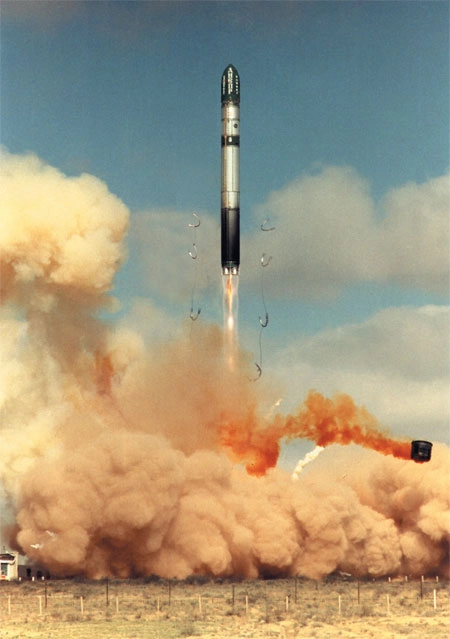
A civilianDnepr rocket built from a modified intercontinental ballistic missile failed tocarry a clutch of small satellites into orbit Wednesday as it crashed justsouth of its Central Asian launch site, according to Russian wire reports.
The Dnepr'sengine apparently shut down prematurely just after rocketing spaceward from itsBaikonur Cosmodrome launch pad in Kazakhstan, Russian space officials told the InterfaxNews Agency. The rocket was scheduled to launch at 3:43 p.m. EDT (1943 GMT)and reach orbit a short time later.
"The firststage failed to separate on time, it stopped working about 10 minutes earlier,and that is why the engine shut down in emergency mode," Yury Nosenko, deputyhead of Russia's Federal Space Agency, told Interfax.
Aninvestigation is underway to determine the root cause of the booster's failure.
"A specialcommission has been set up to investigate into the circumstances of the crash,"Nosenko told Interfax, adding that the Dnepr rocket crashed about 15.5miles (25 kilometers) south of its launch site. "No damages were caused topopulated localities on nearby territories."
Dneprrocket launches are managed by ISC Kosmotras, a joint effort between the Russianand Ukrainian governments. The boosters are based on converted SS-18intercontinental missiles and carry three stages to reach orbit.
Each Dneprbooster stands about 111 feet (34 meters) tall and carries a diameter of about 10feet (three meters).
Today's unsuccessfullaunch was slated to orbit a fleet of 14 CubeSatmicrosatellites built by 10 universities around the world. Additionalpayloads reportedly included a pair of satellites dubbed JAEsats, as well as otherscalled BelKa, Baumanets and UniSat 4.
Accordingto one mission description, the CubeSats were destined for an orbit between 310and 372 miles (500-600 kilometers) above Earth.
The failedlaunch attempt comes two weeks after a successfulDnepr launch from Russia's Yasny Launch Base, an active strategic missilefacility.
That July12 liftoff carried the U.S. spacecraft Genesis-1, an inflatable module developedby Las Vegas, Nevada's Bigelow Aerospace as a prototype for future orbital spacehabitats. Genesis-1continues to do well, relaying telemetryand images from orbit.
A follow upmission - Genesis-2 - was slated to fly in late 2006 or early 2007, but may bedelayed as investigators target the source of today's Dnepr launch failure.
Russia'sInterfax NewsAgency contributed to this report.
