


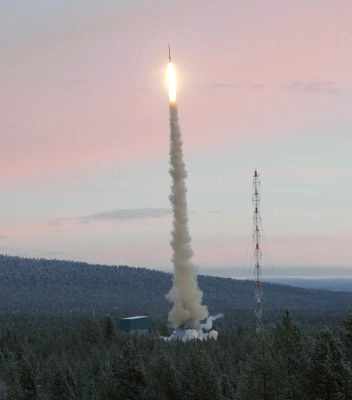
A Braziliansuborbital rocket successfully launched a European microgravity experimentThursday in a debut flight staged from northern Sweden.
A Texus-EMLsounding rocket equipped with Brazil's VSB-30 engine launched from Sweden'sEsrange facility near Kiruna at 4:06 a.m. EST (0906 GMT) on a mission toprovide a few minutes of microgravity for a joint experiment developed by theEuropean and German space agencies, European Space Agency (ESA) officials said.
The spaceshot gave scientists about six minutes and 37 seconds of weightlessness to testthe properties of molten metals for the ESA's IMPRESS science program.
"Thislaunch is a major step forward in zero-g experimentation for the IMPRESSproject," said ESA project manager David Jarvis in a statement.
Thefindings will help the development of new metals for gas turbines, hydrogenfuel cells and jet engines for aircraft, researchers added. IMPRESS is shortfor Intermetallic Materials Processing in Relation to Earth and SpaceSolidification.
The launchalso marked step forward for the Brazilian Space Agency (Agencia EspacialBrasileiria), which hopes to launch its first astronaut - MarcosPontes - to the International Space Station (ISS) in March 2006 aboard aRussian-built Soyuz spacecraft.
During thebrief flight, the two-stage Texus rocket carried a new ElectromagneticLevitator (EML) facility to an altitude of more than 161 miles (260 kilometers), then returned it to Earth via parachute.
Esrangeofficials said the rocket performed flawlessly, but flew higher and landedfurther west than normal - about 6.2 miles (10 kilometers) inside Norway in anuninhabited mountain region. One possible cause of the flight deviation may have been the needto aim the rocket more westward to avoid reindeer herders in the easternsection of the nominal landing zone, they added.
