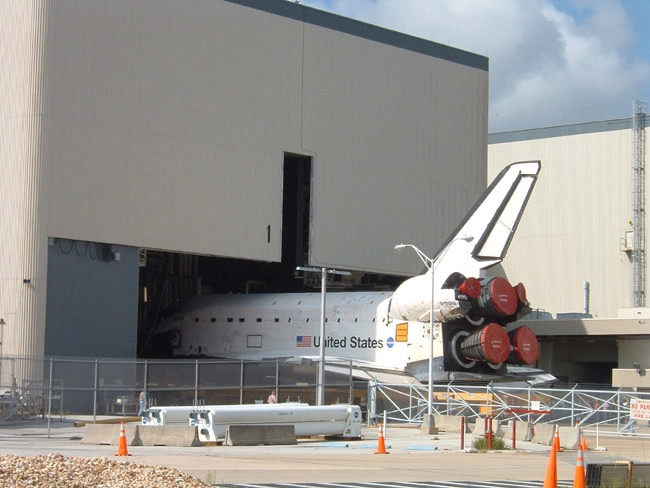
CAPECANAVERAL, Fla. - Despite two delay-filled days, the shuttle Atlantis issafely inside NASA's massive Vehicle Assembly Building (VAB) after a brief hop forwardin its long road toward space.
Shuttle engineersrolled the Atlantis orbiter into the VAB, where it will be mated to itsexternal tank-solid rocket booster launch stack for NASA's STS-121 mission, atabout 10:20 a.m. EDT (1420 GMT) Friday.
Landinggear glitches plagued Atlantis' rollover from its Orbiter Processing Facility(OPF) to the VAB.

On July 20,engineers found a faulty tire pressure sensorconnection between Atlantis' front left tire and the orbiter, promptingengineers to change out the tire, which NASA officials said was an easier fixthan repairing the connector itself. Additional problems retractingAtlantis landing gear, which must be tucked inside the orbiter during rolloveroperations, also delayed the event, NASA officials added.
"This isgreat," a NASA shuttle worker said as the orbiter rolled past photographers,reporters and excited NASA employees. "Especially after all this delay."
"Everythingyou've done to Discovery, we've done to Atlantis too," Scott Thurston,Atlantis' vehicle manager, told SPACE.com before the rollover, addingthat his crew had less time to perform the work since all new hardware andprocedures went to Discovery first. "We've basically had less time, because everybodyfocused on getting those deliveries to Discovery...it's a big accomplishment."
The orbiterwill hold updated cameras and sports a new, 50-foot (15-meter) boom tipped withcameras and laser sensors to probe vulnerable heat-resistant areas for damageduring flight. During a spacewalk, an STS-121 astronaut will ride the end ofthe boom, which will be attached to the tip of Atlantis' robotic arm, to testits dynamics with such a load.
"We've gota special relationship with these vehicles that we see every day," Thurstonsaid. "Everybody's got a different thing that they hold very dear."
- Fixing NASA: Complete Coverage of Space Shuttle Return to Flight
